
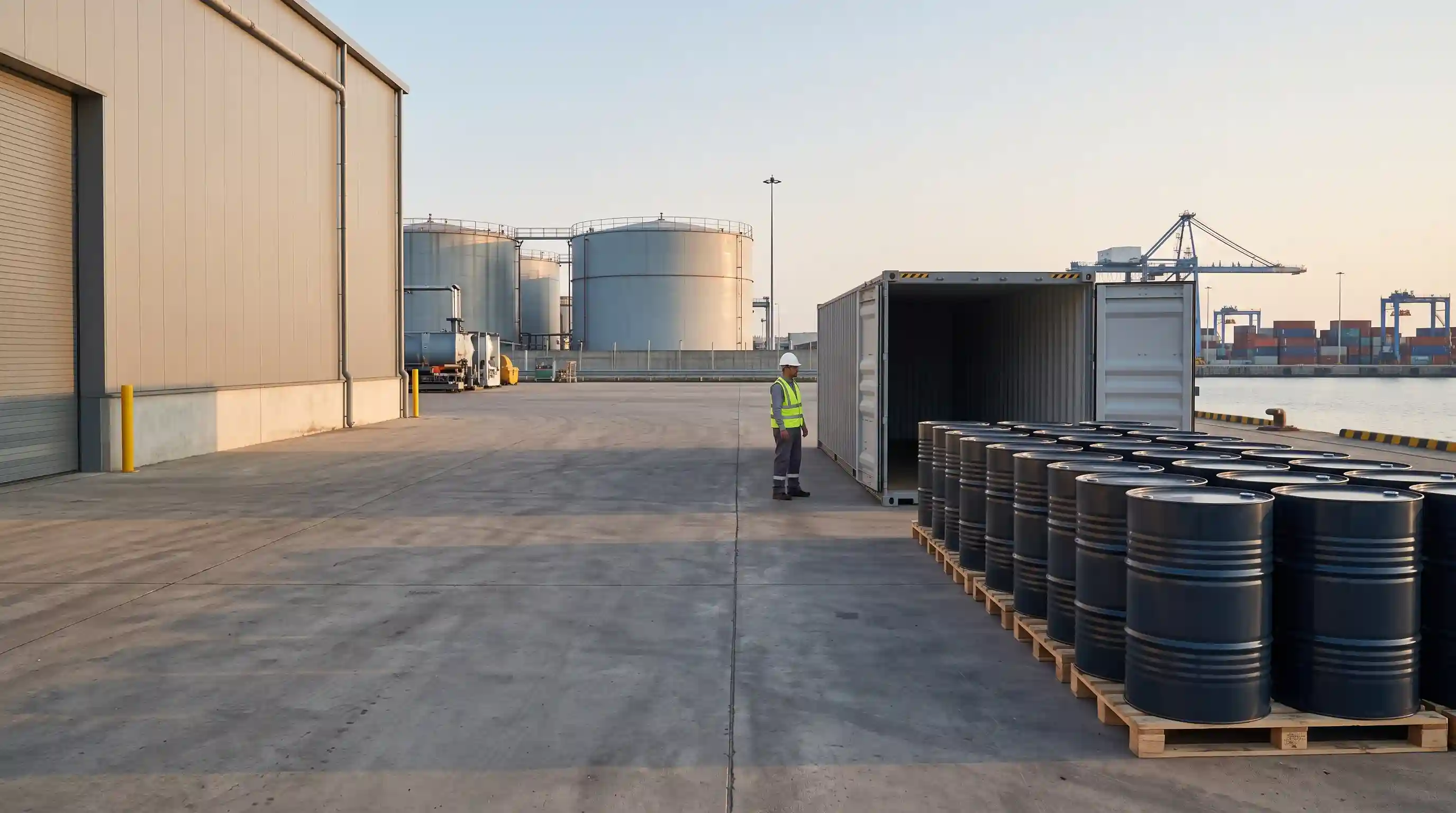
An Iran bitumen supplier should not be assessed by price and grade name alone. Labels such as 60/70, 80/100, 85/100, VG30 and PG 64-22 belong to different grading systems. Without a governing standard, test limits, intended application and sampling procedure, a buyer, seller and laboratory may interpret the same inquiry differently.
Before comparing quotations, buyers should define the grade, specification, quantity, packing, port, Incoterm, cargo documents, inspection scope and non-conformity procedure. Grade selection also requires more than a general description of the destination as hot or cold. Pavement temperature, traffic loading, aggregate properties, mix design and the project authority’s requirements affect the final decision.
Coolak International Group was founded in 2017 on the belief that successful trade is often decided before a contract is signed. Better information and a practical transaction structure help buyers identify technical, logistics and contractual risks before accepting an offer.
Key Takeaways:
State the grade together with the governing standard and numerical test limits.
ASTM, EN, VG and PG are separate grading systems.
Do not assume that 80/100 and 85/100 are equivalent.
A COA, an SDS and a third-party inspection report serve different purposes.
Packing must fit the grade, route and destination handling facilities.
Climate tables support initial screening but do not replace engineering design.
What Should a Buyer Define Before Ordering Iranian Bitumen?
A workable purchase inquiry should define the product in technical and commercial terms. Phrases such as “export-quality bitumen” or “standard bitumen” do not provide enough information for an accurate offer.
A complete request should cover:
Subject | Required information |
Product type | Penetration, VG, oxidized, emulsion, cutback or PG |
Grade | For example, 60/70, 85/100, VG30 or 90/15 |
Standard | ASTM, EN, IS, AASHTO or a project specification |
Application | Hot-mix asphalt, paving, runway, waterproofing or emulsion production |
Quantity | Total volume, shipment lots and weight tolerance |
Packing | Steel drums, bulk, big bags or a specialized tank |
Destination | Country, port and discharge or heating facilities |
Delivery | FCA, FOB, CFR, CIF or another rule |
Inspection | Sampling method, laboratory and inspection scope |
Documents | COA, SDS, invoice, packing list, certificate of origin and transport documents |
Payment | Method, timing and documentary requirements |
Buyers can review the Iranian bitumen product page and the road and industrial bitumen category before submitting an inquiry. Coolak’s petrochemical export guide provides additional context on trading petroleum-derived products.
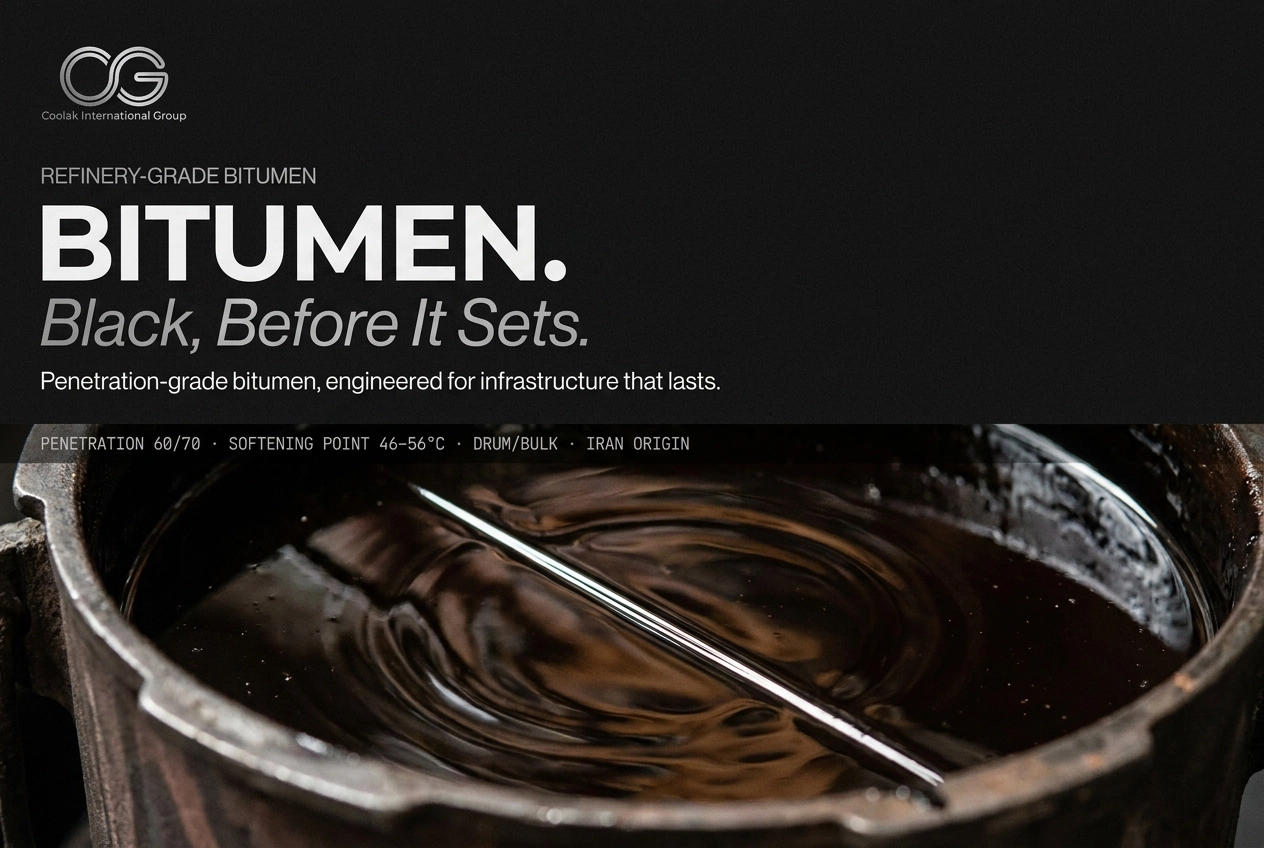

Iran Bitumen Grades and Classification Systems
Bitumen does not have one universal grading system. A product may be classified by penetration, viscosity, expected performance at design temperatures or oxidized-bitumen properties.

Penetration Grade Bitumen
Penetration grading measures how far a standard needle enters a prepared bitumen sample under defined conditions. Results are commonly reported in tenths of a millimetre, or dmm.
A lower penetration range normally indicates a harder binder, while a higher range indicates a softer binder. Penetration is only one quality parameter. Softening point, viscosity, ductility, flash point and ageing behaviour may also form part of the contract specification.
How Is a Penetration Grade Number Read?
For 60/70 bitumen, the penetration result should fall within the stated range. The grade name alone does not describe every performance property.
Two binders with similar penetration values may differ in softening point, temperature sensitivity or behaviour after ageing. Buyers should therefore review the complete property table.
How Should a Buyer Read a COA?
Begin with three items:
the governing standard and test method;
the agreed minimum or maximum limits;
the result recorded for the batch or cargo.
When the contract requires several properties, the COA should report those same properties. A penetration result alone does not establish full conformity.
Sampling and Cargo Acceptance
The contract should identify when and where sampling takes place. Refinery, storage-tank, drum-filling and port samples may be collected at different stages.
The parties should agree on sample quantity, sealing, retained samples, the controlling laboratory and the retest procedure. Missing sampling rules can make a quality claim difficult to resolve.
ASTM Penetration Grades
ASTM D946/D946M defines penetration grades such as:
40/50
60/70
85/100
120/150
200/300
ASTM D5/D5M defines the penetration test method, while ASTM D946/D946M covers the product specification and grading limits.
Grade | Initial interpretation | Buyer’s control point |
40/50 | Harder than 60/70 | Confirm mix design and construction temperature |
60/70 | Intermediate grade used in many paving projects | Review softening point and ageing results |
85/100 | Softer than 60/70 | Do not treat it as identical to 80/100 without a technical comparison |
Grades Under EN 12591
EN 12591 uses designations such as 40/60, 50/70 and 70/100. An EN grade should not be replaced directly by an ASTM grade.
ASTM 60/70 and EN 50/70 share one number but do not represent the same full specification. Their property limits and test methods need separate review.
Viscosity Grades
Under IS 73, paving bitumen is classified as:
VG10
VG20
VG30
VG40
This system places greater emphasis on viscosity at specified temperatures.
Grade | Initial screening direction | Required verification |
VG10 | Lower viscosity in the VG family | Application and construction method |
VG20 | Intermediate grade | Destination standard and climate |
VG30 | Common in many asphalt projects | Mix design and traffic loading |
VG40 | Higher viscosity | Pumping, mixing and compaction temperatures |
The project authority’s specification should control the final choice.
Oxidized or Blown Bitumen
Oxidized bitumen is produced by passing controlled air through bitumen feedstock at elevated temperature. The process raises the softening point and changes the product for waterproofing membranes, roofing, coatings and selected industrial uses.
Commercial names such as 85/25, 90/15 and 95/25 are common. Their meaning should be checked against the producer’s technical data and the contract specification.
Oxidized-grade names should not be interpreted in the same way as paving-grade 60/70.
Bitumen Emulsion
Bitumen emulsion contains bitumen particles dispersed in water with an emulsifying agent. The buyer should define electrical charge, breaking rate, residual bitumen and intended application.
Names such as CRS, CMS and CSS refer to different cationic emulsion families. Selection depends on the road operation and construction conditions.
Cutback Bitumen
Cutback bitumen contains a petroleum solvent that reduces viscosity for application. A request should define the RC or MC family, viscosity limits, flash point, residue properties and destination requirements.
Performance Grade Bitumen
The Performance Grade system classifies binder according to expected high- and low-temperature pavement behaviour.
For a grade such as PG 64-22:
the first number relates to the high design temperature;
the second number relates to the low design temperature.
PG selection depends on pavement temperature, rutting risk, low-temperature cracking, axle loading and traffic speed. When project documents require AASHTO M320 or M332, replacing the requirement with “60/70 bitumen” without engineer approval creates a specification gap.
60/70 vs 80/100 vs 85/100 Bitumen
Under comparable test conditions, 60/70 has lower penetration and is harder than 85/100. This difference may affect mixing temperature, compaction, deformation resistance and low-temperature behaviour.
Final asphalt performance also depends on aggregate, gradation, binder content, additives, layer thickness and construction quality.
The designation 80/100 appears in some commercial offers, but it should not be treated as automatically equivalent to 85/100.
ASTM D946 defines 85/100.
EN 12591 uses grades such as 70/100.
80/100 may refer to a commercial range or a market-specific specification.
A more precise inquiry would state:
Please offer penetration-grade bitumen within the required penetration range and specify the governing standard, softening-point limits, ductility, flash point, ageing requirements and test methods.
The formal offer should identify the governing standard and the test limits that the product meets.
Standards, Tests and Cargo Documents
A product standard should connect the grade name to an acceptance table, test methods and a procedure for handling non-conformity. Writing “ASTM quality” without a standard number and numerical limits is not sufficient.
Document or control | Purpose |
Contract specification | Defines binding product limits |
COA | Records batch or cargo test results |
SDS | Provides safety, handling and emergency information |
Inspection report | Records a third party’s findings |
Certificate of origin | States origin through the applicable formal process |
Packing list | Lists units and packing weights |
Bill of lading | Records principal transport information |
Weight certificate | Confirms weight under the agreed method |
Common Bitumen Tests
Depending on the grade and standard, the specification may include:
penetration at 25°C;
ring-and-ball softening point;
viscosity at specified temperatures;
ductility;
flash point;
solubility;
change in mass after heating;
retained penetration after ageing;
increase in softening point after ageing;
density or specific gravity where required.
Buyers should not combine limits from one standard with unrelated test conditions from another unless the project specification clearly requires that combination.
What Does a COA Prove?
A COA reports test results for a sample attributed to a batch or shipment. It does not by itself prove that:
an independent inspector collected the sample;
every part of the cargo matches the sample;
weight, origin or packing were verified;
every contract obligation was completed.
Sensitive orders may require an agreed sampling protocol, retained samples and a controlling laboratory.
COA, SDS and Third-Party Inspection
A COA reports quality results. An SDS addresses hazards, storage, handling and emergency measures.
Companies such as SGS, Intertek or Bureau Veritas may conduct third-party inspection, but the inspection company’s name does not replace the product standard.
The agreed inspection scope may include:
sampling;
laboratory testing;
weight checks;
drum counting;
visual-condition checks;
loading supervision.
Export Bitumen Packing
Packing should suit the grade, shipment quantity, route, port limits and the buyer’s destination facilities.

Steel Drums
New steel drums with a nominal content of approximately 180 kg are a common export packing option.
Before contracting, define:
target net content and tolerance;
new or reconditioned condition;
steel construction and thickness;
closure and sealing method;
batch identification;
drum count per container;
net and gross shipment weight;
procedures for leakage, damage or short weight.
The 180 kg figure is nominal. The actual quantity and tolerance should appear in the contract or packing list.
Bulk Bitumen
Bulk shipment suits cargoes where origin and destination have compatible heated tanks, pumps, transfer lines and discharge equipment.
The contract should address:
loading temperature;
permitted product-temperature range;
destination tank readiness;
discharge rate;
allowed operating time;
delay and vessel waiting responsibility;
quantity-measurement method.
Poor temperature control or delay can make pumping and discharge more difficult.
Big Bags
Big bags may suit selected grades and routes, but they are not suitable for every order.
The liner, unit weight, filling method, storage conditions, transit time, container arrangement and destination melting or discharge equipment need review.
Availability should be confirmed for the specific shipment.
Specialized Tanks
Heated tank-container systems may provide an alternative between bulk shipment and drums.
The parties should define capacity, heating method, discharge time, rental charges, return route, cleaning and damage responsibility.
Buyers should describe their operating needs rather than limit the request to one equipment brand.
FOB, FCA, CFR and CIF Terms
The phrase FOB Bandar Abbas becomes precise when the port, cargo type, delivery point and Incoterms edition are stated:
FOB Bandar Abbas Port, Incoterms® 2020
Under FOB, the seller delivers the goods on board the vessel nominated by the buyer. Risk transfers after the cargo is placed on board.
FOB is designed for maritime transport. When drums in a container are handed to a carrier or terminal before vessel loading, FCA may define the delivery point more accurately.
Transport form | Rule to examine | Reason |
Bulk bitumen loaded directly on a vessel | FOB, CFR or CIF | On-board delivery can be identified |
Drums in containers | FCA, CPT or CIP | Carrier handover occurs before vessel loading |
Road or multimodal transport | FCA, CPT or CIP | FOB applies only to maritime transport |
Under CFR, the seller pays freight to the destination port, but risk transfers at origin after on-board delivery.
Under CIF, the seller also arranges the required marine insurance, while risk still transfers at origin.
Read Coolak’s Incoterms 2020 guide for a fuller comparison.

Selecting the Loading Port
Depending on the grade, quantity, packing and shipment plan, loading from Bandar Abbas, Bandar Imam Khomeini or Chabahar may be considered.
Port selection can depend on:
access to the product;
tank or drum-filling facilities;
vessel or container schedules;
inland transport costs;
terminal and weight restrictions;
loading equipment;
cargo-preparation time.
The final port, delivery point and Incoterm should appear in the formal offer and contract.
How to Select a Grade for Climate and Project Use
No general table can select the final grade from “hot climate” or “cold climate” alone.
The following table supports initial screening:
Project condition | Initial direction to examine | Risk of a simple choice | Required action |
High pavement temperature and heavy loading | Harder binder, higher VG or suitable PG | Low-temperature cracking or poor workability | Review pavement temperature, traffic and mix design |
Moderate climate and general paving | Intermediate grade such as 60/70 or VG30 | Assuming all sources perform identically | Check COA and mixture tests |
Low-temperature cracking risk | Softer binder or suitable low-temperature PG | Reduced rutting resistance | Balance high- and low-temperature performance |
Slow, heavy traffic | Suitable PG or modified binder | Permanent deformation | Review axle loading and traffic speed |
Emulsion production | Compatible base bitumen | Poor breaking or storage stability | Conduct compatibility testing |
Industrial waterproofing | Oxidized grade with defined properties | Using the wrong paving grade | Match the downstream production specification |

Information Required from the Project Engineer
Before selecting the grade, obtain answers to these questions:
Which standard is mandatory?
What are the high and low pavement design temperatures?
How are traffic loading and speed classified?
Which pavement layer will use the binder?
What mixing and compaction temperatures apply?
What aggregate and gradation will be used?
Will RAP, polymer or another additive be included?
Which mixture and acceptance tests are required?
Iran Bitumen Export Buyer Checklist
Product Specification
The bitumen type is identified.
The grade and governing standard are stated.
The standard edition or project specification is identified.
Numerical test limits are attached.
The final application is described.
Straight-run, oxidized or modified status is clear.
Quantity and Packing
Total quantity and tolerance are defined.
Shipment lots and timing are stated.
Net and gross weights are separated.
Packing requirements are defined.
Leakage and damage procedures are agreed.
Destination discharge facilities are confirmed.
Quality and Inspection
A representative COA has been reviewed.
Sampling time and location are defined.
Inspector and laboratory are agreed.
A retained sample will be kept.
Retest procedures are written.
Testing and inspection costs are allocated.
Shipping and Delivery
The Incoterm matches the transport mode.
The named port or place is precise.
The Incoterms edition is stated.
Vessel or container booking responsibility is clear.
The loading or delivery window is defined.
Delay and waiting costs are addressed.
Contract and Payment
Buyer and seller have been verified.
Bank details match the contractual party.
Payment is linked to defined stages and documents.
The technical specification forms part of the contract.
Quality and quantity claim procedures are included.
Governing law and dispute resolution are stated.
Force-majeure provisions have been reviewed.
Submit a Clearer Iran Bitumen Request
Coolak International Group reviews bitumen inquiries based on grade, standard, application, quantity, packing, destination and delivery terms.
Submit the following through the Coolak contact page:
grade and standard;
technical specification or tender document;
quantity and shipment schedule;
packing requirement;
destination country and port;
requested Incoterm;
expected delivery period;
third-party inspection requirement;
proposed payment structure.
For bulk orders, Coolak’s international trade contract services can address technical schedules, documentation, sampling, inspection, delivery, payment and non-conformity procedures.

Price is only one part of a transaction. Responsibilities, documents, risk-transfer points and claim procedures should also be clear before contract signing.
Secure Trade Begins with Better Decisions.
Need product guidance?
Contact our team for specifications, availability, and pricing details.