
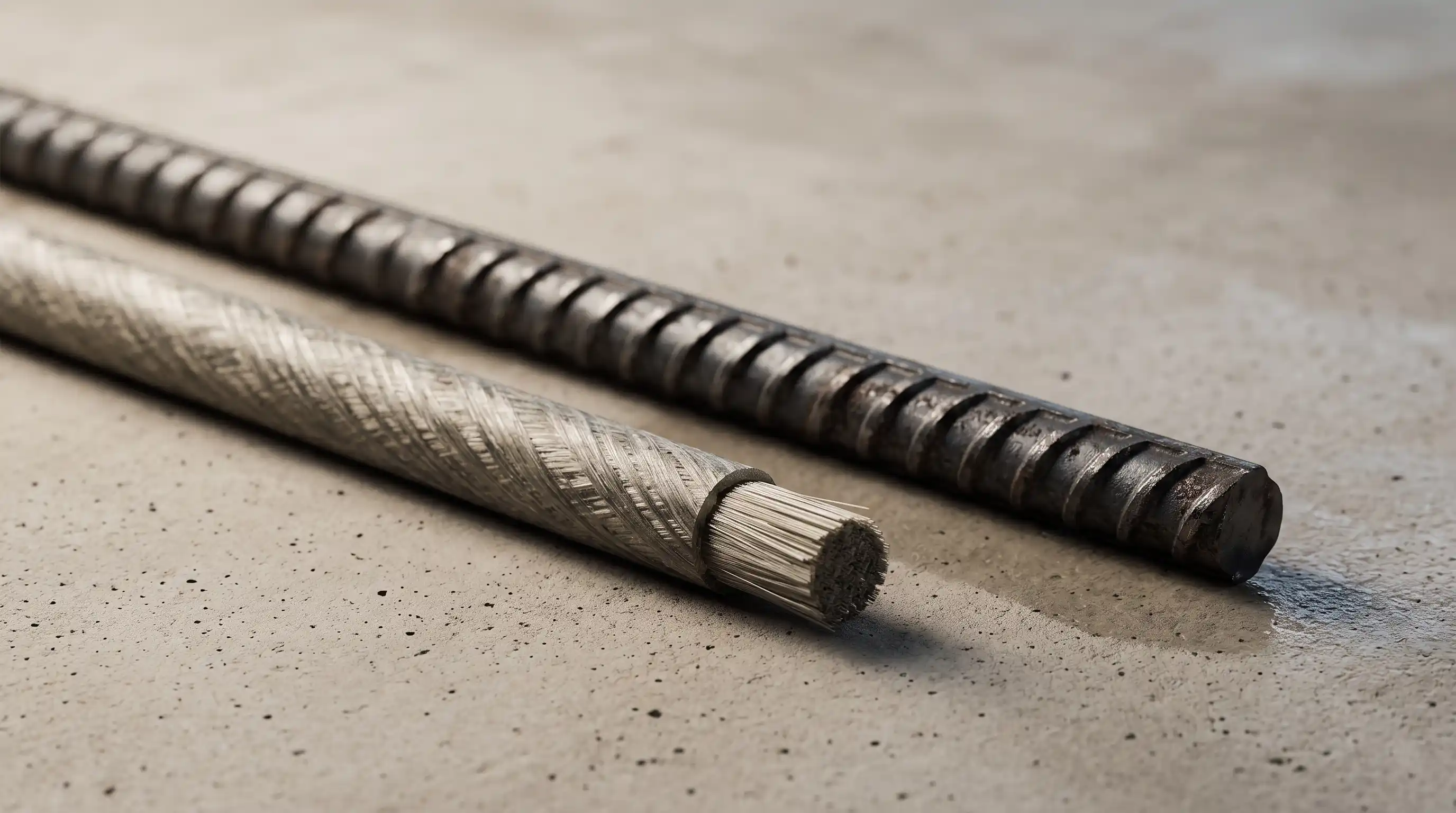
A useful GFRP rebar vs steel rebar comparison needs to answer a project decision, not simply place two tensile-strength numbers next to each other. GFRP combines continuous glass fibers with a polymer matrix, while conventional reinforcing bar is steel. That material difference changes corrosion behavior, weight, stiffness, electrical and magnetic characteristics, fabrication, and mechanical response.
One of the most common comparison errors is turning a high tensile value from a particular GFRP product into a claim of better structural performance than steel. FRP reinforcement generally behaves in an approximately linear-elastic manner to rupture, while reinforcing steel has familiar yielding and post-yield behavior. ACI also maintains a separate structural code for GFRP-reinforced concrete, which confirms that steel design assumptions cannot simply be transferred to GFRP.
Coolak International Group prepared this comparison for engineers, procurement teams, and B2B buyers who need to understand the decision factors before specifying or sourcing either reinforcement system.
Key Takeaways:
Where reinforcing-steel corrosion is a major project risk, GFRP may deserve technical evaluation, subject to the project design and specification.
Do not compare supplier quotations by tensile strength alone; include modulus, bar size, surface, test basis, and product evidence.
Steel may remain the practical choice where conventional fabrication, broad supply availability, familiar yielding behavior, and established project procedures carry more value.
There is no universal rule such as
12 mm steel = 12 mm GFRP.
What Is the Main Difference Between GFRP and Steel Rebar?
The main difference is that GFRP is a non-metallic fiber/polymer composite, while steel rebar is metallic reinforcement with different stiffness, yielding behavior, fabrication characteristics, and design requirements.
GFRP uses continuous glass fibers embedded in a polymer resin matrix. Conventional rebar uses steel whose grade, mechanical properties, rib geometry, and other characteristics are defined by the applicable steel specification.
The material distinction leads to several practical differences:
GFRP does not undergo conventional steel rusting.
GFRP generally weighs less.
Its elastic modulus is different and commonly lower.
It does not exhibit conventional steel-like yielding.
Bending and fabrication are different.
GFRP-reinforced concrete uses a dedicated design framework.
ACI CODE-440.11-22 provides a separate code for structural concrete reinforced with GFRP bars, reflecting the differences in structural behavior and detailing.

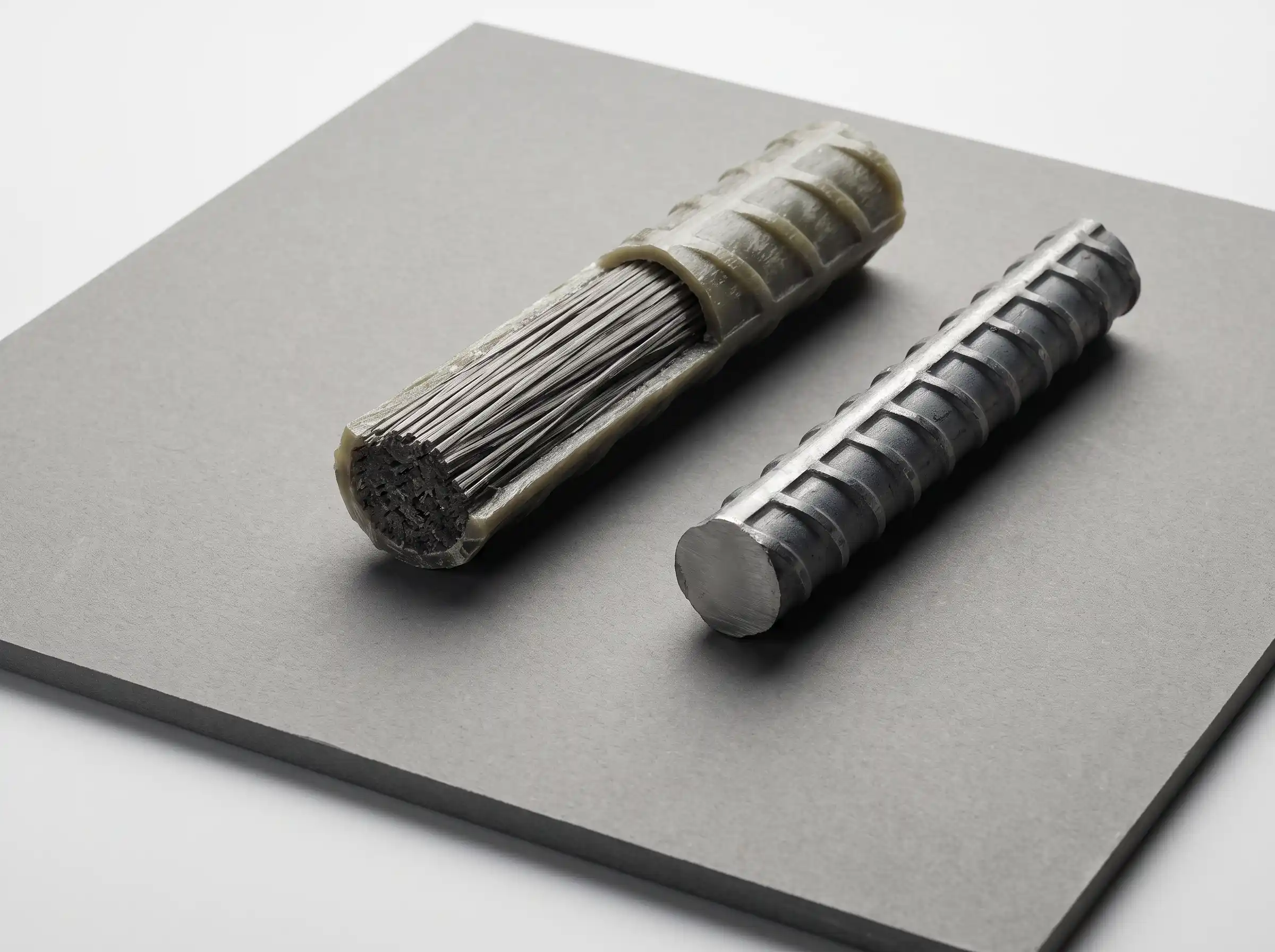
GFRP Rebar vs Steel Rebar Comparison Table
Property | GFRP Rebar | Steel Rebar |
|---|---|---|
Base material | Glass fibers + polymer matrix | Steel |
Material type | Non-metallic | Metallic |
Corrosion behavior | Does not undergo conventional steel rusting | Can corrode under relevant exposure |
Weight | Generally lower | Higher |
Tensile response | Approximately linear to rupture | Elastic response followed by yielding/post-yield behavior |
Elastic modulus | Commonly lower; product-specific | Higher characteristic stiffness |
Electrical conductivity | Non-metallic system | Conductive |
Magnetic behavior | Non-ferrous | Ferrous |
Field bending | Restricted; bent shapes require appropriate fabrication | Commonly fabricated under applicable procedures |
Design framework | GFRP-specific | Steel-specific |
Material specification | ASTM D7957/D7957M where applicable | Depends on grade, jurisdiction, and project specification |
This is a decision framework, not a ranking. No single row establishes which reinforcement is more suitable for a specific project.
How Do Their Material Composition and Structure Differ?
GFRP is a composite fiber/resin system; steel rebar is metallic reinforcement with a fundamentally different material structure.
GFRP Structure
The continuous glass fibers in GFRP provide the main longitudinal tensile reinforcement, while the polymer resin binds and protects the fiber system. The external surface is engineered to interact with concrete.
Fiber type, resin system, surface configuration, and production controls can affect the final properties. “GFRP” should therefore be treated as a material category rather than a complete product specification.
The cluster pillar on GFRP rebar properties and structure should provide the full material introduction once that page is live.
Steel Rebar Structure
Steel rebar is metallic reinforcement identified by its applicable grade, standard, dimensions, rib geometry, and mechanical properties.
How Does Corrosion Behavior Differ?
GFRP is non-metallic and therefore does not experience the conventional electrochemical rusting mechanism of reinforcing steel.
Corrosion of steel reinforcement can become a durability issue where environmental conditions support corrosion initiation and propagation. FHWA has historically identified steel-reinforcement corrosion as a reason for evaluating GFRP in certain infrastructure applications.
GFRP avoids that specific steel-rusting mechanism. This can make it relevant where corrosion resistance has high project value.
That does not mean a GFRP system cannot degrade under any exposure. Long-term behavior still depends on factors such as:
fiber/resin system;
production quality;
alkaline exposure;
moisture;
temperature;
service environment;
product qualification;
structural design assumptions.
“Corrosion resistant” should therefore be read as a material advantage relative to reinforcing-steel corrosion, not as a universal lifetime guarantee.
How Do Weight and Handling Differ?
GFRP generally weighs less than steel, which can change transport, handling, storage, and placement.
FHWA has cited light self-weight as a characteristic of GFRP reinforcement, while ACI construction guidance also recognizes handling differences associated with lower weight and flexibility.
Potential project effects include:
easier manual handling in some situations;
different bundle and storage planning;
lower reinforcement mass during logistics;
different support and tying considerations during placement.
A universal percentage such as “GFRP is X% lighter” should not be used without product-specific data. Actual mass depends on the product, bar size, geometry, and supplier documentation.
Lower weight is also not automatically beneficial in every construction detail. ACI has noted that the combination of low weight and flexibility can require appropriate bar supports to maintain positioning during concrete placement.
Why Can Tensile-Strength Comparisons Be Misleading?
Ultimate tensile strength is only one part of the comparison and cannot establish overall structural performance.
Marketing comparisons sometimes place the tensile value of a GFRP bar beside the value for steel and stop there. That leaves out several decision-critical properties:
tensile modulus;
ultimate strain;
bond;
geometry;
serviceability;
failure response;
design provisions;
qualification basis.
ASTM D7957/D7957M-26 itself treats tensile force, modulus, strain, transverse shear, and bond as separate elements within the GFRP property framework.
A specific GFRP product may have an attractive ultimate tensile value compared with a particular steel grade. That statement only describes the property being compared. It does not prove that the concrete member can use the same diameter, reinforcement ratio, spacing, detailing, or design assumptions.
The central technical point is:
Higher tensile strength does not automatically mean better structural performance.
Why Does Elastic Modulus Matter?
Elastic modulus is one of the most significant differences in a GFRP-versus-steel comparison because stiffness affects serviceability behavior.
GFRP commonly has a lower elastic modulus than reinforcing steel. That means a strength-only comparison can hide an important difference in stiffness.
Serviceability-related issues can include:
deflection;
crack behavior;
member stiffness;
reinforcement requirements under service loads.
This article does not provide design calculations, but the procurement implication is straightforward: a quotation that emphasizes tensile strength while omitting modulus is not presenting a complete mechanical comparison.
ACI CODE-440.11-22 treats serviceability and deflection as explicit design subjects for GFRP-reinforced concrete.
How Do Yielding and Failure Behavior Differ?
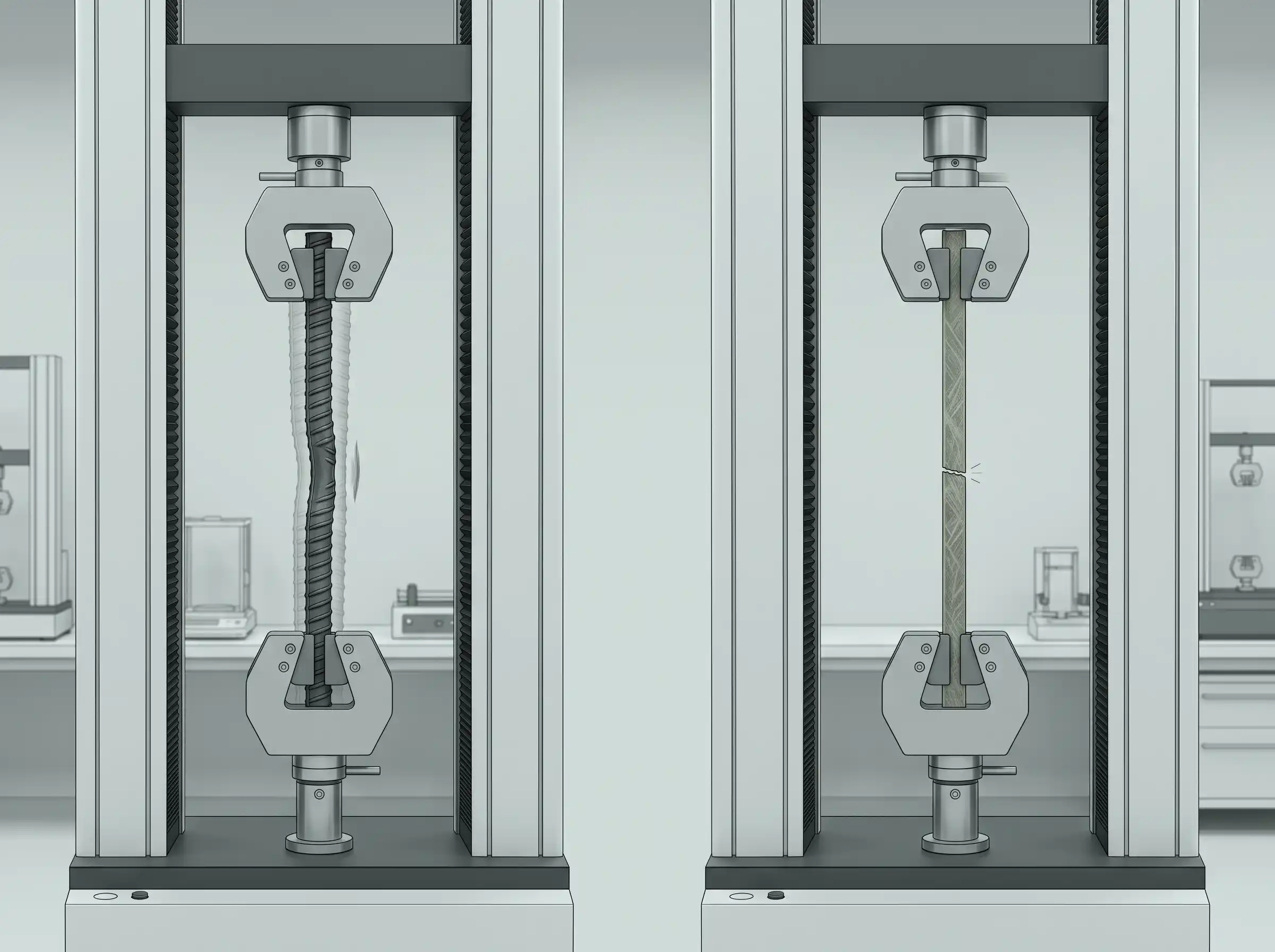
Steel exhibits yielding; GFRP reinforcement generally behaves approximately linear-elastically to rupture and does not have the conventional steel yield plateau.
Official ACI educational material characterizes FRP mechanical behavior as linear-elastic to failure, while steel reinforcement is described as linear elastic-plastic, with yielding followed by continued load-carrying behavior.
This distinction should not be turned into statements such as:
GFRP is unsafe because it is brittle;
GFRP is safer than steel.
Both would ignore the structural design framework.
The useful conclusion is that the design philosophy is different. ACI CODE-440.11-22 provides separate requirements for strength, serviceability, structural analysis, development, splicing, and detailing of GFRP-reinforced concrete.
How Do Electrical and Magnetic Characteristics Differ?
GFRP is non-metallic, so it may be considered in projects where electrical or electromagnetic characteristics of reinforcement matter.
ACI identifies structures requiring non-ferrous reinforcement for electromagnetic reasons as one context in which GFRP can be relevant.
Potential contexts can include selected:
technical facilities;
electrical infrastructure;
structures near sensitive equipment;
facilities with specific electromagnetic requirements.
This does not mean every electrical facility needs GFRP. The required electrical or magnetic performance should be defined by the project specification.
Steel, by contrast, is metallic and conductive. Whether that characteristic matters depends entirely on the project.
How Do Installation and Fabrication Differ?
GFRP construction requires different fabrication assumptions from conventional steel reinforcement.
Steel rebar can be cut, bent, and fabricated under the standards and procedures applicable to the selected steel grade and project.
GFRP has its own construction specification. ACI SPEC-440.5-22 covers construction with GFRP reinforcing bars, reflecting differences in fabrication, handling, placing, and tolerances.
One important distinction is field bending. ACI technical guidance explains that cured thermoset GFRP bars cannot be bent in the field like conventional steel bars; required bent shapes are produced during manufacturing.
For procurement, that means:
distinguish straight bars from bent shapes;
define required shapes before ordering;
coordinate placement drawings with the order;
confirm cutting and handling requirements in the project construction specification.
This article does not provide field cutting or installation instructions. Those procedures belong in the project's approved construction documents and method statements.
How Do GFRP and Steel Compare in Corrosive Environments?
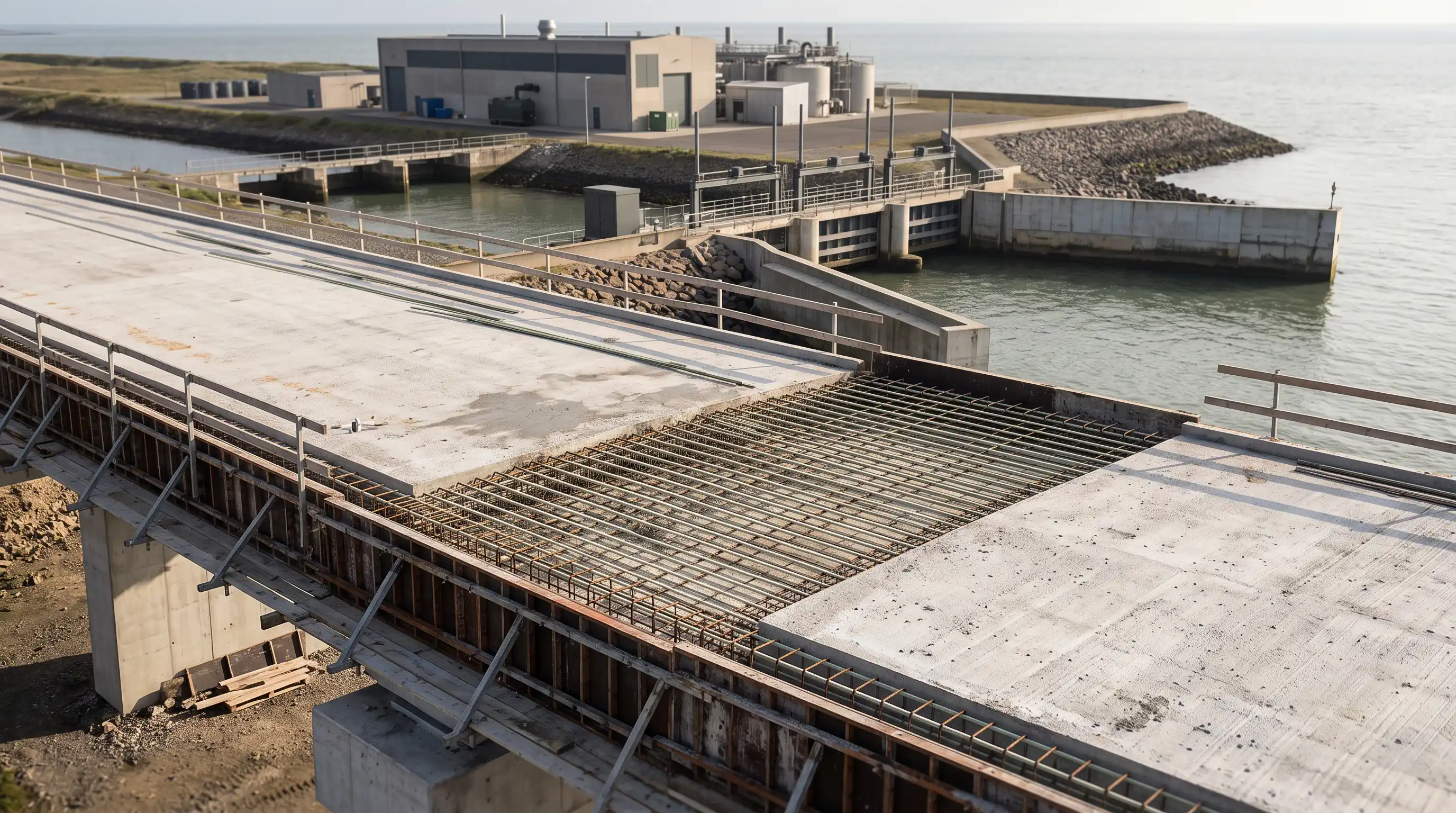
Where reinforcing-steel corrosion is a major durability concern, GFRP can be considered as an alternative reinforcement system, but suitability remains project-specific.
Typical environments where corrosion may become an important decision factor include:
marine structures;
coastal concrete;
water and wastewater facilities;
infrastructure exposed to deicing salts;
selected chemical or industrial exposures.
ACI's current GFRP educational material specifically identifies structures susceptible to corrosion as an important context for GFRP design.
An environment label alone is not enough to select the reinforcement. A marine project, for example, still needs a defined exposure condition, structural demand, member type, fire requirement, construction method, applicable code, and product qualification.
The accurate decision language is:
GFRP may be considered where corrosion resistance is a high-priority requirement.
When Is Steel Rebar Still the Appropriate Choice?
Steel remains a valid and often practical reinforcement choice for a large range of conventional concrete projects.
Its advantages include:
widely established design frameworks;
strong familiarity among designers and contractors;
extensive supply chains;
multiple standardized grades and specifications;
familiar yielding behavior;
established fabrication systems;
mature mill-certification and inspection practices.
Where corrosion is not a controlling project risk and the design, fabrication system, contractor capability, and supply chain are already built around steel reinforcement, changing material does not automatically create project value.
A balanced comparison should preserve that fact. The objective is not to replace steel wherever possible. It is to select reinforcement that fits the actual requirements.
Coolak International Group's steel rebar product provides the current commercial path for steel reinforcement.
When Might GFRP Be Considered?
GFRP may be worth evaluating when one or more of its distinct material characteristics directly address a project requirement.
Examples include situations where:
reinforcement corrosion is a major durability risk;
lower reinforcement weight has logistics or construction value;
non-metallic reinforcement is required;
electromagnetic considerations exist;
the project uses a durability strategy different from conventional steel reinforcement;
the designer or project specification allows or requires GFRP evaluation.
Each case still needs product-specific data and code-based review.

Can GFRP Directly Replace Steel Rebar?
No. GFRP should not be substituted for steel on a simple 1:1 or diameter-for-diameter basis.
A rule such as:
12 mm steel → 12 mm GFRP
is not a valid general design rule.
The bars can differ in:
tensile capacity;
tensile modulus;
ultimate strain;
bond behavior;
surface configuration;
design resistance;
serviceability response;
detailing requirements;
governing design code.
The existence of ACI CODE-440.11-22 as a dedicated GFRP structural code reinforces this difference in design basis.
Any real substitution should be performed by the responsible designer using the applicable material properties, structural requirements, code provisions, and project specification.
Do GFRP and Steel Follow Different Standards and Design Frameworks?
Yes. GFRP and steel reinforcement should be evaluated under the standards and design documents applicable to each material.
For GFRP, two important references are:
ASTM D7957/D7957M-26, the current active product specification for covered GFRP reinforcing bars.
ACI CODE-440.11-22, which provides structural design and detailing requirements within its scope.
The separate cluster article on GFRP rebar standards and specifications owns the detailed discussion of ASTM, ACI, qualification, mechanical properties, and production QC. Its internal link should be activated once that page is live.
For steel reinforcement, the applicable standard depends on the jurisdiction, grade, product form, and project specification. This comparison intentionally does not expand into a full steel-standards guide.
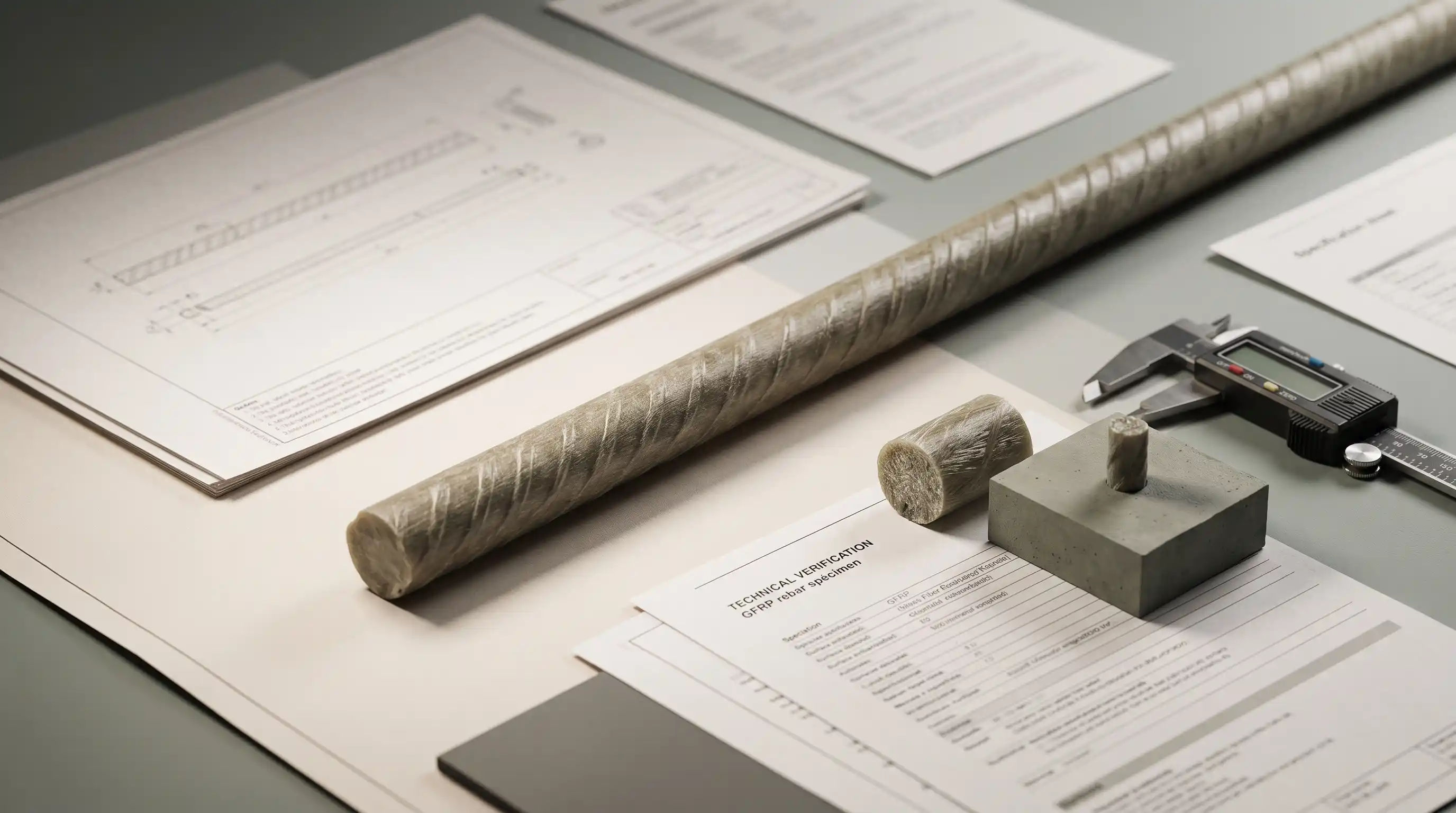
For procurement, neither GFRP rebar nor steel rebar is a complete specification without the applicable technical requirements.
How Should Purchase Price Be Separated from Project Cost?
Initial material price and wider project cost are different questions, and this article does not assume that either material is universally cheaper.
A useful distinction is:
Initial Material Cost
The supplier quotation for a defined product, size mix, quantity, origin, documentation scope, and delivery term.
Wider Project Considerations
Potential project-level factors can include:
transport and handling;
fabrication;
design implications;
installation;
inspection;
durability requirements;
maintenance strategy;
future repair exposure.
Without project-specific data, claims such as “GFRP is cheaper than steel” or “GFRP saves X%” are not supportable.
A deeper cost comparison belongs in a separate cluster article only when search demand and reliable commercial inputs justify it.
What Should B2B Buyers Compare Before Choosing GFRP or Steel?
Buyers should establish technical equivalence before comparing commercial offers.
Use the following checklist:
Project reinforcement specification
Which reinforcement systems are permitted?Applicable design code
Which code governs the design?Exposure environment
Is steel corrosion a major risk?Required mechanical properties
What strength, modulus, and strain requirements apply?Diameter and geometry
Are size, surface, and shape clearly defined?Straight or bent requirements
Is fabrication defined before sourcing?Material qualification
What product qualification evidence is required?Test documentation
Does the evidence relate to the offered product and size?Installation requirements
Is the contractor's construction approach compatible with the reinforcement?Origin and supplier documentation
Are manufacturer, origin, and documents clearly identified?Inspection requirements
What acceptance and inspection scope applies?Lifecycle and project requirements
What durability, maintenance, and service conditions matter?

Align the Technical Scope Before Comparing Price
Two reinforcement quotations are commercially comparable only after their technical scope is clear. A price per meter for GFRP and a price per tonne for steel do not answer the same question unless the design quantity, bar sizes, specification, documentation, delivery basis, and project requirements have already been aligned.
Need product guidance?
Contact our team for specifications, availability, and pricing details.