At Coolak, we believe that successful transactions are built on trust, transparency, and informed decision-making. This belief is reflected in several principles that guide our work: Transparency throughout the commercial process Careful verification before presenting opportunities Risk reduction before problems arise Practical and executable transaction structures Long-term business relationships rather than short-term gains These principles are not marketing statements. They are the standards by which we evaluate our own decisions.

Bitumen

Bitumen, also known as asphalt cement, is a viscous, black, semi-solid hydrocarbon material obtained as the heaviest fraction remaining after atmospheric and vacuum distillation of crude oil. Chemically, it is a complex blend of aromatics, resins, saturates, and asphaltenes, and it stands among the most strategic derivatives of the oil and petrochemical industry, playing a foundational role in road construction, waterproofing, and industrial insulation worldwide. Holding one of the world’s largest proven crude oil reserves and operating a network of advanced refineries, Iran ranks among the leading bitumen producers and exporters in the Middle East. The high asphaltene content and favorable thermal stability of Iranian heavy crude provide an excellent base for producing bitumen grades that meet consistent demand across South Asian, African, and Persian Gulf markets.

Bitumen

Bitumen, also known as asphalt cement, is a viscous, black, semi-solid hydrocarbon material obtained as the heaviest fraction remaining after atmospheric and vacuum distillation of crude oil. Chemically, it is a complex blend of aromatics, resins, saturates, and asphaltenes, and it stands among the most strategic derivatives of the oil and petrochemical industry, playing a foundational role in road construction, waterproofing, and industrial insulation worldwide.

Holding one of the world’s largest proven crude oil reserves and operating a network of advanced refineries, Iran ranks among the leading bitumen producers and exporters in the Middle East. The high asphaltene content and favorable thermal stability of Iranian heavy crude provide an excellent base for producing bitumen grades that meet consistent demand across South Asian, African, and Persian Gulf markets.

Main Types and Grades

Bitumen is classified into several categories depending on the production method and intended application:

  • Penetration Grade Bitumen (40/50, 60/70, 85/100) — the most widely used type in hot-mix asphalt for road construction, with penetration depth measured under ASTM D5 at 25°C under a 100g load.

  • Viscosity Grade Bitumen (VG10, VG20, VG30, VG40) — classified by kinematic viscosity at 135°C, commonly specified for heavy-traffic roads and hot-climate infrastructure projects.

  • Oxidized (Blown) Bitumen (85/25, 90/15, 95/25) — produced by passing air through base bitumen at elevated temperatures, resulting in a higher softening point suited to waterproofing membranes, roofing felt, and roof coating applications.

  • Bitumen Emulsion — cationic (CRS, CMS, CSS) or anionic types, produced by dispersing bitumen particles in water with an emulsifying agent, applied at ambient temperature without the need for heating.

  • Cutback Bitumen (MC, RC grades) — produced by diluting bitumen with petroleum solvents, mainly used for priming and surface sealing.

Production Process and Technical Properties

The production of bitumen begins with atmospheric distillation of crude oil and continues through vacuum distillation, where lighter fractions are separated and the heavy residue is recovered as straight-run bitumen. Final quality is controlled and verified through parameters such as penetration depth, softening point (Ring & Ball method), flash point (typically above 250°C), specific gravity (approximately 1.00–1.06 g/cm³), and low-temperature ductility.

Industrial and Construction Applications

As one of the most widely used materials in the construction industry, bitumen serves the following applications:

  • Road surfacing and base layers, airport runways, hot- and cold-mix asphalt

  • Production of roofing felt, waterproofing membranes, and building damp-proofing systems

  • Anti-corrosion pipe coating for oil and gas pipelines

  • Manufacturing of bituminous paints, industrial adhesives, and sealants for marine and port structures

  • Drilling fluid additives for select oil and gas well operations

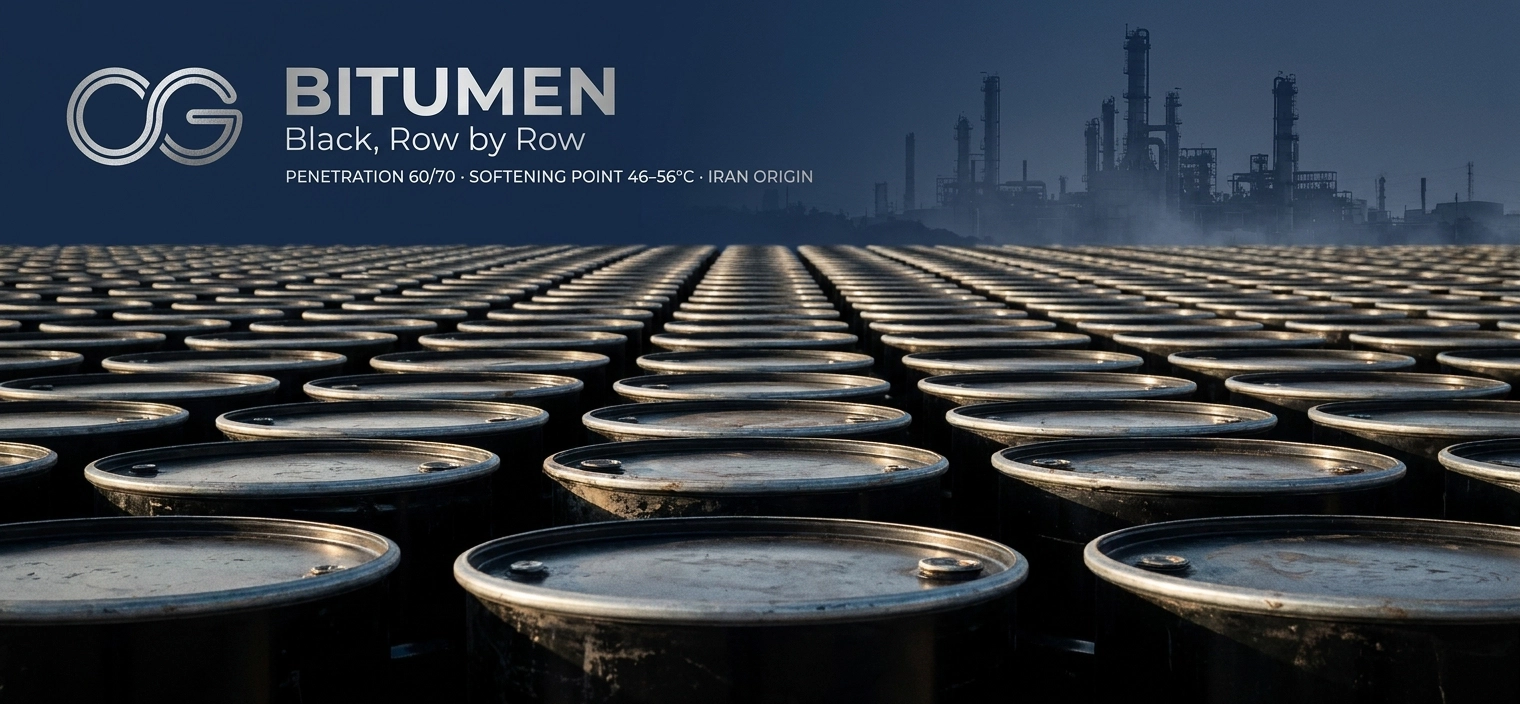
Iran’s export-grade bitumen is typically produced and packed in accordance with international standards including ASTM D946, EN 12591, IS 73:2013, and BS 3690, and shipped in new 180kg steel drums, in bulk, or occasionally in jumbo bags. Backed by a reliable sourcing network across domestic refineries, Coolak supplies a full range of bitumen grades with complete quality documentation (COA) and flexible delivery terms (FOB Bandar Abbas, Bandar Imam, and Chabahar) for international buyers.

Special Offers

Available offers for this product

Special Offer – Supply of Iran Bitumen 60/70 (Export Grade)

Ending Soon
Start Date 2026-07-07
End Date 2026-07-28
Starts In Loading...
Ends In Loading...

Coolak International Group is pleased to present a special opportunity to supply Iran Bitumen 60/70, one of the most demanded export grades for international road construction, infrastructure, and civil engineering projects.

With stable quality, reliable supply capability, and optional third‑party inspection at the loading port, this product is a dependable choice for buyers seeking a transparent and professional partnership with a trusted Supplier.


Technical Specifications

Test Parameter

Specified Value

Test Method

Penetration @ 25°C

60–70

ASTM D5

Softening Point

Min 46°C

ASTM D36

Solubility

Min 99%

ASTM D2042

Ductility @ 25°C

Min 100 cm

ASTM D113

Reference Standards: ASTM D946 / ASTM D3381


Packaging Options

Packaging

Notes

New Steel Drums

Suitable for export handling and destination distribution

Jumbo Bags

Flexible and cost‑efficient option

Bulk

Suitable for large volumes and regular loading schedules


Logistics & Delivery Terms

Item

Terms

Incoterms

FOB Bandar Abbas

Loading/Delivery Port

Bandar Abbas

Loading Coordination

Managed by Coolak International Group

Operational Support

Loading coordination and related shipment operation support


Inspection

Item

Terms

Inspection

SGS or equivalent approved inspection company

Inspection Location

Loading port

Purpose

Quality & quantity verification prior to shipment


Cooperation Procedure (SOP)

  1. Buyer submits official LOI + BCL (under the same corporate name)

  2. Coolak International Group issues the SCO

  3. Buyer confirms the SCO

  4. Buyer issues ICPO

  5. PI is issued

  6. SPA is finalized and signed

  7. Payment is activated and loading/shipment operations commence

Note: Due to market fluctuations, offer validity is subject to market conditions. Payment terms and MOQ will be confirmed based on the buyer’s requested volume and loading plan.

Need a formal quotation or purchase document?

Submit your LOI or ICPO request here. Your request will be reviewed together with the selected product details.

Go to request form
Request Information

Submit LOI / ICPO

Choose the request type and complete only the required fields.

Additional details for ICPO
Required document
Allowed file type: PDF | Maximum size: 20 MB
Required documents

Upload the five required files below. Maximum size is 20 MB for each file.

Allowed file types: PDF, JPG, JPEG, PNG | Maximum size: 20 MB per file

Our Products

Urea 46%
Urea 46%
Refined Copper Cathode
Electrolytic Copper Cathode
EN590 Diesel Fuel
Diesel EN590