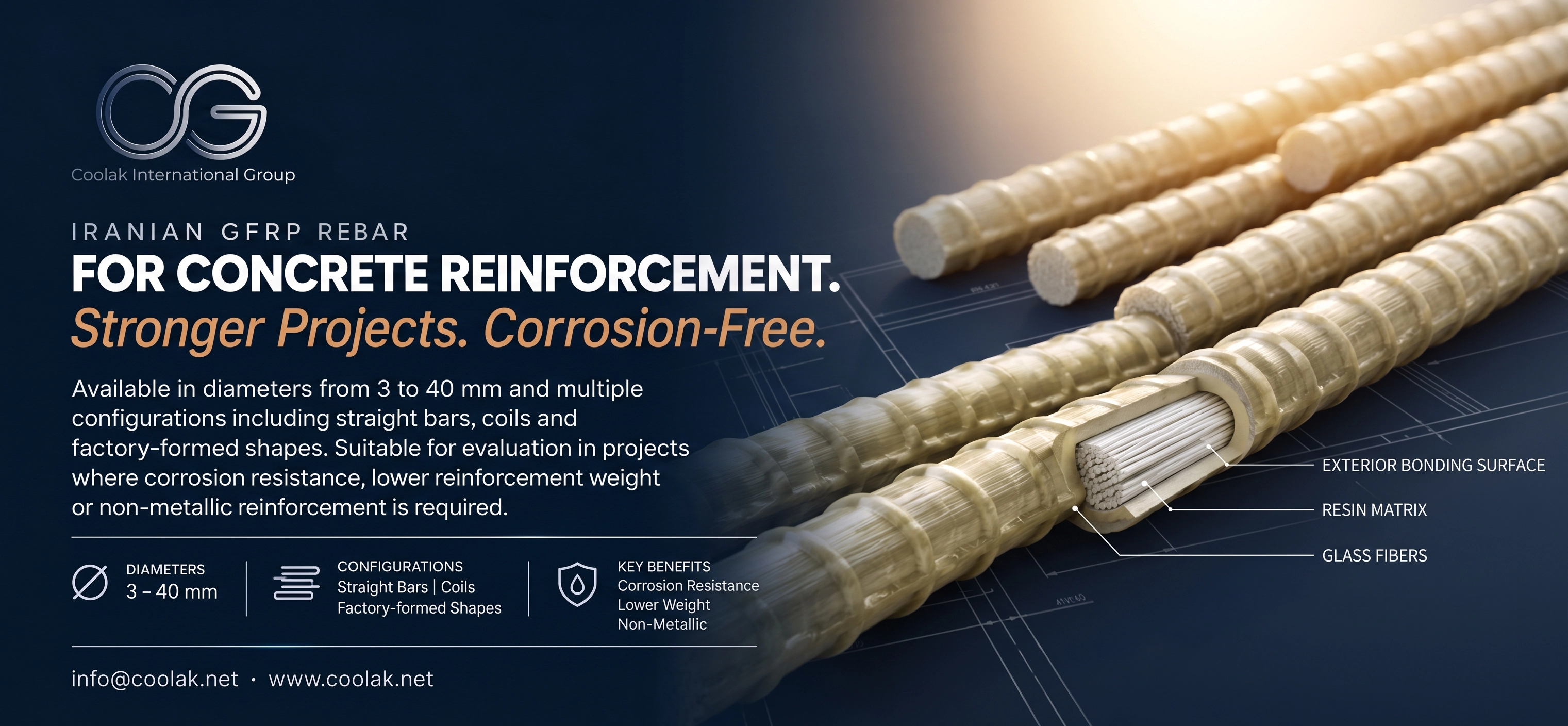
GFRP rebar is a composite reinforcement made from glass fibers and a polymer matrix. It is used as non-metallic reinforcement in selected concrete applications.
Its non-metallic structure and high resistance to corrosion make GFRP relevant to projects where reinforcement is exposed to moisture, chemicals, alkaline environments or other corrosive conditions.
Iranian-origin GFRP rebar is available in different diameters and lengths and can be supplied as straight bars, coils and selected factory-formed products such as Bent Bar and Stirrup.
GFRP Rebar Specifications
Specification | Details |
|---|---|
Product | GFRP Composite Rebar |
Material | Glass Fiber Reinforced Polymer |
Country of Origin | Iran |
Available Diameter | 3–40 mm |
Grades | Grade A and Grade B |
Supply Form | Straight Bar, Coil and Factory-Formed Products |
Rebar Length | 20 cm to 12 m |
Coil Length | Up to 500 m for 3–10 mm diameters |
Surface | Ribbed or plain |
Colour | Available in different colours upon request |
Custom Forms | Bent Bar, Stirrup and other manufacturable forms |
GFRP Rebar Sizes and Weight
Approximate weight per meter for the main available diameters:
Rebar Diameter | Approx. Weight per Meter |
|---|---|
3 mm | 0.018 kg/m |
4 mm | 0.025 kg/m |
5 mm | 0.036 kg/m |
6 mm | 0.052 kg/m |
7 mm | 0.073 kg/m |
8 mm | 0.095 kg/m |
10 mm | 0.157 kg/m |
12 mm | 0.200 kg/m |
14 mm | 0.300 kg/m |
16 mm | 0.400 kg/m |
18 mm | 0.500 kg/m |
20 mm | 0.600 kg/m |
Final diameter and product specifications are confirmed according to project and order requirements.
Approximate Trailer Loading Capacity
The low weight of GFRP rebar allows a high length of product to be loaded per shipment.
Rebar Diameter | Approx. Length per Trailer |
|---|---|
6, 7 and 8 mm | Approximately 160,000 m |
10 mm | Approximately 140,000 m |
12 mm | Approximately 120,000 m |
14 mm | Approximately 80,000 m |
16 mm | Approximately 60,000 m |
18 mm | Approximately 48,000 m |
20 mm | Approximately 40,000 m |
Actual loading capacity depends on diameter, packing configuration, product length, vehicle and applicable transport weight limitations.
Key GFRP Rebar Advantages
Key characteristics of GFRP rebar include:
High resistance to corrosion
Lower weight compared with steel reinforcement
Suitable for wet, chemical and alkaline environments
Non-metallic construction
Low electrical conductivity
Relevant to projects with electromagnetic requirements
Easier handling and transportation due to lower weight
Availability in different diameters, lengths and configurations
Diameters from 3 to 10 mm can be supplied in coils. Depending on the application, this supply form can reduce the need for lap splicing between individual bars.
GFRP Rebar Applications
GFRP rebar is particularly relevant to projects where reinforcement is exposed to corrosion or demanding environmental conditions.
Applications include:
Roads, highways and airport runways
Dams, coastal walls and breakwaters
Bridges and concrete structures
Marine and port structures
Water and wastewater treatment facilities
Water and wastewater channels
Concrete pipes for water and industrial effluent
Manholes and wastewater-related structures
Tunnels and metro structures
Precast concrete components
Concrete barriers and New Jersey barriers
Precast concrete buildings and structures
Precast façade panels
Concrete tanks and structures in oil, gas and petrochemical industries
Parking and industrial floors
Agricultural projects and water pools
Structures near equipment sensitive to electromagnetic fields
Foundations and selected concrete structural components
Educational Articles
Available Supply Forms
GFRP rebar can be supplied in different forms depending on project requirements:
Straight Bar
Coil
Bent Bar
Stirrup
GFRP Mesh
Other custom manufacturable forms
Bent bars and stirrups should be factory-produced according to the required drawings and dimensions. GFRP is not designed for conventional bending or welding on site.
Packaging and Handling
Diameters from 3 to 10 mm can be supplied in coils, while larger diameters can be supplied as straight bars.
During loading, unloading and storage, direct heavy impact, excessive pressure and conditions that could damage the reinforcement should be avoided.
Packing configuration, number of bars, bar or coil length and shipment weight are determined according to the order specifications.
Technical Selection
GFRP has different mechanical behaviour from steel reinforcement and should not be treated as a direct one-to-one replacement for steel in every structural application.
Diameter, configuration, length and application should be selected according to the structural design and technical requirements of the project.
Where a project has specific standards, technical specifications or inspection requirements, these requirements should be included in the enquiry.