
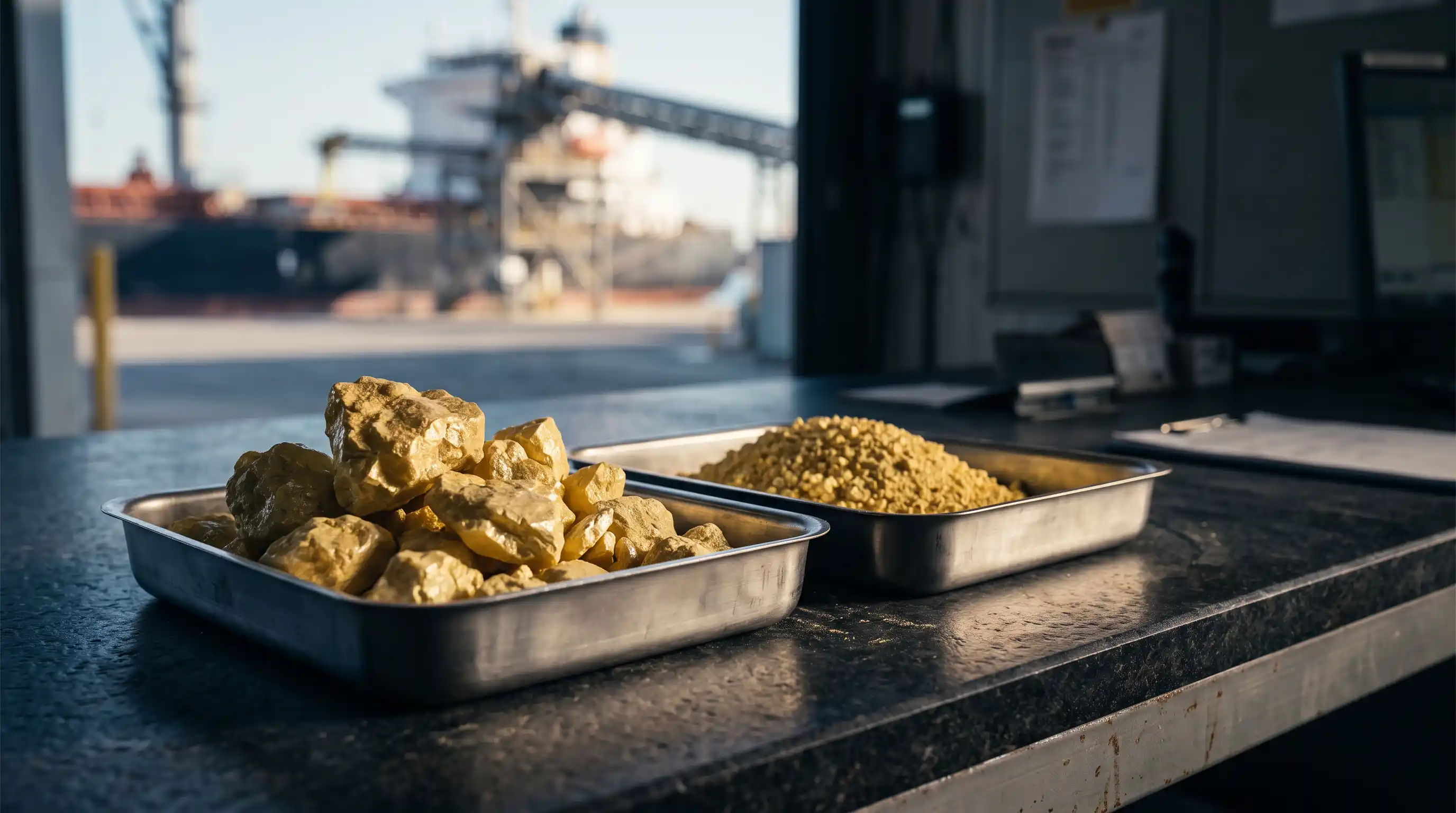
A common mistake in Iran sulfur export analysis is treating terms such as “granular,” “high purity” or “export grade” as complete product definitions. They are not. Physical form, chemical specification and shipment evidence answer different questions, and a commercial review becomes much clearer when those layers are kept separate.
A large share of commercial elemental sulfur is recovered during petroleum refining and natural-gas processing. Sulfuric acid production is a major industrial use of sulfur, linking the commodity to fertilizer, chemical and mineral-processing activity. The U.S. Geological Survey describes sulfur as an important industrial raw material whose principal derivative, sulfuric acid, serves major industrial and fertilizer sectors. (usgs.gov)
This Coolak International Group guide focuses on the information a B2B reader needs to interpret sulfur forms, quality documents, packaging descriptions and market conditions without treating one supplier specification or one historical country list as a universal rule.
Key Takeaways:
Normalize product form and specification before comparing two sulfur descriptions.
Treat measurable parameters and shipment-related documents as stronger evidence than marketing-grade labels.
Use dated market evidence because trade routes, industrial demand and freight economics can change materially over time.
How Should Iranian Sulfur Be Defined in Industrial Trade?
Iranian sulfur should be defined through three separate layers: physical form, technical specification and shipment-related evidence.
Commercial elemental sulfur may be recovered through petroleum refining and natural-gas processing. After elemental sulfur is produced, it can be solidified into different physical forms. The forming step changes the product’s physical characteristics but does not create one universal chemical grade.
Two products described as granular sulfur can therefore differ in sulfur content, moisture, ash, acidity, organic matter or particle characteristics. Two different forms may also share similar values for some chemical parameters.
A useful review separates:
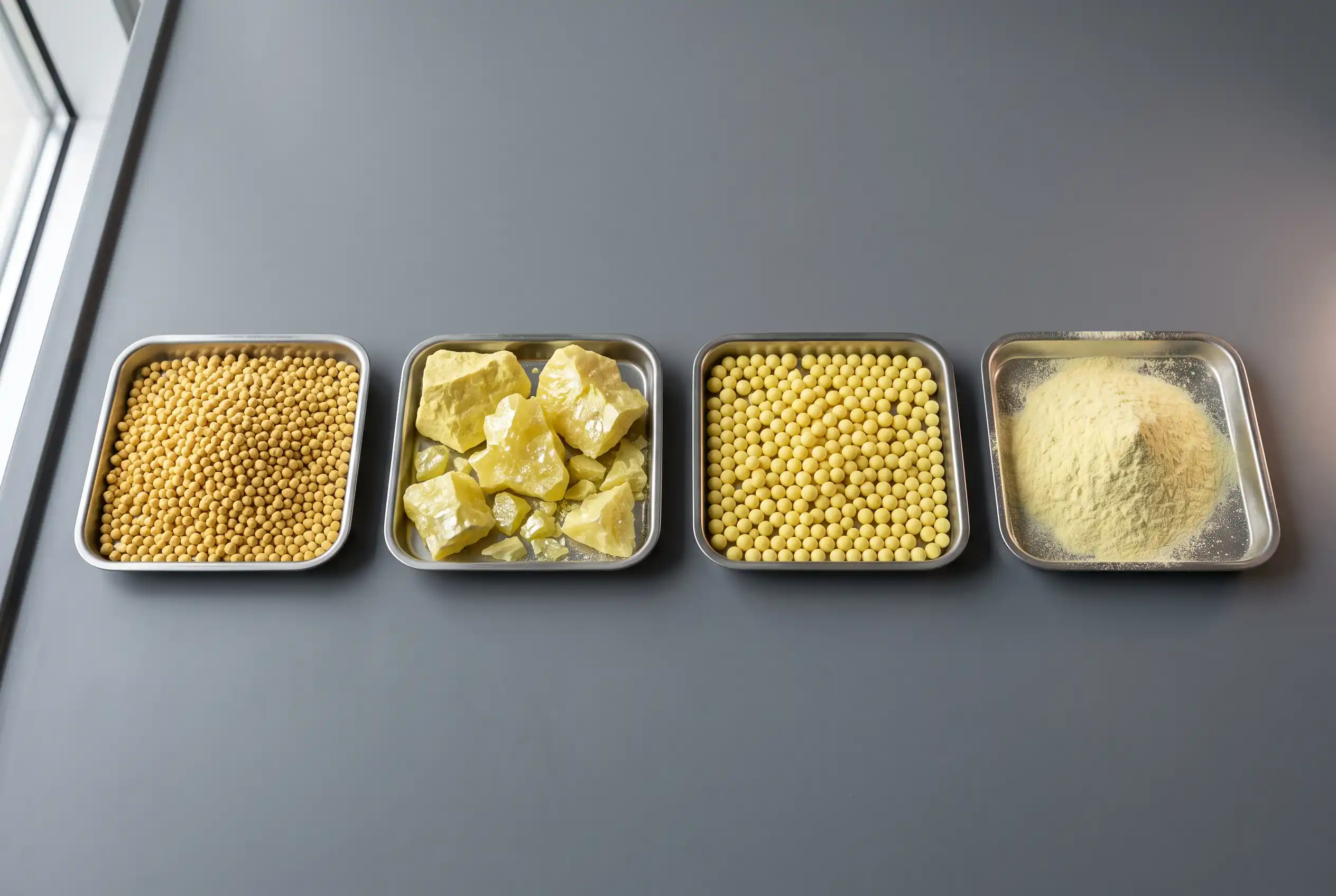
Product Form: granular, lump, prilled or micronized.
Specification: the measurable parameters and acceptance limits.
Shipment Evidence: the COA or quality document connected to the cargo or batch being assessed.
This distinction prevents terms such as “premium” or “export grade” from replacing actual specification data.
Which Sulfur Forms Appear in International Trade?
Granular, lump, prilled and micronized sulfur differ mainly in physical structure and particle characteristics. Their names do not create a fixed purity hierarchy.
Form | General physical characteristic | Main review point |
|---|---|---|
Granular sulfur | Formed, relatively regular particles | Separate particle form from chemical specification |
Lump sulfur | Irregular solid pieces | Check actual cargo condition and size variation |
Prilled sulfur | Particles formed through a prilling process | Do not infer purity from the word “prilled” |
Micronized sulfur | Very fine particles | Particle-size requirements become more significant |


The existing Coolak International Group granular sulfur guide owns the deeper technical discussion of specification parameters, COA interpretation and physical-form differences.
How Are Sulfur Grade and Quality Evaluated?
Sulfur quality is assessed through a set of measurable parameters rather than one generic grade name.
Sulfur Content
Sulfur content reports the proportion of sulfur in the tested sample. It is an important parameter, but a higher number does not automatically mean that a cargo fits every industrial process.
Moisture
Moisture can affect delivered weight and physical behaviour during storage and movement. The figure should be read on the same reporting basis used in the contractual specification.
Ash
Ash represents non-combustible residue under the applicable test method. It can matter where mineral impurities affect downstream processing.
Acidity
Acidity should be interpreted together with its unit and reporting basis. Values reported on different bases should not be compared as though they were identical.
Organic Matter
Organic matter or hydrocarbon content may form part of a recovered-sulfur specification. Its relevance depends on the consuming process.
Particle Characteristics
Particle-size distribution, fines and oversize describe physical performance rather than chemical purity. They may matter where handling equipment or downstream processing requires defined particle behaviour.

A shipment-related COA usually provides more decision-relevant evidence than a broad marketing label because it connects analytical parameters to a defined cargo or batch. Current product information should not be turned into an industry-wide sulfur standard.
Granular vs Lump Sulfur: What Changes in a Trade Review?
The primary difference between granular and lump sulfur is physical form, not a universal quality ranking.
Review area | Granular sulfur | Lump sulfur |
|---|---|---|
Physical form | Formed particles | Irregular pieces |
Size consistency | Generally more controlled | Generally more variable |
Chemical review | Specification and COA | Specification and COA |
Documentation | Shipment- and contract-dependent | Shipment- and contract-dependent |
Suitability | Depends on process requirements | Depends on process requirements |
A buyer or analyst should therefore avoid claims such as “granular is always purer” or “lump is always lower grade.” Either statement requires product-specific evidence.
Documentation is not automatically simpler for one form. COA, origin information, safety documentation and inspection requirements are determined by the shipment and contractual framework rather than by the words granular or lump alone.
How Is Sulfur Packaging Described?
Sulfur packaging should match the physical form, logistics arrangement and documented shipment specification.
Three broad descriptions can appear in trade:
Bulk: used where the cargo and logistics chain are structured for bulk material.
Jumbo Bag: large-unit packaging where the shipment requires bagged handling.
Smaller Bags: possible in some supply chains, but bag weight, material and configuration should be stated in the relevant commercial documents.
There is no universal sulfur bag weight that should be assumed for every trade.
Packaging descriptions should also remain consistent across the specification, packing list and other shipment records. A document set describing the same cargo as bulk in one place and jumbo-bagged elsewhere requires clarification.
Which Documents Are Commonly Reviewed in Sulfur Trade?
Sulfur documentation should provide a consistent description of the product, origin, packing and shipment.
Certificate of Analysis
A COA reports tested or declared product characteristics. Its value increases when the document can be connected to the cargo or batch under review.
Certificate of Origin
A Certificate of Origin records origin information within the applicable documentary framework. Its product and origin details should not conflict with the rest of the shipment file.
Commercial Invoice
The commercial invoice records principal commercial information about the goods and transaction. Product descriptions should remain consistent with related documents.
Packing List
Where packing applies, the packing list records how the goods are organized and described for shipment.
SDS or MSDS
Safety documentation communicates material properties and safety information. Transport status should be checked against the actual form of the product and the rules that apply to the route.
Inspection Documents
Where independent inspection is required, the inspection certificate serves a different role from the COA. A COA and an independent inspection record are not interchangeable documents.


How Should a Sulfur COA Be Read?
A sulfur COA should first be identified as a document connected to a particular product, batch or shipment.
A structured reading asks:
What product and physical form does the document identify?
Is a batch, lot or shipment reference present?
How is sulfur content reported?
Are moisture, ash, acidity and organic matter included where relevant?
Are units and reporting bases clear?
Are particle characteristics documented elsewhere when they matter?
Can the reported results be compared directly with the agreed specification?
The goal is not to look for the highest purity number. The goal is to establish whether the document and the agreed specification describe the same quality requirements.
An old sample COA may be useful as background information, but it should not be treated as evidence for a later cargo unless its relevance to that cargo has been established.
What Drives Sulfur Trade Demand?
Sulfur demand is closely tied to downstream industrial activity, especially sulfuric acid, fertilizer and mineral-processing capacity.
Sulfuric Acid Production
Sulfuric acid is the principal industrial end use for sulfur and feeds numerous chemical and industrial processes. (usgs.gov)
Fertilizer Production
Sulfuric acid is central to phosphate processing and phosphate-fertilizer production. The USGS Mineral Commodity Summaries 2026 identified new phosphate-fertilizer projects, particularly in Africa and west Asia, as a source of additional sulfur demand. (pubs.usgs.gov)
Mining and Mineral Processing
Acid-consuming mineral processes can add to sulfur demand. The same 2026 USGS report identified expanding nickel production through acid-intensive processing projects as another demand factor. (pubs.usgs.gov)
Regional Industrial Capacity
Changes in operating rates or new capacity in sulfuric acid, fertilizer, chemical and mineral-processing facilities can alter regional sulfur requirements.
Freight Conditions
Freight does not create industrial consumption, but it can change which supply routes remain commercially practical for a given market.
How Should Sulfur Export Markets Be Analyzed?
A sulfur export market should be assessed through current demand and commercial conditions rather than a permanent list of “best countries.”
Historical import data can identify established trade routes, but a current market review should consider:
import demand and its direction of change;
industrial consumption capacity;
fertilizer and sulfuric acid production;
buyer technical specifications;
freight economics and route structure;
applicable import rules and documentation;
relevant trade restrictions;
currency and commercial conditions;
compatibility between the required product form and available specification.
A country that received substantial cargoes in one period may become less relevant after a change in industrial operating rates, freight costs, regulations or buyer requirements. Historical destination data should therefore be treated as evidence of past trade, not a permanent market ranking.
What Are Common Risks in International Sulfur Transactions?
Many sulfur-trade risks begin with inconsistent product definitions or documentation.
Specification mismatch: The actual specification does not match the stated industrial requirement.
Outdated COA: The document relates to an older sample or another cargo.
Form-versus-grade confusion: Granular, lump or prilled is treated as though it were a chemical grade.
Packaging mismatch: The packing description differs between documents.
Document inconsistency: Product names, quantities, origin or other material details do not match across the document set.
Origin discrepancy: Origin information conflicts between documents.
HS classification error: The tariff classification is selected without checking the actual product description and the applicable national tariff structure.
Elemental sulfur is commonly reviewed within the HS 2503 family, but the applicable subheading should be confirmed against the exact goods and the relevant tariff schedule rather than assumed from a generic product name.

Pre-Trade Documentation Review Checklist
A documentation review should establish that:
the exact physical form is identified;
the referenced specification is clear;
the COA is relevant to the cargo under review;
the product description is consistent across documents;
origin information is consistent;
HS classification has been checked against the actual goods;
the packing description is consistent;
the commercial invoice and packing list do not conflict with shipment data;
safety and inspection documents are identified where applicable.
This checklist does not determine whether a cargo should be accepted. Its purpose is to identify documentary conflicts that require resolution before the document set is relied upon.
Need product guidance?
Contact our team for specifications, availability, and pricing details.