One of the main risks when reviewing granular sulfur specifications is treating particle form as a chemical quality grade. Granular sulfur is elemental sulfur that has been formed into relatively regular solid particles. “Granular” tells a technical buyer something about physical form, but it does not automatically identify sulfur content, moisture, ash, origin, or suitability for a particular industrial process.
A better technical question is: which measurable parameters and documents define the actual material? Sulfur content is one part of the answer. Moisture, ash, acidity, organic matter or hydrocarbons, and particle-size distribution can also form part of an acceptance specification.
This guide from Coolak International Group separates general sulfur knowledge from supplier-specific product data. A specification attached to one commercial product should not be presented as a universal granular sulfur standard, and grades that exist elsewhere in the market should not be attributed to a Coolak International Group product without supporting product data. For the broader trade context, see the guide to Iran sulfur export, which covers product forms, quality documents, packaging, and market conditions.
Key Takeaways:
Identify the physical form first, then compare measurable specification limits.
Read sulfur purity together with impurities and process-specific requirements.
Confirm that the COA relates to the batch or shipment under assessment.
Where particle size matters, check in-range material, fines, and oversize.
Determine transport status from the actual material and applicable documentation rather than the word “granular” alone.
What Is Granular Sulfur?
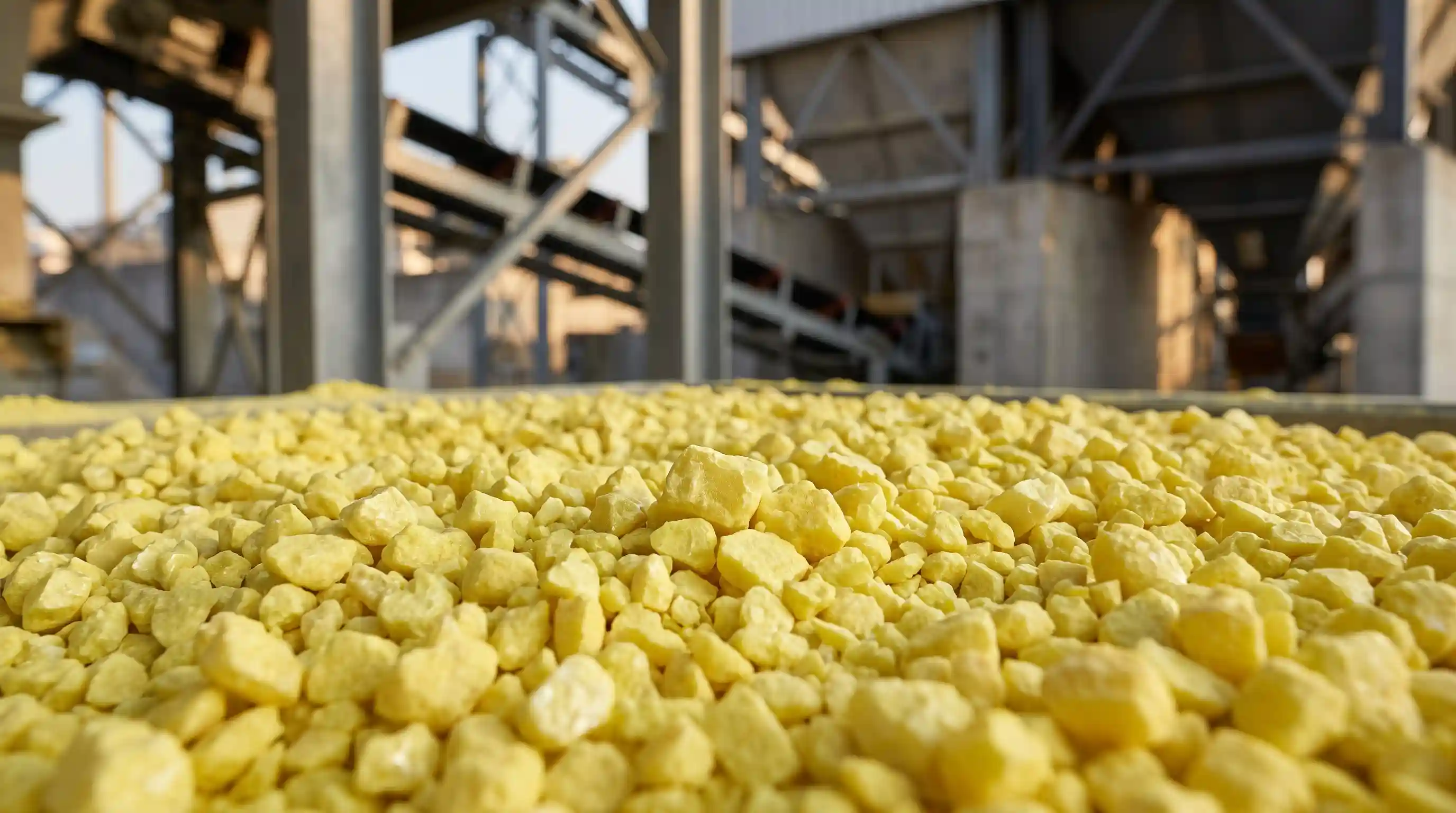
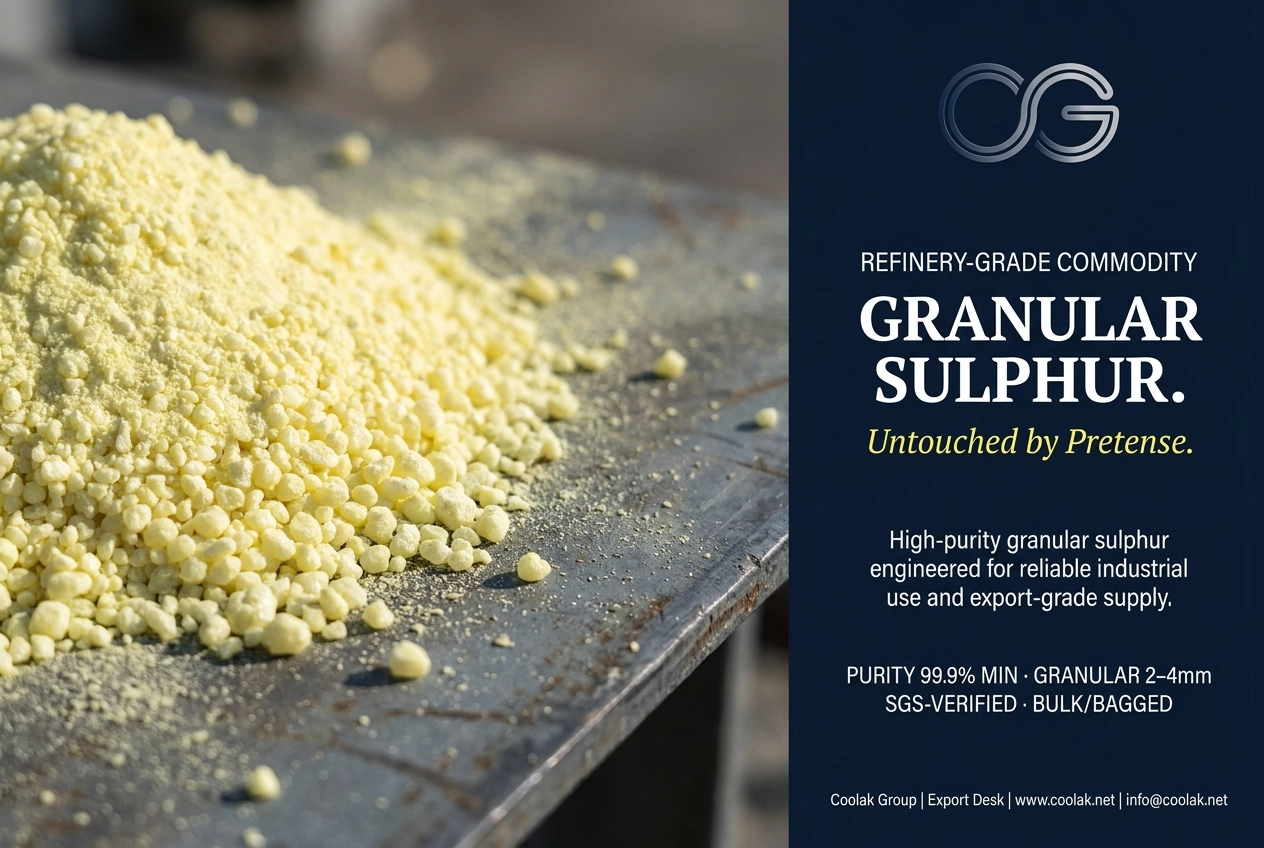
Granular sulfur is elemental sulfur formed into relatively regular solid particles. The term describes physical form rather than one universal chemical grade.
A significant part of commercial elemental sulfur is recovered during petroleum refining and natural-gas processing. Sulfur compounds are removed from hydrocarbon streams, converted into elemental sulfur, and can then be solidified into forms such as granules or prills.
This production route does not create one specification for every recovered sulfur product. Two products described as granular sulfur can have different sulfur content, moisture, ash, acidity, organic matter, and physical particle characteristics.
Physical form and chemical specification should therefore be treated as separate parts of the product definition.
For a technical buyer, the phrase “granular sulfur” is the starting point. A fuller definition comes from measurable chemical limits, particle characteristics, and the documents connected to the actual product.
What Defines a Granular Sulfur Specification?
There is no single numerical specification that defines every commercial granular sulfur product. Producers, grades, and downstream processes can use different acceptance limits.
One consuming plant may place more emphasis on ash, while another may apply tighter limits to organic matter or particle-size distribution.
Parameter | Common unit | What it describes |
|---|---|---|
Sulfur / S | % | Elemental sulfur measured in the sample |
Moisture | % | Water measured under the stated test method |
Ash | % | Non-combustible residue and part of the inorganic impurity profile |
Acidity, often as H₂SO₄ | % | Acidity reported on the defined basis |
Organic matter / hydrocarbons | % | Residual organic components |
Particle-size distribution | mm or % | Distribution across defined particle-size bands |
Fines | % | Material below the specified size limit |
Oversize | % | Material above the specified size limit |
Colour / appearance | Descriptive | Visual condition rather than chemical analysis |
This table is a framework for reading a sulfur specification. It is not a universal set of acceptance values.
What the Main COA Parameters Mean
Sulfur Content
The S percentage identifies the measured elemental sulfur content of the tested sample. It is a major specification parameter, but it does not define the full quality profile by itself.
Two products with similar S results can still differ in ash, moisture, acidity, organic matter, or physical characteristics. The relevance of those differences depends on the downstream process.
Moisture
Moisture reports water measured in the sample according to the stated method. When two results are compared, units, methods, and contractual limits need to be technically comparable.
Ash
Ash describes non-combustible residue and can indicate part of the inorganic impurity profile. The acceptable ash level depends on the downstream requirement rather than one global sulfur standard.
Acidity
Acidity can be reported on a defined basis such as Acidity as H₂SO₄. Meaningful comparison requires compatible units and reporting methods.
Organic Matter or Hydrocarbons
Recovered sulfur can be assessed for residual organic matter or hydrocarbons where these components matter to the consuming process.
Particle-Size Distribution
A useful particle-size specification says more than “2–5 mm” or another headline interval. It can define the percentage inside the target range as well as allowable fines and oversize.
Two materials can have the same nominal size range while showing different actual particle distributions.
General Specifications vs Product-Specific Data
A general specification usually describes an indicative product range. It should not automatically be treated as a confirmed analysis for every cargo.
Coolak International Group maintains supplier-specific or product-specific information separately for the sulfur product presented on its website. Those figures describe that documented product range rather than every granular sulfur product available in the wider market.
Likewise, other sulfur grades and purity levels found in the market should not be attributed to a Coolak International Group product unless the current product information supports them.
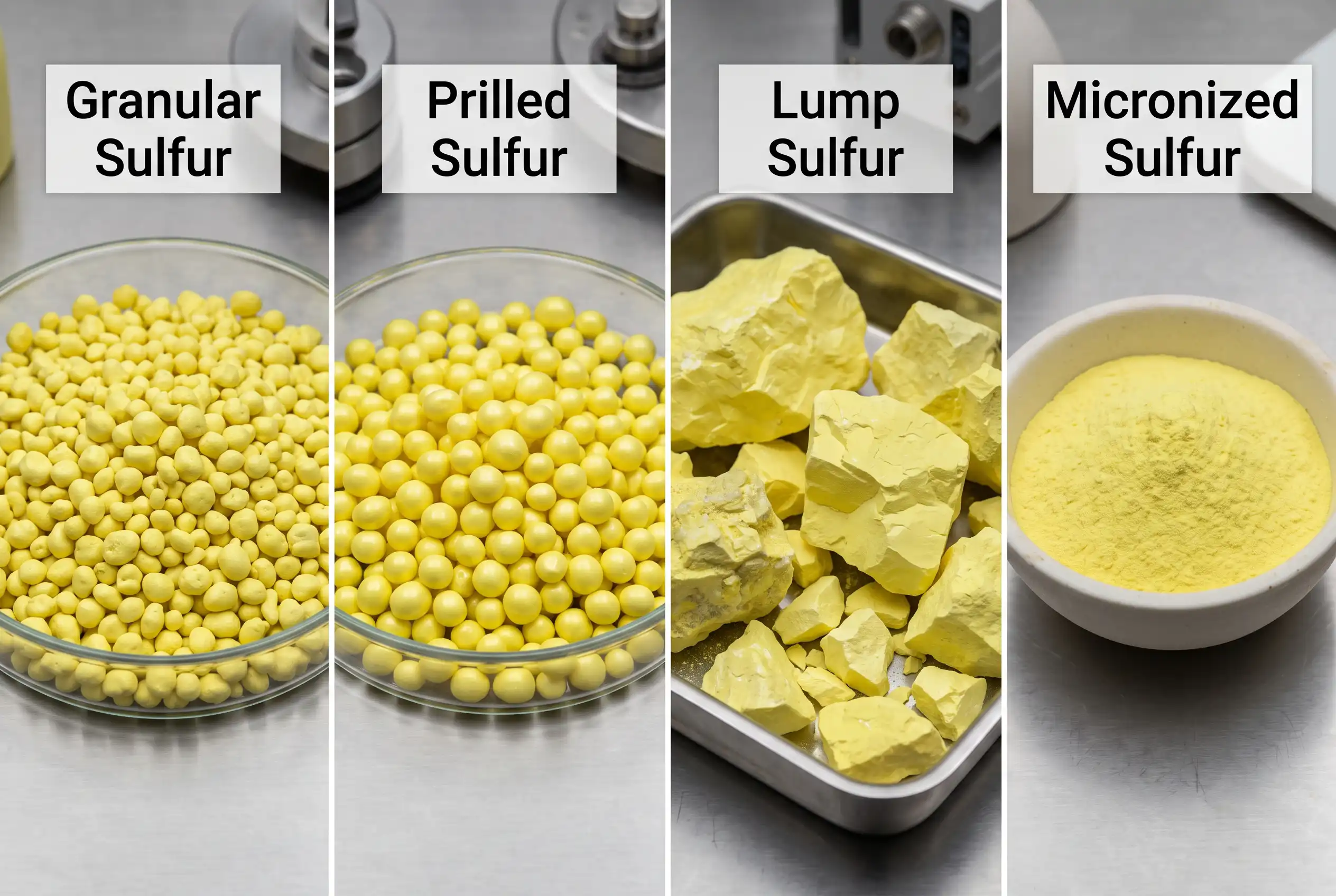
Granular vs Prilled vs Lump vs Micronized Sulfur
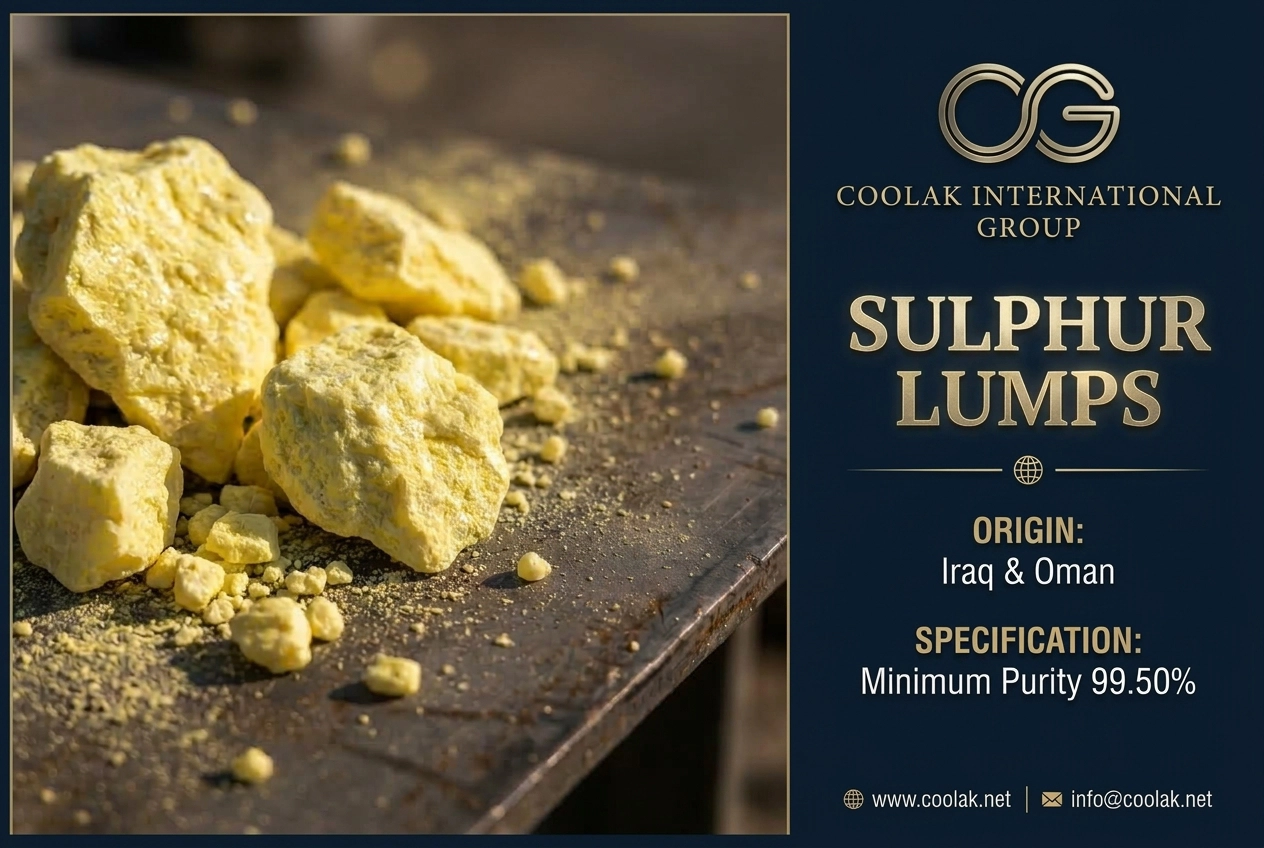
The main differences between these sulfur forms are particle structure, shape, and size. Physical form does not establish a fixed chemical-purity ranking.
Form | Physical characteristic | Main practical distinction |
|---|---|---|
Granular | Formed, relatively regular particles | More controlled physical characteristics than irregular lumps |
Prilled | Solidified droplets | Different particle structure |
Lump | Irregular pieces | Wider variation in physical size |
Micronized | Very fine particles | Higher surface area |
Granular vs Prilled Sulfur
Prilled sulfur is commonly produced by solidifying droplets of molten sulfur. Granulation can use other particle-forming or progressive growth methods.
The resulting differences can affect particle shape, size distribution, physical strength, and fines.
The actual technical data should be reviewed rather than assuming that prilled sulfur is lower purity or that granular sulfur is a higher chemical grade.
Granular vs Lump Sulfur
Lump sulfur consists of irregular pieces and can have a wider variation in piece size. Granular sulfur is intentionally formed into more regular particles.
Mechanical movement and breakage can affect fines content. The actual material condition and specification should therefore be reviewed instead of describing all granular sulfur as completely dust-free.
How Micronized Sulfur Differs
Micronized sulfur consists of much finer particles. Smaller particles create higher surface area, which can affect physical behaviour and suitability for particular downstream processes.
Micronized and granular sulfur can therefore serve different physical requirements even when their elemental sulfur content is similar.
How to Read a Sulfur Specification Correctly
The first step is to identify what kind of document you are reading. A generic specification, TDS, COA, independent inspection report, and contractual specification serve different purposes.
Generic Specification
A generic specification describes an indicative product or range. A value shown there does not by itself confirm the result for a specific shipment.
Technical Data Sheet
A Technical Data Sheet provides broader technical information about the defined product and its stated characteristics.
Certificate of Analysis
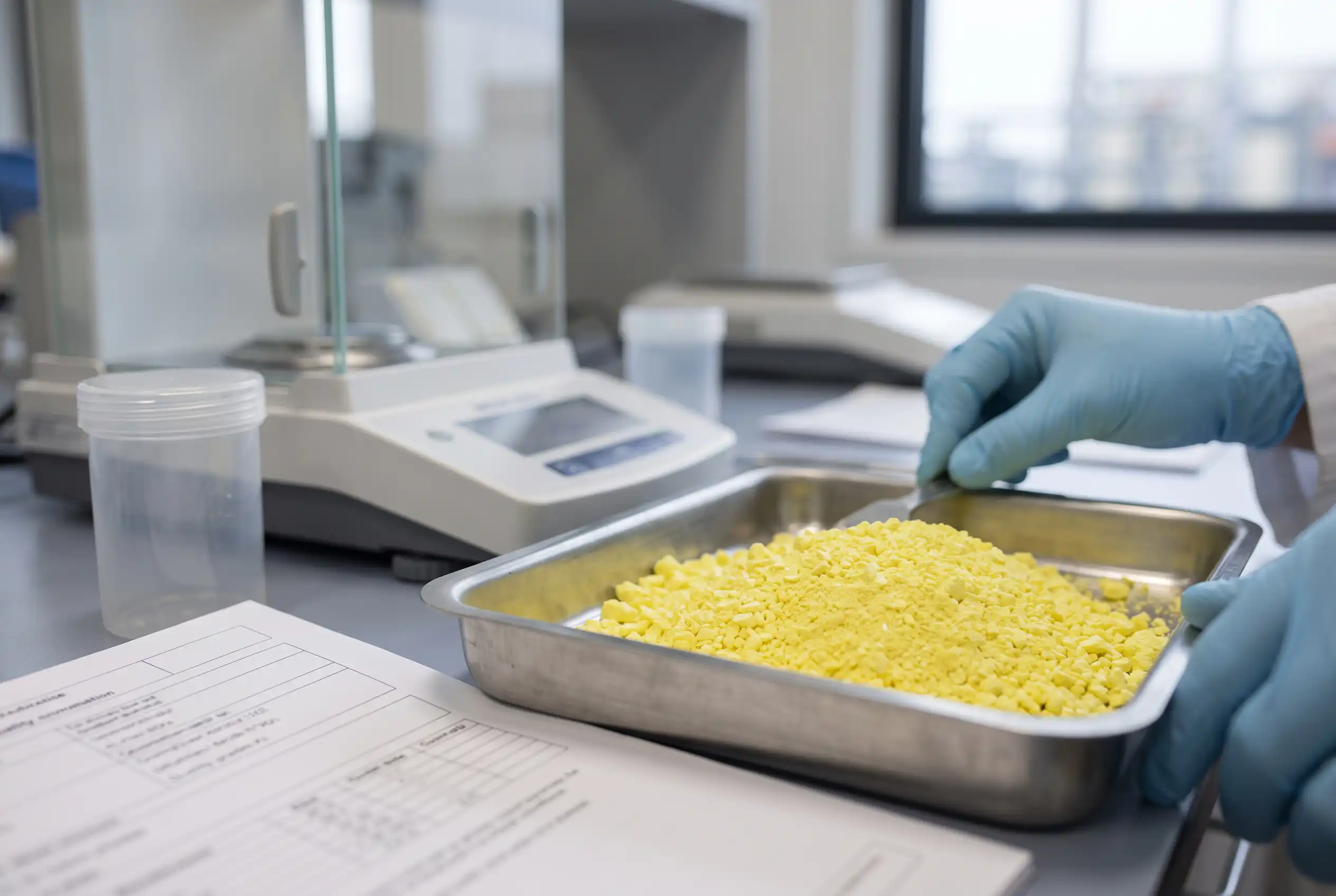
A Certificate of Analysis reports test results associated with a sample, batch, or shipment. Its connection to the material being assessed should be clear.
Independent Inspection Result
An independent inspection report can document sampling, testing, or inspection findings. The scope of the inspection and sampling basis matter when results are interpreted.
Contractual Specification
A contractual specification sets the acceptance limits agreed between the parties. Clear values, units, methods, and document references reduce ambiguity.
Labels such as “Premium Grade,” “Export Grade,” or “High Purity” cannot replace measurable specification limits.
For general background on how responsibility and cost allocation are defined in international trade, Coolak International Group's Incoterms 2020 guide provides a separate explanation of the eleven trade terms.
Specification Review Checklist
Confirm the actual physical form.
Compare sulfur content and relevant impurity limits.
Confirm that the COA relates to the relevant batch or shipment.
Review fines, oversize, and particle distribution where sizing matters.
Check that the contractual specification and quality documents do not contain unresolved conflicts.
Packaging, Documentation and Transport Classification
There is no universal package weight or packaging configuration for every granular sulfur product. Packaging needs to be defined for the product and commercial arrangement being reviewed.
Industrial sulfur can be supplied in bulk or in large packaging formats depending on the defined product. A package weight used for one product should not be presented as a market-wide standard.
Documentation
Depending on the contract, documentation can include:
Certificate of Analysis
Safety Data Sheet
Certificate of Origin
Independent inspection documentation where agreed
The purpose of document review is not merely to collect document titles. The information should relate to the actual material and remain consistent with the agreed specification.
For broader information about commercial-document structure, the Coolak International Group page on international trade contracts and commercial documents explains the related service area.
Is Granular Sulfur Always Non-Dangerous Goods?
No. The word “granular” does not create a universal Non-DG classification.
Transport regulations can distinguish between different physical sulfur forms. The actual material form, current SDS, mode of transport, applicable regulatory framework, and shipment documentation need to be considered when classification is reviewed.
A blanket claim that all granular sulfur is Non-DG is therefore too broad.
This guide does not provide operational sulfur transport or handling procedures. Those requirements need to come from the applicable rules and the documents for the specific cargo.
What Are the Main Industrial Uses of Granular Sulfur?
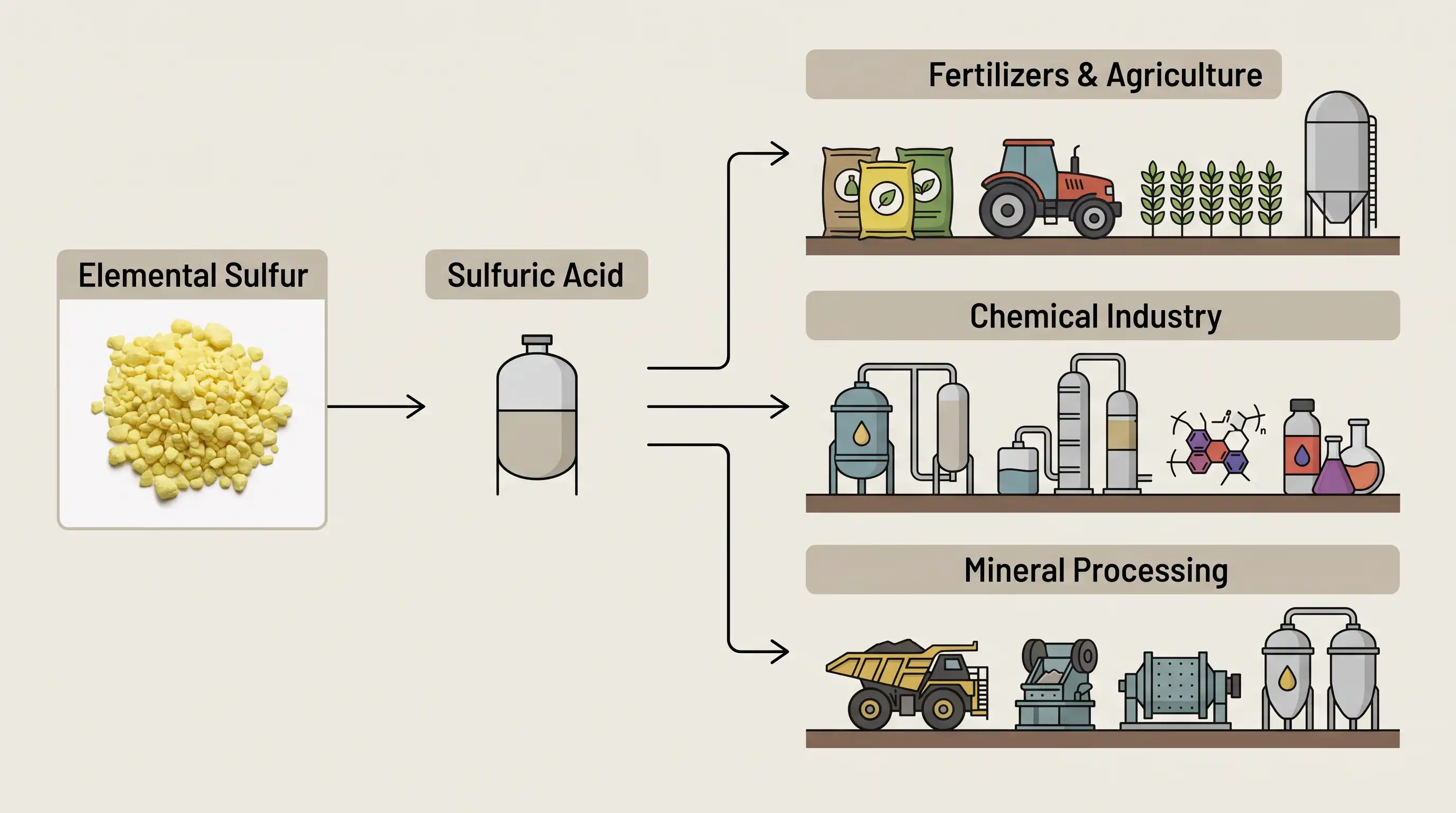
Elemental sulfur is an important raw material or intermediate in several industrial chains. Sulfuric acid production is one of its principal industrial uses, while the required specification can differ between downstream processes.
Sulfuric Acid Production
Sulfur is widely used as a feed material for sulfuric acid production.
“Sulfurs suitable for sulfuric acid production” is not a complete technical grade description. A plant may define its own limits for sulfur content, ash, moisture, or other impurities.
The consuming plant's requirements remain the correct technical reference.
Fertilizers and Agriculture
Sulfur has two distinct roles in the agricultural sector.
First, sulfur compounds and sulfuric acid are part of several fertilizer and agricultural-chemical production chains.
Second, elemental sulfur can undergo biological oxidation in suitable soil conditions and influence soil chemistry.
The outcome depends on soil type, starting pH, moisture, temperature, microbial activity, and carbonate content. Elemental sulfur should not be presented as a guaranteed treatment for every soil or crop.
Rubber and Polymer Processing
Sulfur has an established role in the vulcanization of many rubber compounds, where it participates in cross-link formation within polymer structures.
The physical form used in rubber processing may differ from bulk industrial sulfur. Fine particle control and dispersion can become more important for specific formulations.
Chemical and Mineral Processing
Sulfur and sulfur-derived chemicals are used across chemical and mineral-processing chains.
One process may place greater emphasis on ash, while another can require closer control of organic matter or particle-size distribution.
This is why the downstream use should help define the required specification.
For information about Coolak International Group’s industrial sulfur and chemical products, visit the industrial sulfur and chemical products page.
From a Product Name to a Verifiable Specification
“Granular sulfur” is the starting description rather than a complete technical definition.
A fuller specification can include:
Sulfur Content
Moisture
Ash
Acidity
Organic Matter
Particle-Size Distribution
Fines and Oversize
Physical Form
COA and applicable quality documentation
For a B2B reader, it is important to distinguish general information about sulfur from commercial data related to a specific supplier.
A purity level or specification published on one supplier’s product page should not automatically be treated as an industry-wide standard. Likewise, other commercial grades available in the market should not be attributed to Coolak International Group unless they are supported by the group’s current product documentation.
The sulfur product offered by Coolak International Group has its own documented specification range and quality information. These details should be reviewed through the relevant product documents and should not be generalized to all granular sulfur products.
This guide focuses specifically on the definition of granular sulfur, technical specifications, COA interpretation, physical forms, and industrial applications. Current offers, pricing, and purchasing procedures are outside the scope of this informational content.
Need product guidance?
Contact our team for specifications, availability, and pricing details.