
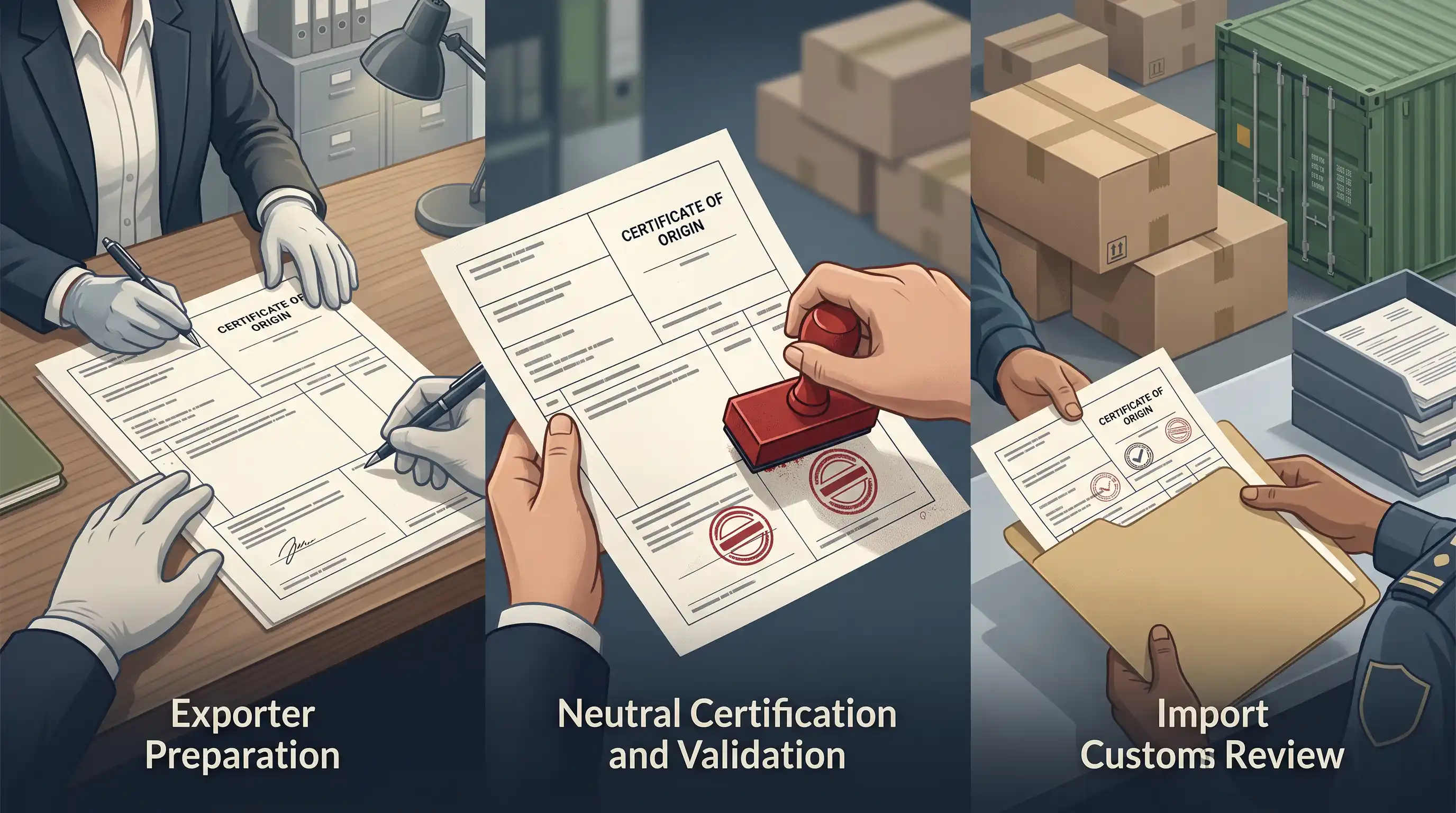
An incorrect origin statement, product description or shipment detail can create questions across an otherwise complete export document set. That is why understanding a certificate of origin requires more than knowing what the form looks like. Exporters need to know when proof of origin is required, which origin rules apply and how the document relates to the commercial invoice, packing list, HS classification and customs records.
A Certificate of Origin, often referred to as a COO certificate, is documentation used to support or certify the origin of goods. It may be relevant to customs procedures, buyer requirements, banking or documentary-credit conditions, trade-policy measures or preferential tariff treatment. It should not be treated as a document that every shipment must carry.
Coolak International Group approaches origin documentation as part of the wider transaction structure. The document should reflect the actual goods and remain consistent with the commercial and customs information used throughout the shipment.
Key Takeaways:
Determine the destination's proof-of-origin requirement before requesting a particular certificate form.
Do not claim preferential origin until the product satisfies the specific rules of the applicable trade arrangement.
Review HS classification before applying a product-specific origin rule or tariff-shift test.
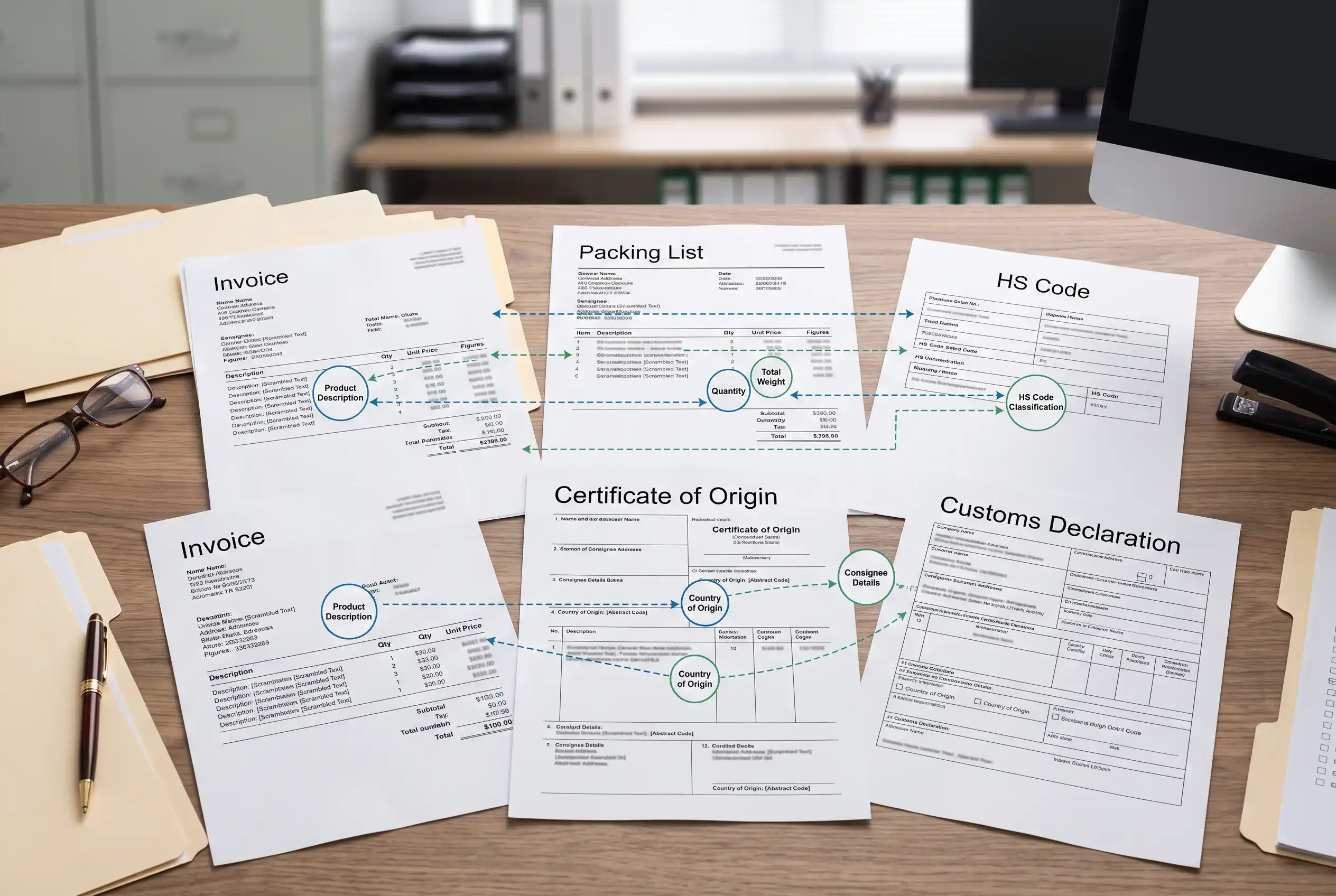
Match the final COO against the invoice, packing list, contract and other shipment documents before presentation.
What Is a Certificate of Origin?
A Certificate of Origin is a trade document that certifies or supports the claimed country of origin of goods in a specific shipment.
Origin identifies the country to which goods are attributed under the applicable rules of origin. It is not simply the place where the cargo is currently stored, the port where it was loaded or the country through which it moved.
Depending on the destination or trade arrangement, proof of origin may take the form of a formal certificate or another permitted origin statement. Exporters should therefore establish the exact form of evidence accepted for the transaction rather than assuming that one standard COO works everywhere.
A Certificate of Origin is also not universally mandatory. As explained in Coolak International Group's guide to export documents required for shipments from Iran, the document package for a shipment depends on factors such as the product, destination, HS classification, contract, payment structure and transport arrangements.
Why Is a Certificate of Origin Used?
A Certificate of Origin is used when the origin of goods must be established for a customs, commercial, banking or trade-policy purpose.
Common situations can include:
customs procedures in the importing country;
a buyer's documentary requirements;
contractual document requirements;
bank or Letter of Credit conditions;
trade-policy measures linked to origin;
a claim for preferential tariff treatment where an applicable arrangement exists;
origin-marking or other destination-country requirements.
These are possible uses, not a universal checklist.
A buyer may require a COO even where another transaction does not. A bank may specify a particular document under a documentary credit. Customs requirements can also vary by destination, commodity and applicable trade arrangement.
The practical question is therefore not simply, “Do exports need a COO?” It is, “What proof of origin is required for this product, destination and transaction?”
Preferential vs Non-Preferential Certificate of Origin
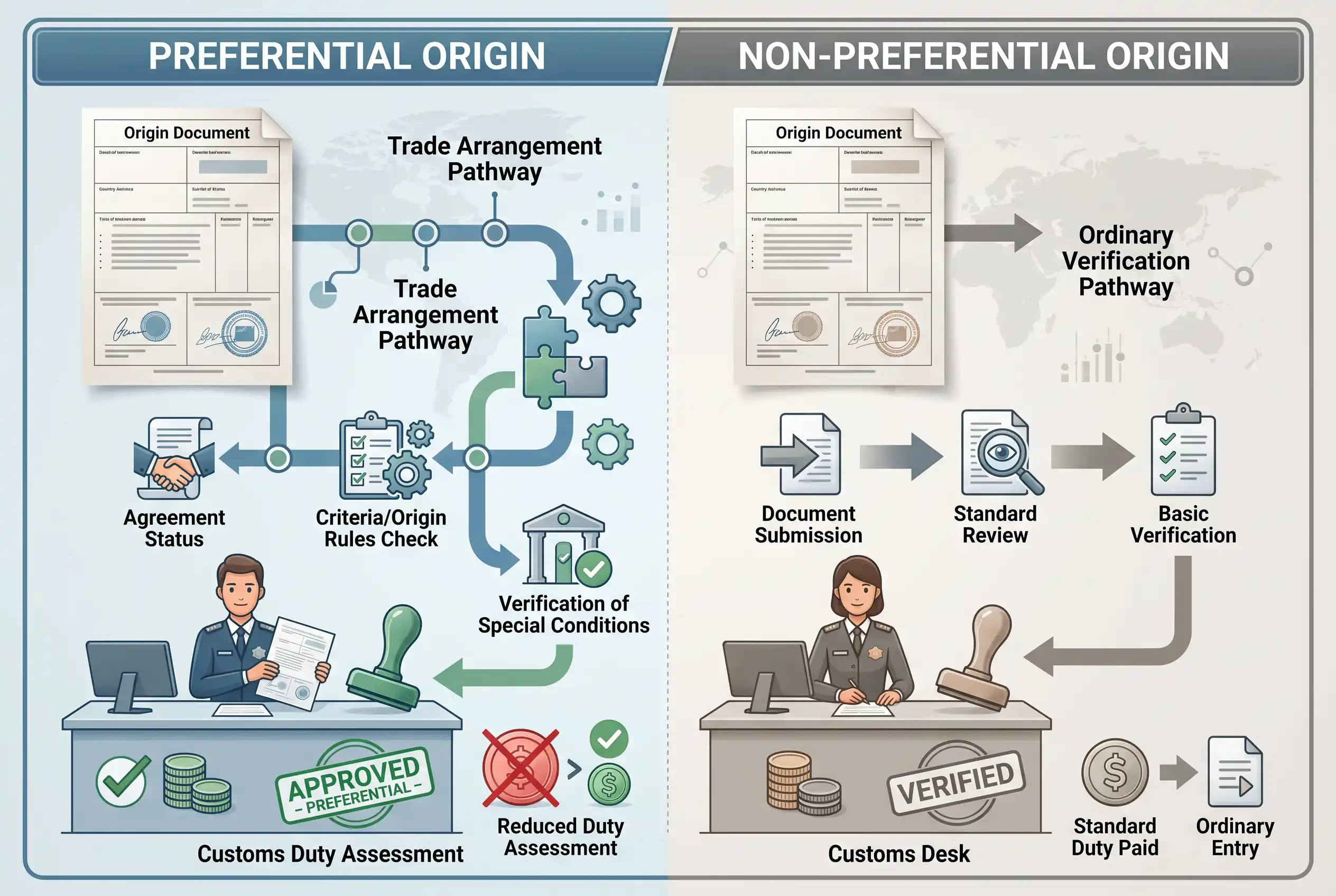
Preferential origin is used to determine whether goods qualify under a preferential trade arrangement, while non-preferential origin establishes origin without claiming that preferential tariff treatment.
Preferential Origin
Preferential origin becomes relevant when a trade agreement or another qualifying preference may provide reduced or exempt customs duties for eligible originating goods.
A certificate alone does not establish entitlement. The product must first meet the applicable rules of origin, and the trader must use the proof of origin accepted under that arrangement.
This creates two separate checks:
Is a relevant preference available between the countries involved?
Does the product satisfy the applicable product-specific origin rule?
If either condition is not met, the existence of a document titled “Certificate of Origin” does not create preferential treatment.
Non-Preferential Origin
Non-preferential origin determines the origin of goods without a claim under a preferential tariff arrangement.
It may be relevant to customs procedures, commercial-policy measures, origin marking, contractual requirements or other destination-country rules.
For exporters and importers, the key distinction is straightforward: not every Certificate of Origin reduces customs duties.
Who Issues a Certificate of Origin?
The competent issuer depends on the exporting country, the type of origin evidence, the destination and any applicable trade arrangement.
Chambers of commerce have an important certification role in many jurisdictions, particularly for non-preferential certificates. Other systems may involve customs authorities, ministries, government agencies or another body authorized under local rules.
Preferential systems can operate differently. Depending on the arrangement, the accepted proof may involve a designated authority or an origin declaration or statement completed under specified conditions.
Exporters should therefore avoid treating the issuing process used in one country as a global procedure.
For a shipment from Iran, the relevant Iranian process and the importing country's acceptance requirements both need to be checked for the actual transaction.
What Information Usually Appears on a Certificate of Origin?
A Certificate of Origin normally contains enough information to connect the origin claim to the relevant exporter, goods and shipment, although exact fields vary by form.
Depending on the applicable certificate, fields may include:
exporter details;
consignee details;
country of origin;
destination country;
description of goods;
quantity and weight;
package information;
commercial invoice reference;
transport or shipment details where applicable;
HS classification where required;
certificate number and date;
authorized certification, signature or validation.
Exporters should not assume that every form contains every field listed above. The correct certificate format should be identified before the data is prepared.
The final information should also reflect the actual shipment rather than an earlier proforma or preliminary set of commercial data.
How Is Country of Origin Determined?
Country of origin is determined under the rules of origin that apply to the product and trade context, not through one universal formula.
Some goods can qualify as wholly obtained in one country. More complex manufactured goods may use inputs, components or processing from several countries, requiring an origin rule to determine where sufficient production occurred.
Depending on the applicable regime, the test may involve:
wholly obtained criteria;
substantial transformation;
a change in tariff classification;
a defined value-added calculation;
a specified manufacturing or processing operation;
a product-specific rule linked to an HS heading or subheading.
These tests are not a menu from which a trader can select the easiest option. The applicable destination rule or trade arrangement determines which criterion must be used.
This is particularly important for manufactured goods with multi-country supply chains, where the purchase location of a component does not by itself establish the origin of the finished product.
Certificate of Origin vs Country of Shipment
Country of origin describes the economic origin of the goods under the applicable rules; country of shipment identifies where the cargo was dispatched or routed from.
Consider a simple example.
A product satisfies the origin requirements of Country A. It is then moved to Country B for consolidation or transshipment before being delivered to an importer in Country C.
In that transaction:
Country A may remain the country of origin.
Country B may be the country of shipment.
Country C is the destination.
Passing through Country B does not automatically change the product's origin. Whether processing in another country changes origin depends on the applicable origin rule and what was actually done to the goods.
This distinction should remain clear anywhere origin is stated in the shipment documentation.
Certificate of Origin vs Commercial Invoice
The commercial invoice records the commercial transaction, while the Certificate of Origin supports the origin claim for the goods.
The invoice normally identifies commercial elements such as the seller, buyer, goods, quantity, price and agreed transaction details. The Certificate of Origin has a different purpose and focuses on origin.
The documents do not need to look alike, but shared information should be compatible with the actual shipment.
For example, unexplained differences in product description, quantity, party information or origin can create documentary questions. The same principle applies to the packing list, which describes the physical cargo structure and commonly records packages, quantities and weights.
Document consistency is therefore not about copying the same sentence into every form. It is about ensuring that each document describes the same underlying shipment.
How HS Code Affects Origin Verification
HS classification can be central to origin verification when an origin rule uses a tariff-classification change or another product-specific rule.
Some rules of origin test whether processing has resulted in a Change in Tariff Classification between non-originating inputs and the final product. Product-specific rules may also be organized around an HS heading or subheading.
An incorrect classification can therefore lead the exporter to evaluate the wrong origin rule.
Before relying on a tariff-based origin test, review how to determine the correct HS Code for the actual product and confirm that the classification used in the origin assessment reflects its characteristics.
An HS Code does not independently establish country of origin. Its role is to identify the product within the tariff nomenclature and, where the applicable origin rule uses that classification, provide the basis for applying the required test.
When Is a Certificate of Origin Required?
Whether a Certificate of Origin is required should be decided shipment by shipment using the destination, trade arrangement, buyer, bank, product and contract as the decision framework.
Use these six checks before shipment:
Destination customs requirements
Check the importing country's official customs or trade information for the product concerned.Applicable trade arrangement
If preferential treatment is being considered, identify both the origin rule and the accepted proof of origin.Buyer requirement
The buyer may request documentary evidence beyond the basic customs requirement.Bank or Letter of Credit requirement
Check the exact document title, issuer conditions, required copies and data stated in the credit.Product-specific requirements
Determine whether the commodity is subject to an origin-related rule or other special documentation.Contract requirement
Confirm that the document package matches the sale contract and transaction procedure.
The selected Incoterms 2020 rule can affect the allocation of certain delivery and clearance responsibilities, but Incoterms do not by themselves decide whether a COO is mandatory.
Common Certificate of Origin Mistakes
Most COO problems arise when the certificate is treated as an isolated form rather than part of an origin determination and a connected document set.
Common mistakes include:
assuming every export requires a Certificate of Origin;
confusing country of shipment with country of origin;
entering incorrect exporter or consignee information;
using a product description that conflicts with the invoice;
showing quantities or weights inconsistent with the packing list;
relying on an incorrect or unreviewed HS classification;
using the wrong certificate or proof-of-origin format;
claiming preferential origin without meeting the applicable rule;
overlooking documentary-credit conditions;
preparing the document so late that corrections or required validation become difficult.
For B2B exporters, the objective should not be simply to obtain a stamped document. The certificate should be appropriate for the transaction and compatible with the information presented to customs, the buyer or the bank.
Certificate of Origin Pre-Shipment Checklist
Before shipment, verify both the origin claim itself and the consistency of the certificate with the rest of the transaction documentation.
Exporter name and details are correct.
Consignee details match the transaction structure.
Product description is consistent with the commercial invoice.
Country of origin has been checked under the applicable rules.
HS classification has been reviewed.
Quantity matches the invoice and packing list.
Weight and package information are consistent.
Invoice reference is correct where required.
Destination-country requirements have been checked.
Preferential or non-preferential origin has been identified correctly.
The correct certificate or proof-of-origin type has been selected.
Required certification or validation is complete.
Contract and Letter of Credit requirements have been reviewed.
The final COO has been checked against customs and transport documents.
Completing these checks before formal presentation gives the exporter an opportunity to identify discrepancies while the documentation can still be corrected.
Align Export Documents Before the Transaction Reaches Execution
A Certificate of Origin is one part of a wider international transaction. If the contract requires one document, the Letter of Credit requires another format and the invoice or packing list carries conflicting data, possession of individual documents does not resolve the underlying inconsistency.
Coolak International Group focuses on clarifying commercial structures, responsibilities and transaction documentation before avoidable problems reach the execution stage. For B2B trade, reviewing the contract, delivery structure, transaction procedure and required document set before commitment can identify issues while the parties still have room to address them.
For support with the commercial structure and document requirements of an international transaction, see our service for international trade contracts and commercial documents.
Need product guidance?
Contact our team for specifications, availability, and pricing details.