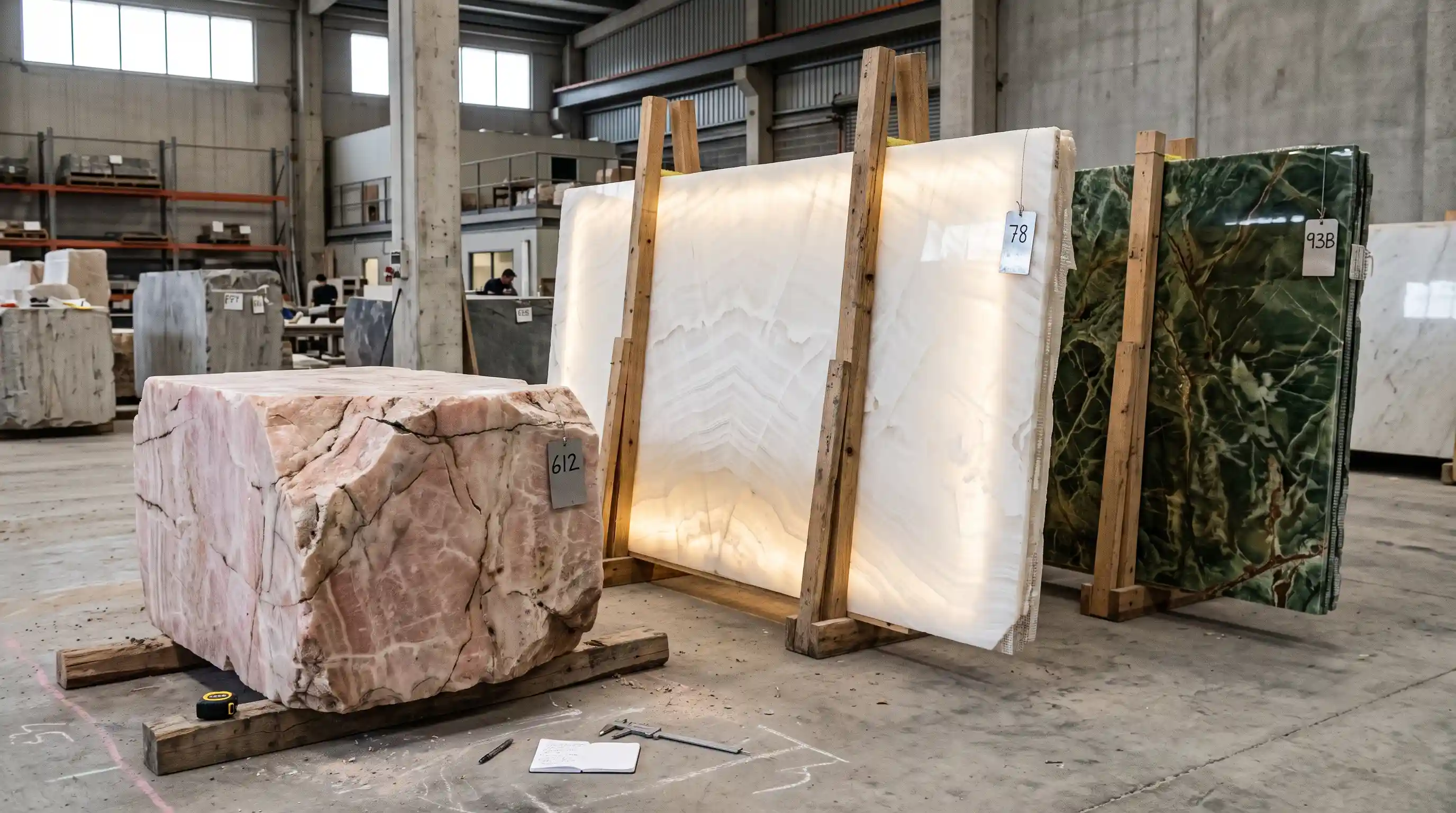
The main risk when selecting an Iran onyx supplier is rarely the absence of stone. The greater risk is that the buyer and seller use different definitions of acceptable color, translucency, veining, natural fissures, polish and variation. A catalogue image can introduce a selection, but it cannot replace current-lot photographs, continuous video, an approved sample, measured dimensions, a quality report and written acceptance criteria.
Coolak International Group reviews and sources Iranian onyx for B2B buyers, importers, distributors and stone-processing factories. The confirmed range includes pink, white and green material supplied as raw blocks, cut slabs and polished finished products. This guide does not rely on broad claims about a universal “best grade.” Its purpose is to turn a vague request into a measurable order. Buyers can use it to select the correct supply format, prepare a useful RFQ, define inspection scope, assess crating and container loading, select a suitable Incoterm and distinguish the responsibilities of a producer, supplier and exporter.
Key Takeaways:
Onyx grade should be defined for the actual lot through color, veining, translucency, fissures, voids, resin, mesh and polish.
Common slab thickness may range from 2 to 3 centimetres, but the contracted thickness and tolerance must be written into the specification and packing list.
General density or absorption figures cannot replace a test report connected to the selected sample or lot.
Effective export packing requires suitable crates, separators, edge protection, moisture control and correct blocking, bracing and lashing.
Every Incoterm should include an exact named place or port, a defined risk-transfer point and clear allocation of costs and inspection duties.
Exporter, supplier and producer describe different functions, even when one company performs more than one of them.
Why Iranian Onyx?
Iranian onyx is relevant to buyers seeking natural stone with distinctive veining, light transmission in many selections and several commercial supply formats. Its commercial value depends on more than color: structural condition, processing quality, cutting yield, packing and shipment planning all affect the final result. Coolak International Group’s confirmed range includes pink, white and green onyx in raw blocks, cut slabs and polished finished products. The correct format depends on the buyer’s processing capability and the project’s final requirements.
Onyx stands apart from many common decorative stones because of its layered appearance and translucent sections. These characteristics make purchasing decisions more sensitive. A modest difference in tone, vein concentration or repaired fissures may be acceptable for one application and unacceptable for another.
“Pink onyx” or “white onyx” is therefore not a complete commercial specification. The enquiry should describe the accepted color range, cutting direction, vein-matching requirement, expected translucency and final use.
A stone-processing factory may value a block that supports its intended cutting plan, acceptable recovery and manageable breakage risk. A slab distributor may care more about saleable dimensions, relative lot consistency, polish and the ability to create matched pairs. A project contractor may prioritise panel layout, dimensional tolerance, edge finish and piece numbering.
A capable supplier needs to identify the buyer’s position in this chain before quoting. A raw-block offer for a processing factory is not equivalent to an offer for numbered, finished slabs intended for an architectural installation. The pricing unit, included processing, inspection scope and buyer risk are different.
Iranian origin should not be presented as a substitute for specification. The stone creates value when the buyer can review the actual selection, accept a realistic range of natural variation, exclude defined defects and receive material that matches the approved sample and order documents.
Types and Commercial Grades of Onyx
Onyx does not have one universal commercial grading label. In a B2B order, grade should be translated into observable and measurable criteria. Base color, accepted color range, vein pattern, translucency, natural fissures and voids, repair quality, thickness consistency and polish are the main parts of this definition.
Coolak’s onyx category page likewise states that catalogue images alone are insufficient for approval. Current-lot images or video, samples, the accepted color range, resin treatment and rejection criteria should be documented.

How Color, Veining and Translucency Affect Selection
Color should be defined as a range rather than a single name. Two slabs within the same color family may differ in intensity, background tone, vein width and mineral markings. For project orders, the permitted range is often more useful than a commercial selection name.
Evaluation photographs should be taken under controlled light. Camera angle, distance and white balance should remain consistent across the slab set. A neutral color reference or the approved sample can be placed in the frame to improve comparison.
Color filters, colored lighting and aggressive contrast adjustments can change the buyer’s interpretation. Images edited for marketing should not be used as the sole approval record.
Veining is not only an aesthetic feature. Direction, concentration and continuity affect cutting orientation, book-matching, wall layout and usable yield. The buyer should state whether the project needs calm, flowing, dense or high-contrast veining and whether mirrored pairs are required.
The term “bookmatch” should be supported by slab numbers and a matching map. Writing the word in a proforma invoice does not prove that every slab can form an acceptable pair. Cutting sequence should be recorded and preserved in numbering, photographs, packing and the slab list.
Translucency should also be reviewed under comparable conditions. A slab may appear relatively opaque under ambient light but contain sections with varying light transmission when illuminated from behind.
For backlit applications, a short continuous video, a light-transmission map and a physical sample provide more information than one front-facing photograph. Light source, color temperature, spacing and support construction affect the installed result. These are project-design variables, not only stone properties.

How Should Commercial Grading Be Structured?
A practical grade is created through a selection acceptance sheet. The sheet records the main criteria in clear language and connects them to a sample, photograph, block number or lot.
Labels such as Premium, A or Commercial are useful only when the seller provides a written definition. Without that definition, two sellers may use the same label for different characteristics. One may grade primarily by color, while another may focus on structural integrity or polish.
Prices cannot be compared accurately until the content of each grade is understood.
First Criterion: Color and Permitted Variation
The buyer can separate color into three bands: preferred, acceptable and rejected. This approach recognises natural variation while protecting the design or resale requirement.
Dark veins, cream or yellow areas, cloudy sections and differences in tone should be described only to the level that matters for the final use.
Variation may be more critical in a large, continuous wall than in independent decorative pieces. In craft products, variation can add visual interest. In a hotel lobby with a planned panel sequence, the same variation may disrupt the composition.
Defining an Acceptance Range for Each Order
An acceptance range should be built with several reference images rather than one perfect image. The perfect image indicates the upper target, while boundary images show which changes remain acceptable.
Natural stone does not repeat like an industrial print. The purpose is not to remove all variation. The purpose is to control variation that would damage the design, processing yield, resale plan or installation.
A highly restrictive selection may reduce recovery and affect the cost or preparation period. This commercial effect should be discussed before the order is accepted.
The Controlling Color and Vein Reference
The controlling reference should include a version number, date, selection name, block or lot number, lighting conditions, approved examples, rejected examples and approval by the responsible party.
It can be attached to the contract as a Quality Appendix. At pre-shipment inspection, the inspector should compare the goods against this record rather than memory, scattered messages or promotional photographs.
Any revision should be issued as a new controlled version. The previous version should not remain active alongside a conflicting replacement.
The Three Confirmed Colors in Coolak’s Product Range
Pink: Intended for buyers seeking warm backgrounds with pink or cream veining. Color intensity and vein distribution should be reviewed across the full lot. The word “pink” does not guarantee uniformity.
White: Relevant to projects where a light background and light transmission are central. Mineral marks, cloudy areas, tonal changes and translucency often require closer control because small differences are more visible on a pale surface.
Green: Suitable for statement applications and designs requiring deeper contrast. The proportion of green, white or brown areas, vein continuity and the ability to coordinate several slabs should be approved before purchase.
The expression “Iranian onyx marble” is commonly used in the market. For commercial documents, the product name should be supported by reference images, supply format, dimensions and technical acceptance criteria so terminology does not become a quality dispute.
How Should Fissures, Voids, Resin and Mesh Be Reviewed?
Onyx may contain natural fissures, voids and structural discontinuities. Their presence alone does not determine the grade. Location, size, frequency, repair method and effect on processing, transport and installation are what matter.
The buyer should distinguish natural veins, closed fissures, open cracks, filled voids, chipped edges and repaired breaks. A broad phrase such as “crack-free” may be unrealistic or open to interpretation for natural stone.
A better criterion can specify the maximum size, number, location and permitted repair method. Different rules may apply to the visible face, edges and areas removed during cutting.
Resin and backing mesh are used to reinforce and prepare slabs. Their presence should be disclosed and workmanship should be checked. Resin staining, detached mesh, incomplete coverage, brittle edges or visible surface penetration can be recorded as non-conformities.
Supply Formats: Raw Blocks, Slabs and Finished Products
The supply format should be chosen according to where processing value will be created. A factory with sawing, calibration, resin, mesh, polishing and waste-control capability may prefer raw blocks. A distributor or project with limited processing capacity may prefer slabs or finished pieces.
Coolak’s confirmed range includes raw blocks, cut slabs and polished finished products.
Supply format | Best suited to | Main controls | Principal risk |
Raw blocks | Stone factories and processors | Dimensions, weight, vein direction, fissures, corners and cutting recovery | Hidden internal defects and uncertain recovery |
Cut slabs | Distributors, workshops and projects | Thickness, dimensions, resin, mesh, polish, numbering and vein matching | Transport breakage or lot variation |
Finished products | Projects with final drawings | Tolerance, edge work, drilling, layout, piece coding and packing | Mismatch with installation drawings or edge damage |
When Does Buying Raw Blocks Make Sense?
Raw blocks are suitable when the buyer can evaluate and process them and is prepared to manage cutting-yield risk. External dimensions are only one part of the review.
Layer direction, open and closed fissures, filled areas, broken corners, irregular geometry and the proportion of usable material should be assessed. Scale weight, volume-measurement method and dimensional tolerance should be agreed in advance.
If the price is based on weight, the controlling scale and weighing point matter. If the transaction uses cubic metres, the method used for irregular blocks should be written into the offer.
Block inspection should include photographs of every face, continuous video, close views of fissures and a unique identification number. If the offered blocks come from several quarry faces or lots, that mixture should be disclosed.
The buyer may request a suggested cutting direction or a photograph of a trial face. Surface evidence cannot eliminate every internal defect. Internal risk should remain part of the purchase decision, price and production plan.
Cutting recovery should not be guaranteed without a clear basis. Machine type, blade thickness, cutting orientation, block structure and finished-product acceptance rules all affect output. Any estimate should state its assumptions.
What Are the Advantages of Buying Slabs?
Slabs move a substantial part of initial processing risk away from the buyer because the surface, veins, many fissures and finish can be seen before shipment. Packing sensitivity and transport cost become more significant.
Every slab should carry a unique number. Dimensions, thickness and visible condition should appear in a slab list. For book-matched projects, cutting sequence and pairs should be preserved.
Photographs should display each slab number clearly. A general warehouse video is useful for context but cannot replace individual slab records.
Resin and mesh should be assessed for continuity, appearance, staining and their reinforcing purpose. Resin treatment is not automatically evidence of low quality. The issue is whether the treatment matches the agreed specification and whether repaired areas have been disclosed.
The buyer should define accepted levels for open fissures, filled voids, edge breaks and patches. A distributor may agree to several quality groups, but each group needs a written definition before invoicing.
What Information Is Needed for Finished Products?
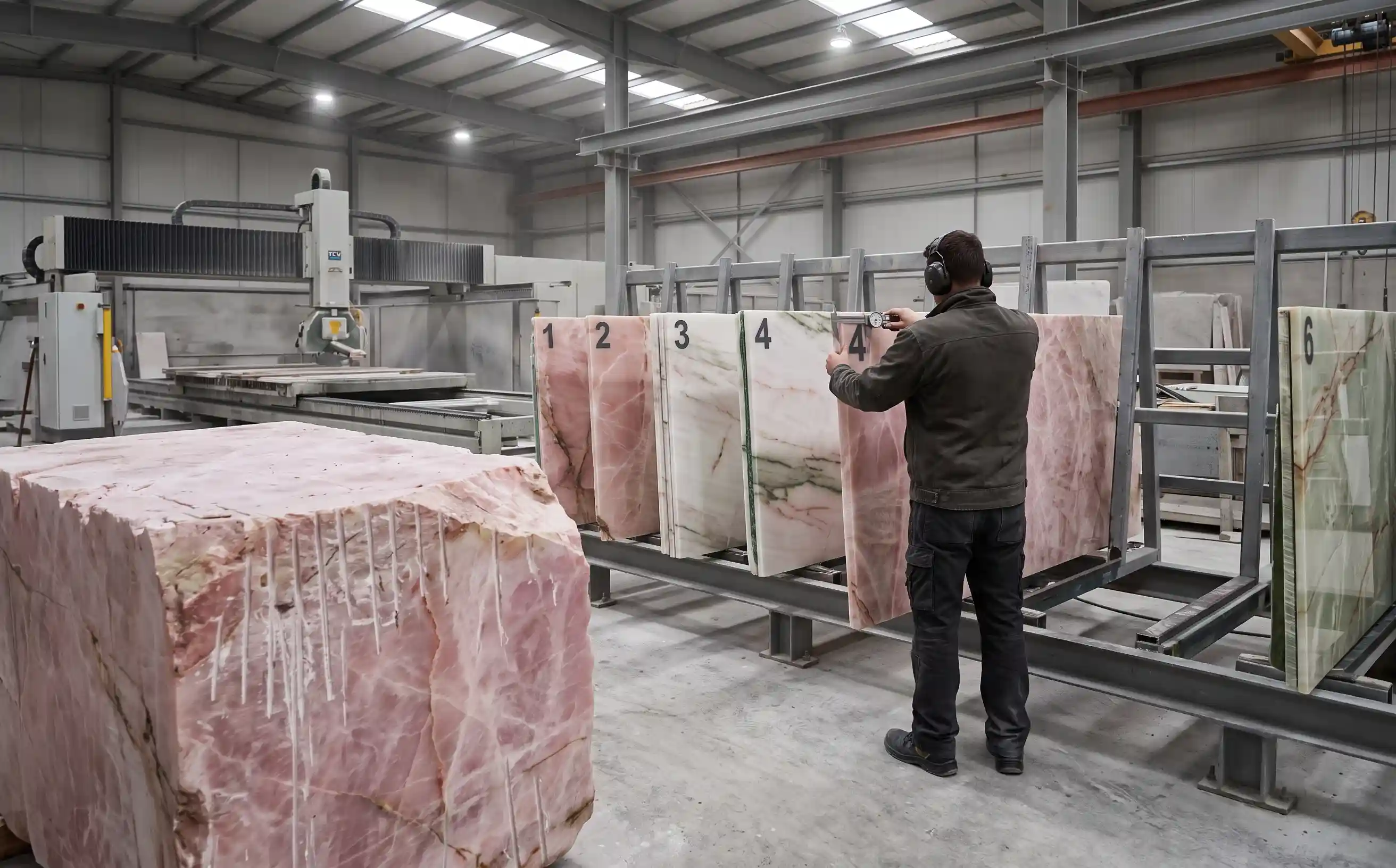
For finished pieces, production and packing drawings form part of the product specification. Length, width, thickness, angle, edge profile, drilling position, visible face, vein direction and installation code should appear in drawings or a cutting list.
Similar pieces should be coded so the installation team can reconstruct the layout. A crate map should identify where each item is packed, reducing the need to open every crate at the site.
A color and polish sample does not confirm dimensional production. A first article or dimensional prototype can be inspected before the full order is processed. This step helps prevent the repeated production of an incorrect cut, edge or hole position.
Technical Specifications for Export Onyx
Technical data should be connected to an actual sample or lot. General figures are useful for early comparison, but they should not be inserted into a contract as a guarantee for every shipment.
Coolak’s product content describes a general density range of approximately 2.6 to 2.8 grams per cubic centimetre and a common slab thickness of 2 to 3 centimetres. Final values should be controlled through testing, shipment measurements and contracted tolerances.
Parameter | What to request | Why it matters |
Density | Result for an identified sample, test method and unit | Weight estimation, packing design and selection comparison |
Water absorption | Report for the selected sample or lot | Material comparison and project requirements |
Slab thickness | Nominal thickness, tolerance and measurement method | Installation, weight, pricing and panel alignment |
Dimensions | Invoiceable length and width, tolerance and method | Usable area and cutting plans |
Polish | Approved sample, surface consistency and defect limits | Visual acceptance |
Resin and mesh | Treatment description and back-face images | Transport strength and processing disclosure |
Fissures and voids | Measurement or rejection criteria | Consistent inspection decisions |
Mechanical properties | Project-specific test requirements | Engineering assessment of the final use |
How Should Density Be Used?
Density assists with early weight estimates and sample comparison. Commercial shipment weight should still be based on actual dimensions, thickness, piece count and an agreed weighing method.
Using one general density number for the packing list can create weight discrepancies, unsuitable vehicle selection or poor container load distribution. Net stone weight, crate tare and gross weight should be separated.
A laboratory report should identify the block or lot from which the specimen was taken. A result from an unrelated selection has limited evidential value for a new shipment.
Test date, laboratory identity, method and unit are part of the report’s reliability. A figure without this information should be treated as an indicative statement rather than a shipment certificate.
Why Should Water Absorption Not Be Stated as One Fixed Number?
Water absorption varies among stones and can vary within a natural source. ASTM C97/C97M covers methods for determining absorption and bulk specific gravity of dimension stone. It is useful for comparing samples, but the result must be tied to the material tested. This guide therefore does not declare one guaranteed water-absorption value for all Iranian onyx.
When water absorption is a design or acceptance requirement, the buyer should define the limit, test method, number of specimens, sampling location and laboratory in the contract.
“Low water absorption” without a figure, method and report is not a complete technical specification. One small specimen should not automatically represent a large or visibly mixed lot. The sampling plan must reflect the material’s variation.
How Should Polish Be Evaluated?
A good polish is more than a high-gloss appearance. The surface should be examined under raking light for waves, sanding lines, burn marks, resin halos, stains, local gloss differences and chipped edges.
When a gloss-meter value is required, the instrument, measuring angle, number of readings and acceptance range should be defined. In many orders, an approved physical sample combined with controlled visual inspection is more useful than a single reading.
Two slabs can produce similar gloss readings but look different because of surface waviness, resin or vein direction. A polish report can therefore combine measurements with raking-light photographs.
Protective surface materials should be compatible with the stone, resin and installation process. Film or adhesive should not create staining or residue. Removal procedures should be tested before full production.
What Is the Standard Slab Thickness?
Coolak’s product content identifies 2 to 3 centimetres as a common slab-thickness range. “Common” does not mean mandatory in every market.
The buyer should define nominal thickness, positive and negative tolerance and measurement points. A nominal 20-millimetre slab may vary across its surface; acceptance should follow the contracted tolerance.
Measurements taken near an edge and in the centre may differ, so the procedure should be consistent. The inspection report should record the instrument and number of points checked.
For finished panels, the parties should clarify whether thickness is measured after calibration, resin, mesh or back treatment. Lightweight systems, laminated panels or special fixings require confirmation by the designer and processor rather than reliance on a generic recommendation.
Which Other Tests May Be Relevant?
Test selection depends on the application. ASTM C170 covers determination of the compressive strength of dimension stone. Flexural, abrasion or anchorage tests may be relevant to certain engineered applications, but every test is not required for every decorative-stone purchase.
The project architect, engineer or consultant should identify critical properties. A supplier should not present a general test result as a substitute for project-specific engineering approval.
Export Packing and Shipping
Onyx packing has two jobs: protecting the finished surface and controlling the movement of a heavy cargo unit throughout transport.
An attractive but weak crate can fail. Excessive restraint applied to a fragile edge can also cause damage. Packing design should match product format, unit weight, handling method, container type, route and unloading equipment.
The packing specification is part of the product and contract. It should not be left as an undefined activity performed after production.
Crating Blocks, Slabs and Finished Pieces
Raw blocks need a stable arrangement that prevents movement, rolling and concentrated loading. Contact points should distribute weight over suitable areas. Chains or straps should not impose damaging point loads on vulnerable corners.
Slabs are commonly placed on a suitable A-frame or engineered support. Separators should not scratch the polished face or trap moisture. Edge protection, lateral restraint, longitudinal restraint and safe lifting access are required.
Book-matched sequence and slab numbering must be preserved during packing. Each crate list should identify its slab numbers, and gross weight should appear on the crate and packing list.
Finished pieces require layered protection and an unpacking plan. A piece needed first at the installation site should not be inaccessible beneath several unrelated layers.
Crate code, piece codes, gross weight, correct orientation and handling instructions should remain legible and consistent with the commercial documents.
What Does Moisture Control Require?
Moisture control is not limited to placing desiccant inside a crate. Wet timber, residual wash water, temperature changes, poor ventilation and fully sealed wrapping can all contribute to condensation.
Stone surfaces should be dry before packing. Contact materials should not transfer color or hold moisture against the polished face. Protective films need to be checked for compatibility with resin, polish and voyage duration.
The IMO/ILO/UNECE CTU Code warns that poor packing, weak securing, concentrated loading and inadequate humidity control can damage cargo and transport equipment. It specifically recognises stone as one of the heavy and bulky cargoes carried in cargo transport units.
Wood Packaging and ISPM 15
When crates or dunnage use raw wood, the destination’s ISPM 15 requirements must be checked. The standard defines phytosanitary measures intended to reduce pest risks associated with raw-wood packaging and includes dunnage. Processed wood such as plywood may be treated differently under the standard.
A compliance mark should not be applied without valid treatment and authorisation. The buyer should state the destination’s wood-packaging requirement in the RFQ.
The seller should identify the crate material, construction method and party responsible for compliance. The broad phrase “export packing” does not replace these details.
A packing inspection can record the ISPM 15 mark on each relevant crate and connect the photograph to the crate number.
Loading the Container
Container selection should not be based only on dimensional fit. Permitted mass, floor point loading, centre of gravity, lifting capacity, loading method and inland transport restrictions must be reviewed.
Heavy cargo should not be concentrated in one small area or stowed asymmetrically. Blocking, bracing and lashing should control longitudinal, lateral and vertical movement. Qualified personnel should design and execute the securing arrangement.
The empty container should be checked for floor damage, wall and roof condition, door operation, lashing points, contamination, moisture and unusual odours. A damaged or leaking container should not be accepted only because the shipping schedule is tight.
Before the doors close, a loading report can record the empty container, floor and walls, container number, seal number, crate sequence, securing points and final stow.
This report is not a replacement for cargo insurance or contractual responsibility, but it supports operational control and later damage investigation.

Incoterms and Iranian Export Ports
The appropriate Incoterm should follow the actual transport method and operational handover point rather than market habit.
Incoterms® 2020 contains 11 rules that allocate obligations, costs and risk between seller and buyer. The rule name is incomplete without an exact named place or port. A contract should state, for example, “FCA [exact location] Incoterms® 2020” or “CIF [exact destination port] Incoterms® 2020.”
FCA, FOB, CFR or CIF?
FCA can be considered for containerised and multimodal movements because delivery takes place when the goods are handed over at the agreed place or point. ICC guidance identifies FCA as suitable for multimodal transport, including container operations.
The named point should be precise: factory, warehouse, terminal or another location where delivery can be evidenced. “FCA Iran” is too broad.
FOB applies to maritime delivery when the goods are placed on board at the port of shipment. For containerised cargo, the seller often hands the container to a terminal before it reaches the vessel. Automatic use of FOB can create a gap between the physical operation and the contractual delivery point.
The parties should review that gap with their freight forwarder and contract adviser.
CFR and CIF require the seller to arrange and pay carriage to the named destination port. Under the C rules, however, risk transfers at origin upon the defined delivery event rather than when the cargo arrives safely at destination.
Under CIF, the seller also provides cargo insurance according to the rule’s requirements. Buyers should understand the difference between the seller paying freight and the seller carrying voyage risk.
A D rule such as DAP may be considered when the seller accepts transport responsibility and risk to a named destination point. Practical use depends on destination regulations, import clearance, inland access and the seller’s operational capability.
The Incoterm should be selected before the final price because it changes origin charges, freight, insurance, terminal costs and documentary responsibilities. Two quotations under different Incoterms should be compared through total landed cost.

How Is the Export Port Selected?
No single Iranian port can be declared correct for every onyx order. Quarry or processing location, cargo weight and dimensions, inland access, carrier schedules, container type, destination, terminal charges and loading capability all affect the decision.
For containerised sea shipments, Shahid Rajaee in the Bandar Abbas port area may be one route considered during freight enquiries. It should be written into the contract only after a current routing quotation and operational check.
The presence of a port in the container network does not prove that it is the best route for every stone shipment.
Factory-to-port distance is not only a kilometre calculation. Road conditions, axle-load restrictions, heavy-transport permits, crane or forklift access and the number of handling events affect cost and breakage risk.
For neighbouring markets, road or combined transport may be more appropriate. The delivery place, border terminal, transit responsibility, vehicle permits and weight restrictions should be written into the commercial proposal.
The final decision should compare total landed cost, transit time, breakage exposure, handling frequency and the ability to control loading. The lowest headline freight rate may not produce the lowest final cost.
What Should a Freight Proposal State?
The proposal should separate:
loading place and delivery point under the Incoterm;
container or vehicle type and weight limits;
responsibility for loading, securing, VGM where applicable and sealing;
origin charges, main freight, insurance and destination charges;
free time, demurrage and detention where relevant;
potential routing or transshipment;
export and import documentation requirements;
insurance scope and exclusions related to breakage or inadequate packing;
claim procedure and notification deadline.
An Incoterm is not a contract of carriage or an insurance policy. The sales contract must still address product specification, packing, inspection, payment, timing, title, claims and dispute resolution.
Quality Certificates and Pre-Shipment Inspection
A quality certificate is useful only when it states what was inspected, when, by which method and by whom. A generic sheet without a lot number, block number, slab numbers or shipment connection cannot settle a dispute about color, thickness or packing condition.
Inspection scope should be agreed before final processing or packing. Introducing new criteria after crating may create rework, delay and additional breakage risk.
Suggested Document Package
Depending on the contract and destination, the document package may include a commercial invoice, packing list, certificate of origin, block or slab list, internal quality report, photographs and video, loading report, laboratory results and a third-party inspection certificate.
Coolak’s product information states that standard export documents and laboratory analysis of density, porosity and chemical composition may be provided on request. The exact scope must be confirmed in the offer and contract for the individual transaction.
A stone packing list should contain more than the number of crates. Crate number, piece count, dimensions, area or volume, net and gross weight, slab numbers and invoice relationship should be consistent.
For raw blocks, the volume and weight calculation method matters. For slabs, the invoiceable area and treatment of irregular edges should be clear. For finished pieces, quantity and piece codes should match the drawings and crate map.
Which Inspection Stages Should Be Used?
Inspection can be divided into control gates:
Source and selection approval: Review the block or lot, color, veining and permitted variation.
Sample approval: Approve a coded polished sample or trial face.
In-process control: Check thickness, resin, mesh, cutting sequence and numbering.
Final product inspection: Check dimensions, face, fissures, voids, polish, quantity and slab-list conformity.
Packing inspection: Check crate construction, separators, edge protection, markings and weight.
Loading supervision: Check the container, load distribution, securing, seal and final photographic record.
A third-party inspection company such as SGS or another appointed inspector should be named in the contract only after the parties agree on the company, place, time, cost, scope and contractual effect of the result.
The inspector’s name does not guarantee quality by itself. The inspection instruction needs measurable criteria. An inspector cannot determine whether a slab is “beautiful enough” without an approved color and vein reference.
Acceptance Criteria and Claims
The contract should identify which deviations are minor, major or critical and define the sampling method. Permitted defect levels, replacement procedure, corrective action or price adjustment should be clear.
Pre-shipment approval may settle some visible-quality matters, but it should not remove responsibility for hidden defects, non-compliant packing or documentary discrepancies unless the contract expressly provides for that result.
The claim period should match the time required for unloading and destination inspection. Before opening a visibly damaged crate, the buyer should photograph the condition, record the seal and container and obtain any survey required by the insurance policy or contract.
The seller should retain packing and loading records. Without pre-shipment evidence, identifying when and how damage occurred becomes more difficult.
Producer, Supplier and Exporter Are Different Roles
Producer, supplier and exporter are not synonyms. Separating these roles helps the buyer understand who is accountable for production, selection, processing, commercial documents and delivery.
Role | Principal function | Buyer’s key question |
Producer | Extracts or processes blocks, slabs or finished products | Which production stage is under your direct control? |
Supplier | Finds, matches and coordinates material against the RFQ | How do you verify the source, selection and execution capability? |
Exporter | Executes export documentation, formalities and shipment coordination | Which legal entity issues the documents and performs delivery? |
An onyx producer may not have direct export capability. An exporter may not own a quarry or processing factory. A supplier may review several producers and coordinate the option that fits the buyer’s requirements.
The relevant question is not how many titles a company displays on its website. The relevant question is whether its real role, authority and responsibility can be established in the contract.
The buyer should verify the legal contracting entity, authority to sell, cargo location, relationship with the quarry or factory, inspection access, bank account, invoice issuer and party responsible for delivery.
When several companies are involved, document and payment flows must be clear. Payment to a party without a defined position in the contract or invoice can create commercial and compliance risk.
A supplier may create value through source comparison, information verification, sample coordination, processing management, inspection design and commercial structuring. This role should not be misrepresented as quarry ownership when ownership has not been established.
Onyx RFQ and Purchasing Checklist
A useful RFQ requires measurable answers. “Please quote your best white onyx” is not enough for an accurate commercial offer.
A stronger enquiry identifies the application, supply format, color range, dimensions, thickness, quantity, destination, target timing, inspection method and preferred Incoterm.
Product Information
Color: pink, white or green;
reference photograph or approved sample;
supply format: raw block, cut slab or polished finished product;
cutting direction and book-match requirement;
dimensions and tolerances;
nominal thickness and tolerance;
polish or finish;
permitted fissures, voids, resin and mesh treatment;
required quantity and measurement method;
final application and installation conditions.
Commercial and Logistics Information
destination country and city;
proposed port or delivery place;
Incoterm and version;
preferred transport mode;
target timing, subject to feasibility confirmation;
buyer’s import-document requirements;
destination requirement for ISPM 15;
third-party or buyer inspection;
proposed payment method for negotiation;
cargo-insurance requirement and coverage level.

Recommended Decision Process
The buyer first submits a complete RFQ. The supplier confirms sourcing feasibility, available selections and possible supply formats. Current-lot photographs, samples or a site visit are then reviewed.
The buyer and seller record acceptance criteria in a technical appendix. The commercial offer and Incoterm are completed around the actual transport route. Contract, inspection, payment and claim terms are aligned with the same technical structure.
After final approval, processing, packing and loading follow the agreed control gates. Each report should connect to the order, lot and cargo items.
This order of decisions prevents a common mistake: agreeing a price before agreeing what the price describes. A selected slab, a commercial mixed lot and a raw block with cutting risk are not equivalent. Offers should be compared on a like-for-like basis.
Contract Clauses for an Onyx Transaction
An onyx contract should recognise natural variation without turning that variation into permission to supply any quality. Balance is created through an accepted range, controlling sample, inspection method and remedy for non-conformity.
The technical appendix may include the selection name, reference images, block or lot number, supply format, dimensions, thickness, tolerance, polish, resin and mesh limits, fissure and void criteria, measurement method and packing specification.
Any approved change should be recorded through a written change order. A new image or verbal instruction should not alter the order without defining its effect on price, timing and quality.
The inspection clause should define place and time, inspector access, sampling method, acceptance criteria, non-conformity record and the effect of inspection on payment release or shipment.
The claim clause should distinguish visible defects, hidden defects, transport breakage and documentary discrepancies. The Incoterm establishes a risk-transfer point, but responsibility for packing that breaches the contract or for inaccurate documents is a separate matter.
Payment structure should correspond with control points. This guide does not prescribe one fixed payment method because the appropriate structure depends on party credit, countries, banking access, order value, processing time and available instruments.
The objective is to balance the buyer’s financial commitment with credible evidence of order progress. Payment stages may be connected to verifiable events such as sample approval, processing completion, inspection or document presentation, subject to a transaction-specific review.
Complete the Commercial Decision Before Signing
Coolak International Group was founded in 2017 on the belief that transaction success is often decided before the contract is signed. In an onyx purchase, incomplete selection information, unverified parties, vague quality criteria and an unsuitable delivery structure can turn an attractive material into a high-risk transaction.
Review available Iran onyx blocks and slabs, examine Coolak onyx marble specifications and place the material within the wider Iranian natural stone export range.

State the color, supply format, dimensions, thickness, quantity, destination, inspection requirement and proposed Incoterm when you request an onyx supply quote. This information allows sourcing feasibility and the execution structure to be assessed against the actual requirement.
When the order needs a technical appendix, inspection clause, responsibility matrix, payment structure or claim mechanism, Coolak’s international export contract structure service can support the decision before final commitment.
Secure Trade Begins with Better Decisions.

Need product guidance?
Contact our team for specifications, availability, and pricing details.