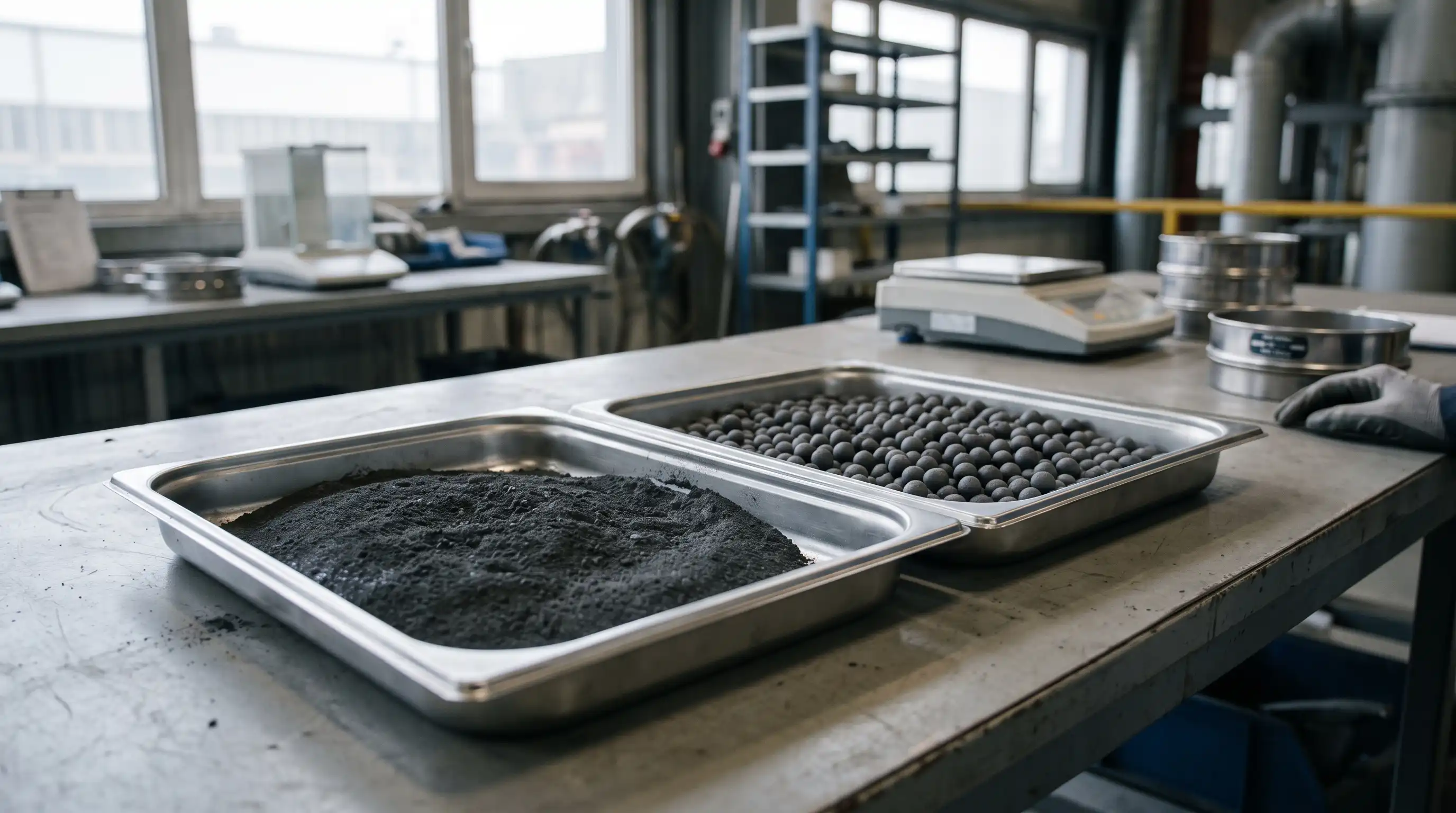
The main difference in iron ore pellets vs concentrate is their physical form and position in the steel raw-material chain. Iron ore concentrate is a fine product created by beneficiation, which upgrades the iron-bearing portion of ore and reduces unwanted gangue. Pellets are produced further downstream by forming suitable fine iron ore feed into green pellets and then indurating them to create stronger, more consistent units.
As a result, pellets are generally closer to furnace-ready burden material. Fine concentrate normally needs agglomeration or additional preparation before conventional blast-furnace or shaft-based direct-reduction use. That does not make pellets universally better. The correct choice depends on the steel plant's process route, chemical and physical specification, handling requirements and commercial terms.
Key Takeaways
A plant with pelletizing capacity may evaluate concentrate; a shaft-based DR plant seeking prepared feed will normally focus on appropriately specified DR-grade pellets.
Fe should be reviewed together with SiO₂, Al₂O₃, moisture, particle size and other relevant product parameters.
DR-grade and BF-grade pellets are not automatically interchangeable.
A valid commercial comparison must match the product specification and downstream process before comparing price.
Iron Ore Pellets vs Concentrate: Side-by-Side Comparison
The table below summarizes the practical differences that matter most to technical and commercial buyers:
Factor | Iron Ore Concentrate | Iron Ore Pellets |
|---|---|---|
Physical form | Fine particulate material | Formed and indurated units |
Processing stage | Beneficiation product | Downstream agglomerated product |
Typical role | Feed for pelletizing or other agglomeration routes | More furnace-ready iron-bearing burden, depending on grade |
Particle form | Fine particles with product-specific size distribution | Relatively consistent pellet form |
Fe / gangue | Product-specific | Product-specific; DR grades generally require tighter gangue control |
BF suitability | Fine concentrate usually requires appropriate preparation or agglomeration before conventional BF charging | BF pellets may form part of the burden |
DR suitability | Fine concentrate normally requires further preparation for shaft-based DR | Suitable DR-grade pellets can feed shaft-based DR |
Mechanical strength | Not described by pellet-strength tests | CCS, tumbler and abrasion properties may be specified |
Moisture relevance | Important for certain fine-cargo transport classifications | Standard iron ore pellet schedules are treated differently under IMSBC |
Processing value | Earlier processing stage | Includes pelletizing and induration |
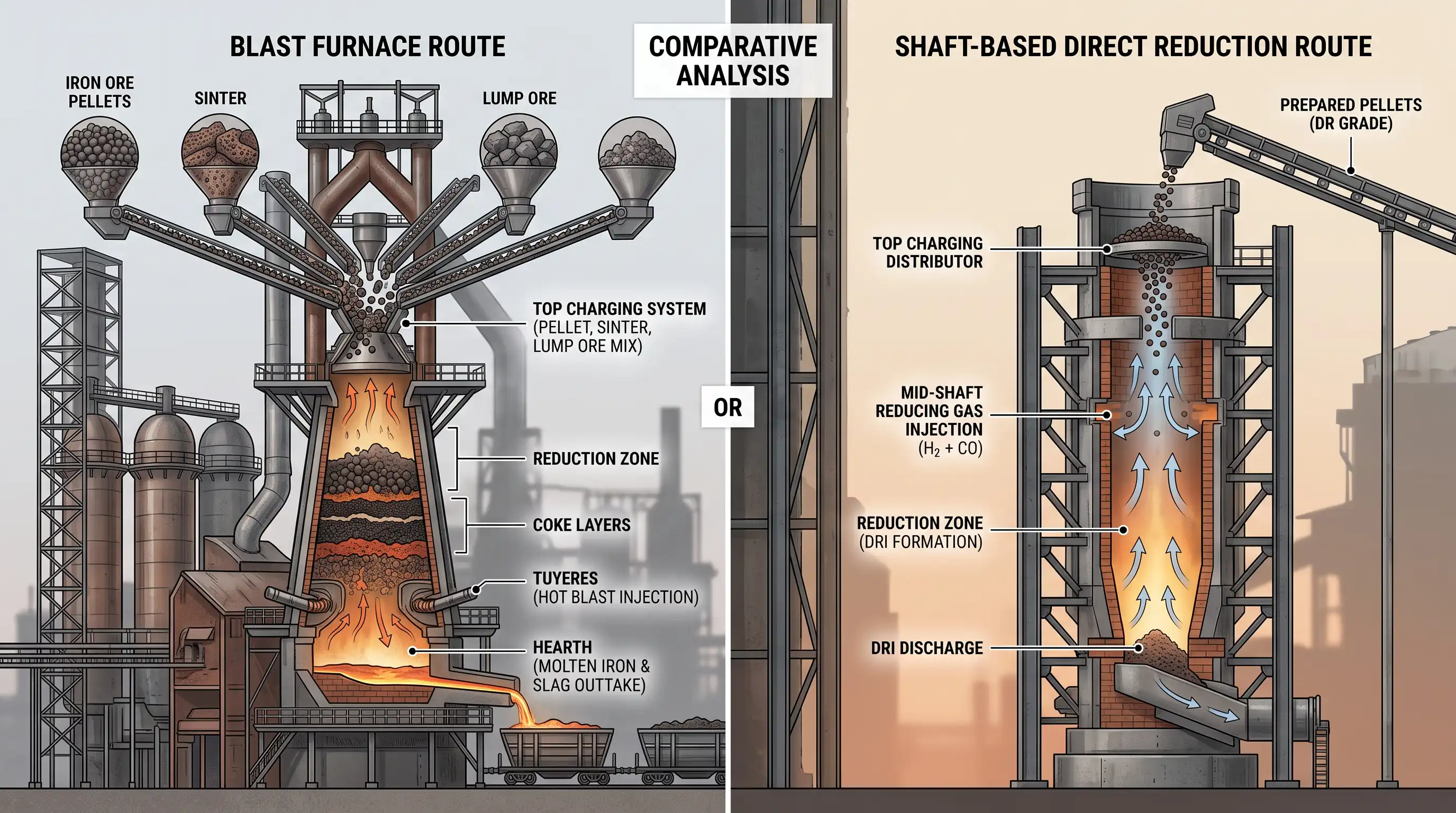
A blast furnace does not have one universal iron-bearing feed mix. Industrial BF burden can include combinations of sinter, pellets and lump ore depending on plant practice.
What Is Iron Ore Concentrate?
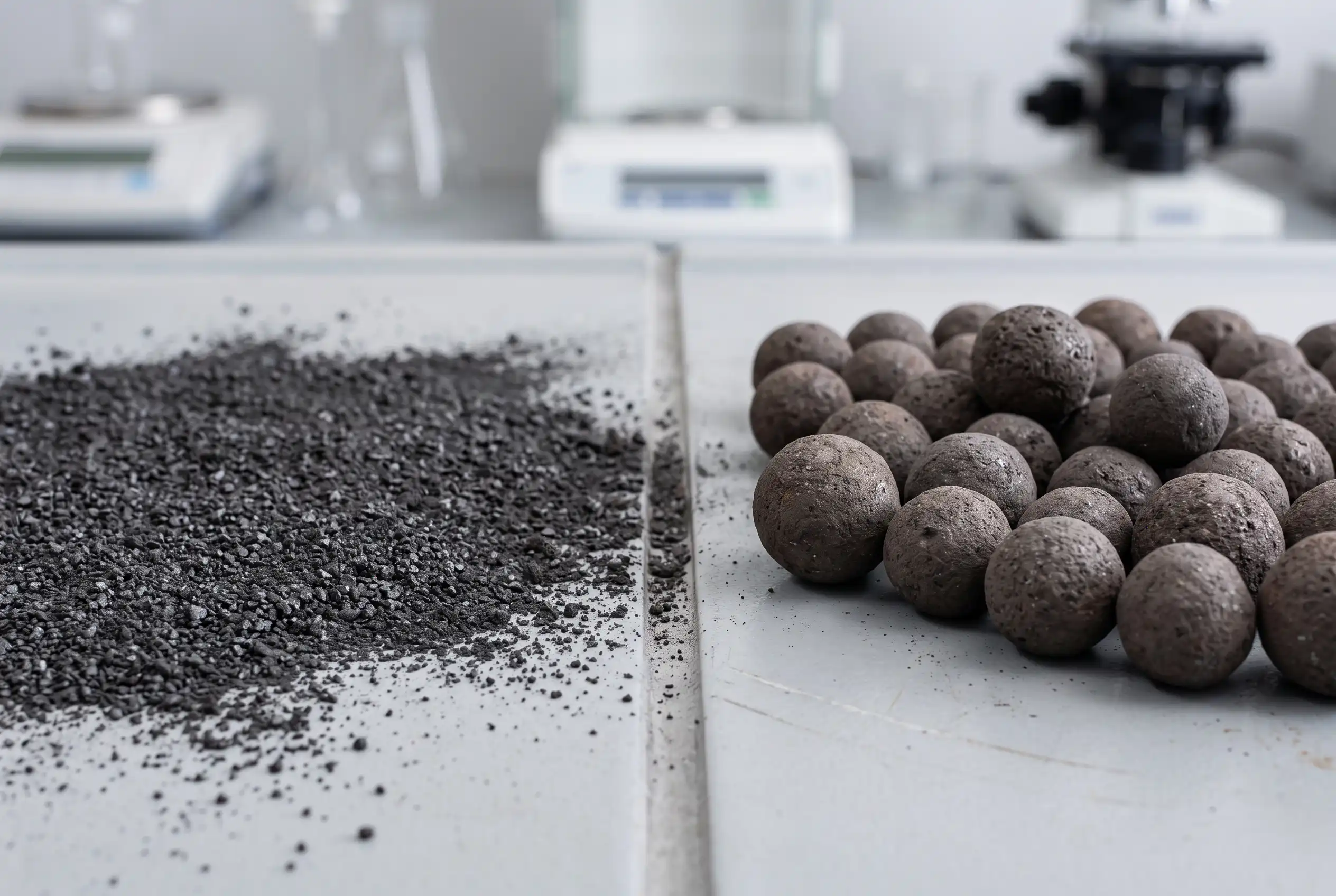
Iron ore concentrate is the fine product obtained after beneficiation of iron ore. The ore is crushed and ground, then processed through a beneficiation route suited to its mineralogy to increase the proportion of valuable iron minerals and reduce part of the unwanted gangue.
The resulting material is normally fine-grained. Its chemistry is not fixed: Fe, SiO₂, Al₂O₃, phosphorus, sulfur and other components vary with the orebody and processing route. For that reason, the term “iron ore concentrate” by itself is not a sufficient purchasing specification.
Concentrate can serve as feed for pelletizing or other agglomeration routes. A more accurate technical statement than “concentrate can never be fed to a furnace” is that fine iron ore concentrate generally requires agglomeration or further preparation before use in conventional blast-furnace or shaft-based direct-reduction routes.
This distinction matters commercially. Concentrate sits earlier in the processing chain than pellets, so a buyer must understand what preparation will occur between receiving the concentrate and charging iron-bearing material into the downstream process.
What Are Iron Ore Pellets?
Iron ore pellets are formed agglomerates produced from suitable fine iron ore feed. During pelletizing, the fine material is formed into green pellets; induration then develops the mechanical integrity needed for subsequent handling and furnace use.
Pelletizing changes more than appearance. It turns a fine feed into relatively consistent units whose chemical, physical and metallurgical properties can be specified for downstream use. The exact characteristics depend on the feed, additives, processing route and target application.
BF-grade and DR-grade pellets therefore should not be treated as identical products. Chemistry, gangue, size distribution, strength and other relevant properties need to match the intended furnace route.
This comparison article keeps pellet-specific procurement detail at a high level. For COA assessment, inspection points and detailed pellet specifications, see the iron ore pellet sourcing guide.
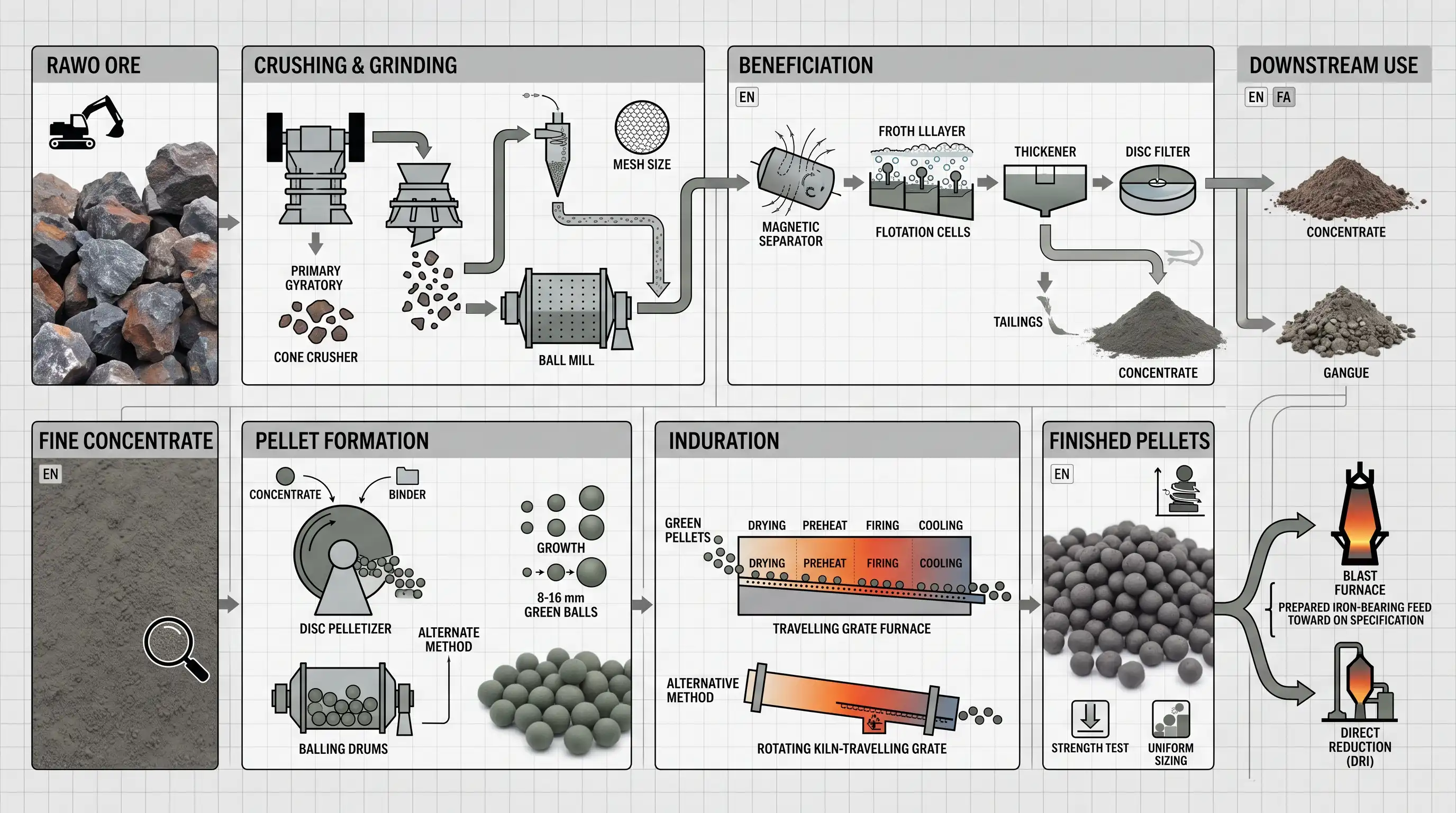
How Are Concentrate and Pellets Produced Differently?
The two materials occupy different points in the same processing chain:
Iron Ore → Crushing/Grinding → Beneficiation → Concentrate → Pelletizing → Induration → Pellets
For concentrate, beneficiation aims to increase valuable iron content, reduce unwanted gangue and produce a fine feed suitable for the next processing stage.
For pellets, pelletizing converts suitable fines into formed units. Green pellets are then indurated so they develop the physical integrity required for handling and downstream furnace charging.
The distinction is therefore not simply powder versus spheres. Pellets have undergone an additional downstream agglomeration and heat-treatment stage.
Iran's domestic steel value chain includes iron ore mining, concentration, pelletizing, direct reduction and steelmaking operations. Specific company-to-company supply relationships, however, should be verified separately rather than assumed from the general structure of the industry.
How Do Their Technical Specifications Differ?
A useful specification reflects the physical nature and intended use of each material. Several chemical parameters apply to both, while pellet products also require properties associated with formed units.
Concentrate Parameters
Common concentrate parameters include:
Fe content: important, but not a complete quality measure.
SiO₂ and Al₂O₃: key indicators of gangue chemistry.
Phosphorus and sulfur: relevant where required by the downstream process or contract.
Moisture: commercially and logistically significant.
Particle-size distribution: important for compatibility with the next processing stage.
Other parameters: should be included only when relevant to the specific ore, process and specification.
Pellet Parameters
Pellet specifications may include:
Fe and gangue chemistry
moisture
pellet size distribution
CCS, or Cold Crushing Strength
Tumbler Index
Abrasion Index
additional metallurgical properties where the purchasing specification requires them
A higher Fe number does not by itself prove that one shipment is better for a particular plant. Chemistry, physical properties and process compatibility have to be reviewed together.
Are DR and BF Pellets the Same?
No. DR-grade and BF-grade pellets are not universally interchangeable.
In direct reduction, a liquid slag phase does not remove gangue during the reduction step. Much of that gangue remains with the reduced iron and later contributes to slag during downstream melting. Lower SiO₂ and Al₂O₃ are therefore particularly valuable in DR feed. MIDREX describes the effect of higher gangue on downstream slag volume, power demand and iron losses.
As an illustrative commercial reference rather than a universal standard, MIDREX technical material describes DR-grade pellets at about 67% Fe or higher and typical BF-grade material at lower Fe levels. Actual acceptance limits must come from the producer's specification, plant requirements and contract.
Which Material Is Used in Blast Furnaces?
Pellets are one furnace-ready iron-bearing burden used in blast furnaces, but they are not the universal or exclusive BF feed.
Conventional BF burden can contain sinter, pellets and lump ore in proportions determined by plant design, raw-material availability and operating practice. A worldsteel case study, for example, describes a BF burden using all three forms.
Fine concentrate is generally not charged into a conventional blast furnace in its original powder-like state. It usually requires an appropriate preparation or agglomeration route to create feed with physical properties suited to the burden.
For procurement, the relevant question is not “Does a blast furnace use pellets?” but “What burden design and specification does this specific blast furnace require?”
Which Material Is Used in Direct Reduction?
For many conventional shaft-based direct-reduction routes, appropriately specified DR-grade pellets are a common iron oxide feed.
The requirements go beyond Fe content. Physical integrity, reducibility and gangue chemistry can affect shaft performance and the quality of the reduced product. MIDREX technical work discusses the use of oxide pellets and lump ore in shaft-based DR and the effect of gangue on downstream DRI/HBI melting.
Fine concentrate normally requires additional preparation before it can serve this role in a conventional shaft furnace.
Not every direct-reduction technology uses exactly the same feed form. Buyers should therefore match the material to the specific DR technology and plant specification instead of applying one feed rule to every DR process.
How Do Shipping and Moisture Risks Differ?
The shipping distinction depends on the cargo's physical characteristics and its applicable IMSBC Code schedule.
Under the 2023 IMSBC amendments, IRON CONCENTRATE, IRON CONCENTRATE (pellet feed), IRON CONCENTRATE (sinter feed) and IRON ORE FINES are listed as Group A, while IRON ORE PELLETS are listed as Group C. Group A covers cargoes that may present a liquefaction hazard when shipped with moisture above the relevant transportable limit.
That distinction should not be rewritten as “pellets have no shipping risk.” The Iron Ore Pellets schedule still contains cargo-specific provisions.
IMO adopted IMSBC amendment 08-25 in June 2025, including a revision to the Iron Ore Pellets schedule. The amendments may be applied voluntarily from January 1, 2026 and are scheduled to enter into force on January 1, 2027.
For an actual shipment, the shipper, carrier and other responsible parties should use the applicable Code edition, correct Bulk Cargo Shipping Name and shipment documentation. This comparison is not an operational cargo-handling procedure.
Are Pellets More Expensive Than Concentrate?
Pellets have undergone additional processing and may trade at a premium to suitable concentrate feed, but the price difference is not fixed.
Commercial value depends on factors such as Fe content, gangue chemistry, pellet grade, processing economics, market conditions, origin, freight, energy costs and contractual terms.
For a buyer with pelletizing capability, a lower concentrate purchase price does not by itself prove a lower total cost. Conversion cost, energy, yield, capacity constraints and logistics also matter. Conversely, a more processed pellet is not automatically the economically superior option.
For that reason, a fixed pellet premium or live price comparison would not provide a reliable decision rule in an evergreen comparison article.
Which Should a Steel Buyer Choose?
The more relevant product depends on the buyer's downstream process:
Buyer / Plant Situation | More Relevant Material |
|---|---|
Plant has pelletizing capability | Concentrate may be relevant |
Shaft-based DR plant requiring prepared feed | Appropriate DR-grade pellets |
BF using pellet burden | BF-grade pellets matched to burden design |
Buyer seeking upstream fine feed | Concentrate |
Buyer seeking more processed furnace-ready units | Pellets |
This is a decision framework, not a purchasing specification.
Final selection requires alignment across chemical specification, physical specification, plant route, handling requirements and contractual requirements.
If those factors are not matched first, two offers with different prices may not represent commercially equivalent materials.
What Should Buyers Check in the Specification?
Before comparing offers, the buyer should establish exactly what product is being offered, how it will be tested and what constitutes acceptance.
At a high level, review:
Fe content
SiO₂ and Al₂O₃
moisture
size distribution
relevant impurities such as phosphorus or sulfur
pellet mechanical properties where applicable, including CCS, tumbler and abrasion values
the agreed test standard or method
a batch- or lot-linked COA
relevant cargo classification and transport documentation
For pellet procurement, those points need to be developed into a more detailed specification and inspection plan. The detailed pellet specification and sourcing guide covers that next level without duplicating it here.
What Is the Next Step for a Buyer?
If the decision is still between concentrate and pellets, confirm the plant route and required specification before comparing commercial offers. A price comparison only becomes meaningful when both offers are suitable for the same downstream requirement.
For detailed pellet specifications, inspection points and sourcing considerations, continue to the Iron Ore Pellet Trade & Sourcing Guide.
Buyers with a defined material, grade or specification, quantity and destination can submit the requirement through the Coolak International Group Trade Request page.