
A common procurement risk in composite reinforcement is treating phrases such as “ASTM compliant” or “high-strength GFRP” as complete technical descriptions. They are not. GFRP rebar standards only become useful for sourcing when the product, bar size, standard edition, test basis, and supporting documentation are clearly identified.
The current active ASTM product specification is ASTM D7957/D7957M-26. It addresses covered GFRP bar properties, qualification, quality control, and production-lot acceptance. ACI CODE-440.11-22, by contrast, is a structural concrete code covering material, design, detailing, analysis, serviceability, durability, inspection, and related construction requirements. The current ACI text refers to ASTM D7957-22 rather than the newer 2026 ASTM edition.
Coolak International Group developed this guide to help engineers, procurement teams, and B2B buyers interpret specifications and supplier documentation more precisely. It does not provide structural design recommendations or replace the full text of ASTM or ACI documents.
Key Takeaways:
Write RFQs with the standard edition, bar size, required properties, and documentation instead of using
ASTM compliantas a stand-alone requirement.Compare tensile strength together with modulus, strain, geometry, surface configuration, and the test basis.
Treat the TDS, qualification evidence, test report, and production QC records as different document types.
Confirm technical equivalence before comparing commercial offers from different suppliers.
Why Do GFRP Rebar Specifications Matter?
GFRP rebar specifications matter because the product name alone does not define the performance of a specific bar. Two products sold as GFRP rebar can differ in resin system, external surface, bar size, mechanical properties, qualification basis, and production controls.
A technically useful product description should connect at least the following:
Material system
Bar size and geometry
Surface configuration
Mechanical properties
Physical properties
Qualification basis
Production quality control
Applicable standard and edition
Product identity and traceability
This distinction is also commercial. A procurement team comparing two quotations by product name and tensile strength alone may be comparing products that were tested at different sizes or documented against different requirements.

What Is ASTM D7957/D7957M-26?
ASTM D7957/D7957M-26 is the current active ASTM specification for Glass Fiber Reinforced Polymer (GFRP) Bars for Concrete Reinforcement. ASTM lists the 2026 edition as active.
Its official scope covers GFRP bars supplied as cut lengths and bent shapes with external surface enhancement for concrete reinforcement. Covered bars must satisfy the relevant geometric, material, mechanical, and physical requirements. The standard also separates product qualification from quality control and acceptance of production lots.
From a procurement perspective, ASTM D7957 primarily answers this question:
What must the reinforcing-bar product demonstrate, and how are its specification, qualification, and production control structured?
That product-centered role is why ASTM D7957 should not be confused with a structural design code.
What Does ASTM D7957 Cover, and What Is Outside Its Scope?
ASTM D7957/D7957M-26 applies to a defined class of GFRP reinforcement rather than every FRP product associated with concrete.
At a conceptual level, its scope includes:
GFRP reinforcing bars
Solid round cross sections
External surface enhancement
Straight cut lengths
Bent shapes covered by the specification
Qualification and production quality-control provisions
The standard explicitly excludes:
Hybrid FRP bars with more than one load-bearing fiber type
Plain or smooth bars without external surface enhancement
Bar geometries other than solid round cross sections
Pre-manufactured FRP grids and gratings
This scope distinction has direct commercial value. A supplier may offer several forms of FRP reinforcement, but the presence of “FRP” in a product name does not mean ASTM D7957 is the applicable specification for every one of them.


What Is the Difference Between ASTM D7957 and ACI CODE-440.11-22?
ASTM D7957 is a product specification; ACI CODE-440.11-22 is a structural design and construction code for concrete reinforced with GFRP bars.
Document | Main Role | Primary Question |
|---|---|---|
ASTM D7957/D7957M-26 | Product/material specification | What properties, qualification, and QC framework apply to the bar? |
ACI CODE-440.11-22 | Structural design and construction code | How is GFRP-reinforced structural concrete designed and detailed? |
ACI CODE-440.11-22 provides minimum requirements for materials, design, and detailing of structural concrete reinforced with GFRP bars. ACI describes its scope as covering topics including strength, serviceability, durability, structural analysis, deflection, development and splicing of reinforcement, construction documents, field inspection, and testing.
A product quotation that mentions ACI 440.11 has therefore not automatically established the product specification. In the opposite direction, a bar that is documented against ASTM D7957 has not automatically demonstrated that a structural member or project design complies with ACI 440.11.
Why Does the Edition Difference Matter?
ASTM D7957/D7957M-26 is now the active ASTM edition, but ACI CODE-440.11-22 currently refers to GFRP bars conforming to ASTM D7957-22.
This difference should not be edited away or silently reconciled.
It would be inaccurate to state:
ACI CODE-440.11-22 requires ASTM D7957/D7957M-26.
unless an official ACI source updates that reference.
For an actual project, the technical team should identify three separate references:
Which ASTM edition appears in the project specification?
Which ACI edition or adopted code appears in the design documents?
Which edition does the supplier claim for the offered product?
This check avoids a situation where the latest product standard is assumed to have been retroactively incorporated into an older design code.
Which Geometric and Mechanical Properties Should Buyers Review?
Mechanical data should be tied to the actual product and bar size being purchased; a generic GFRP value is not enough for comparison.
Bar Size and Geometry
A product specification should identify the nominal bar size or designation, relevant geometry, and external surface configuration.
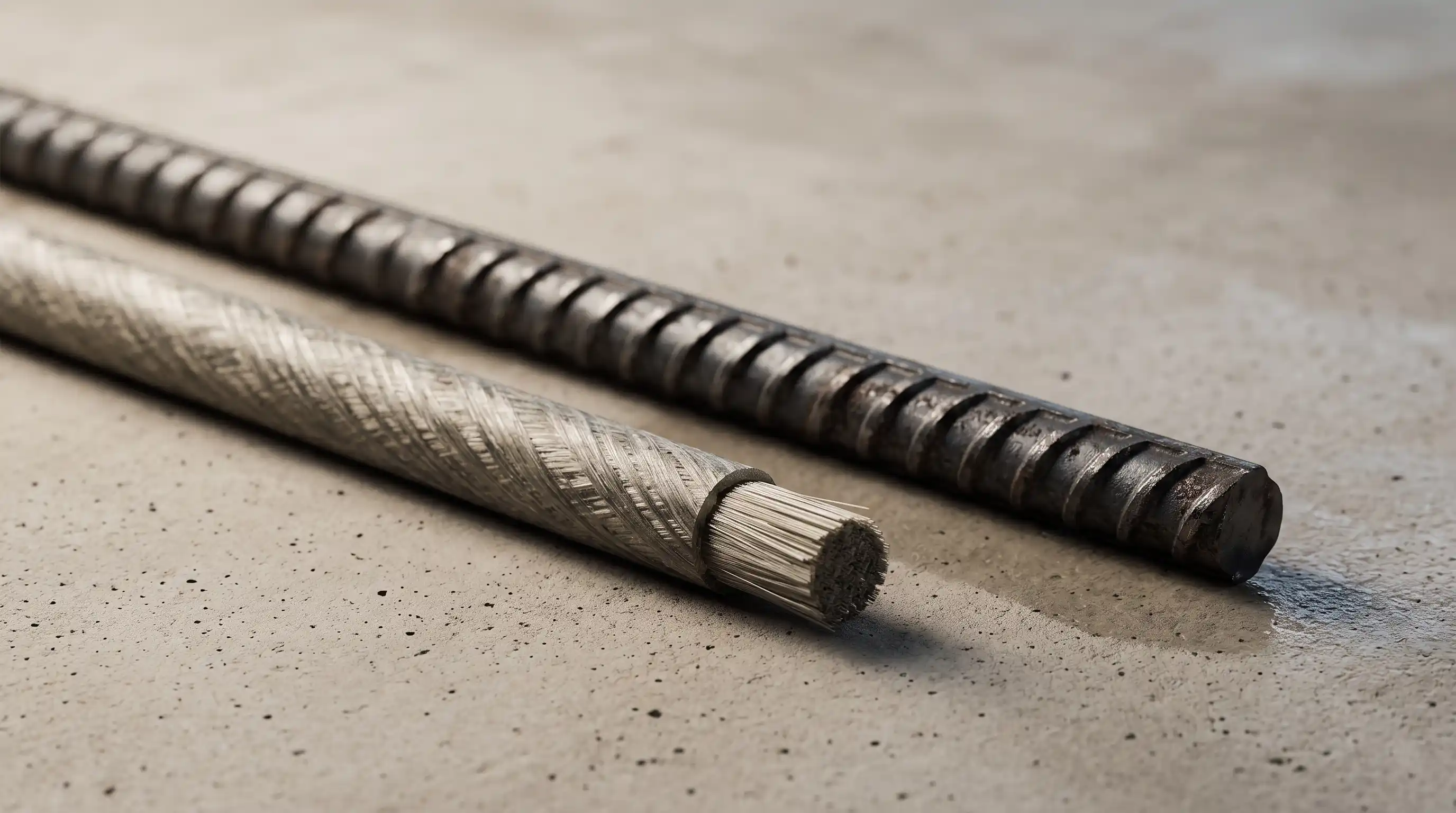
Surface configuration is part of product identity, not just appearance. ASTM D7957 defines its covered bars as having external surface enhancement. Depending on the product, a supplier may describe the surface as ribbed, sand-coated, wrapped, or another engineered configuration.
The commercial inquiry should also state whether the project requires straight bars or bent shapes. ASTM D7957/D7957M-26 covers both cut lengths and bent shapes, but the required form should be defined before sourcing rather than assumed after a quotation is received.
Ultimate Tensile Properties
ASTM's official description identifies mechanical properties that include ultimate tensile force, tensile modulus of elasticity, ultimate tensile strain, transverse shear strength, and bond strength.
Whenever a supplier presents a tensile value, the buyer should ask:
Which product does the value represent?
Which bar size was tested?
Which test method was used?
How is the reported value characterized?
Is the number taken from a TDS or from a traceable test report?
Does the result relate to the product currently being offered?
A tensile result for one manufacturer, bar size, or test basis should not be treated as a universal property of GFRP rebar.
Tensile Modulus of Elasticity
Tensile modulus is a separate property from tensile strength. A bar can have high ultimate tensile capacity without having stiffness comparable with steel or another GFRP product.
This distinction matters because marketing language often emphasizes strength. Technical review should not allow a single attractive ultimate value to hide differences in stiffness.
When two products are compared, tensile modulus and ultimate strain should be reviewed alongside tensile capacity and the project requirement.
Ultimate Tensile Strain
Ultimate tensile strain provides another part of the tensile-property picture. Like strength and modulus, it should be tied to the actual product, size, and test basis.
It should not be compared directly with steel behavior, or with another GFRP product, without understanding the relevant test and material context.
Transverse Shear Strength
Transverse shear strength is an independent mechanical property of the composite bar. ASTM includes it among the mechanical properties relevant to the GFRP specification.
ASTM's current composite standards catalog lists ASTM D7617/D7617M-25 as the test method for transverse shear strength of fiber-reinforced polymer matrix composite bars.
A buyer does not need to reproduce the laboratory method in an RFQ. The useful procurement question is whether the reported property comes from relevant test data for the offered product.
Bond Strength
Bond performance relates the bar surface to its interaction with concrete. It should therefore be reviewed together with surface configuration rather than treated as an isolated marketing value.
ASTM's current catalog lists ASTM D7913/D7913M-26 for bond strength of FRP matrix composite bars to concrete by pullout testing.
The article does not reproduce standard limits because acceptance must be based on the applicable standard, project specification, and actual test documentation.

Which Physical and Material Properties Matter?
A complete GFRP specification includes more than mechanical strength; material-system and physical properties help define what the bar actually is.
Fiber Mass Content
Fiber mass content is one of the physical/material properties identified within the ASTM GFRP specification framework. It contributes to product definition and manufacturing consistency.
A buyer should use the value documented for the actual product rather than assume one generic percentage applies across suppliers.
Glass Transition Temperature (Tg)
Glass transition temperature, or Tg, relates to the polymer/resin system. ASTM identifies Tg among the physical properties relevant to covered GFRP bars.
Tg should not be reduced to a universal service-temperature claim. Its interpretation depends on the material system, applicable requirements, and engineering context.
For procurement, its presence is useful because it reminds the buyer that GFRP technical documentation should describe the polymer system as well as mechanical strength.
Degree of Cure
Degree of cure describes the state of cure of the polymer system and is another physical-property element identified by ASTM.
It is relevant to manufacturing consistency. If a basic TDS does not report this level of information, the technical team can check whether it is covered in qualification or supporting quality documentation.

Which Tests Are Relevant to GFRP Properties and Durability?
GFRP evaluation relies on multiple property-specific test methods rather than one universal “GFRP test.”
ASTM's current composite standards catalog includes, among others:
ASTM D7205/D7205M-26 for tensile properties of FRP matrix composite bars
ASTM D7617/D7617M-25 for transverse shear strength
ASTM D7705/D7705M-26 for alkali resistance
ASTM D7913/D7913M-26 for bond strength to concrete by pullout testing
ASTM D7337/D7337M-26 for tensile creep rupture
These editions are listed in ASTM's current composite standards catalog.
The practical lesson is that the phrase “tested GFRP” has little value unless the buyer knows which property was tested and under which method.
Durability-related evaluation can involve exposure to moisture, alkaline environments, and conditions relevant to concrete service. This article intentionally does not reproduce ASTM property-limit tables or minimum values. Formal acceptance should rely on the licensed standard text, project requirements, and applicable product evidence.
What Is the Difference Between Qualification Testing and Production Quality Control?
Qualification establishes the technical basis of a defined product system; production quality control checks the consistency of ongoing production and production lots.
ASTM D7957/D7957M-26 states that bars produced under the standard are qualified using specified test methods, while quality control and acceptance of production lots are addressed separately.
What Does Qualification Tell the Buyer?
Qualification answers a product-system question:
Has this defined product system demonstrated compliance with the applicable qualification requirements?
It establishes a technical basis for the product. It should not be read as evidence that every later package, shipment, or production lot automatically has identical quality.
What Does Production QC Tell the Buyer?
Production QC answers a consistency question:
Is current production being checked against the required manufacturing and acceptance framework?
A historic qualification report and a lot-related QC record therefore serve different purposes.
Why Does the Distinction Matter in Procurement?
Two suppliers may both state that their products are qualified, but the evidence package behind their quotations may differ.
One may provide product qualification evidence plus current production documentation. Another may provide only a general qualification record. That difference should be identified before the commercial comparison is treated as technically equivalent.
The purpose of this distinction is not to approve or reject a supplier automatically. It is to make sure each document is used for the question it can actually answer.
What Should a GFRP Rebar Technical Data Sheet Include?
A useful TDS should connect product identity, material system, geometry, key properties, and the standard basis in one consistent product description.
A technical review should look for:
Manufacturer
Product name or identification
Fiber type
Resin system
Surface configuration
Available bar sizes
Nominal geometry
Straight or bent configuration, where relevant
Tensile properties
Tensile modulus
Ultimate tensile strain
Relevant transverse shear data
Relevant bond data
Applicable standard
Standard edition
Test method or test basis where reported
Reference to available qualification documentation
Relevant QC information or a route to obtain it
A TDS is not the same document as a test report.
A TDS summarizes product specification.
A Test Report records measured results from defined testing.
Qualification Documentation supports the qualification status of a product system.
Production QC Documentation relates to ongoing production or production lots.
Procurement becomes clearer when these four document types are not collapsed into one generic request for “certificates.”
How Should a Buyer Read a GFRP Rebar Test Report?
A test report is useful only when the buyer can connect the reported result to the relevant product, size, test method, and supply requirement.
Review the following:
Product identification: Is the tested product clearly identified?
Manufacturer: Is the manufacturer stated?
Bar size: Which diameter or designation was tested?
Property tested: What was actually measured?
Test method: Which method was used?
Standard edition: Which edition is referenced?
Test date: When was the testing performed?
Laboratory: Which laboratory issued the report?
Reported result: How is the result presented?
Supply relevance: Does the report apply to the product being offered?
Is a Third-Party Test Report Always Required?
This article does not assume that every project or purchase requires third-party testing. Documentation requirements depend on the project specification, contract, applicable standards, and acceptance process.
If a supplier uses a third-party report to support a technical claim, however, the buyer should confirm that the report is relevant to the offered product and requirement.
Can a Report for One Bar Size Be Applied to Another?
That should not be assumed without a documented technical basis.
If the report covers one bar size and the quotation concerns another, the buyer should check the standard, qualification documentation, and manufacturer data before treating the result as transferable.
Is “ASTM Compliant” Enough to Accept a GFRP Rebar Offer?
No. ASTM compliant is incomplete unless the specific standard, edition, product identity, and supporting basis are clear.
A useful verification sequence is:
Which ASTM standard?
Which edition?
Which product and bar size?
Which evidence supports the statement?
If the only answer is “ASTM standard,” the specification is still incomplete.
The same caution applies to ACI compliant. ACI CODE-440.11 is a structural design and construction code. A supplier should not use the ACI reference as a substitute for the product specification required from the reinforcing bar itself.
What Are the Most Common Specification Mistakes in GFRP Procurement?
The most common error is allowing one property or one compliance label to replace the complete technical specification.
1. Asking Only for Tensile Strength
Tensile strength is important, but it does not replace modulus, strain, size, geometry, or test-basis information.
2. Ignoring Tensile Modulus
High tensile capacity does not mean high stiffness. They are separate properties.
3. Comparing Different Bar Sizes Without Relevant Data
A comparison should use data that relates to the sizes actually being considered.
4. Treating All GFRP Manufacturers as Equivalent
Resin system, fiber system, surface configuration, manufacturing controls, and documentation can differ.
5. Writing “ASTM Standard” Without an Edition
The edition matters, especially when a current product specification has changed while a design code still references an earlier edition.
6. Treating ASTM and ACI as Interchangeable
ASTM D7957 defines the product specification framework. ACI CODE-440.11 addresses structural concrete design and construction.
7. Treating Qualification Data as Production-Lot QC
Qualification supports the product system; production QC addresses ongoing consistency.
8. Comparing GFRP with Steel Through One Mechanical Property
Structural performance cannot be reduced to one strength value. Modulus, failure behavior, and the applicable design approach are different.
GFRP Rebar Specification Checklist for B2B Buyers
A professional inquiry should define technical equivalence before suppliers are compared commercially.
Item | Verify |
|---|---|
Product Type | GFRP rebar |
Fiber Type | Confirmed |
Resin System | Confirmed |
Surface Configuration | Confirmed |
Diameter / Bar Size | Confirmed |
Straight / Bent | Confirmed |
Geometry | Size-specific |
Tensile Properties | Product/size-specific |
Tensile Modulus | Product/size-specific |
Ultimate Strain | Product/size-specific |
Shear / Bond Data | Where required |
ASTM Reference | Standard + edition |
Qualification | Relevant documentation |
Production QC | Lot/production information where required |
Test Reports | Relevant to product and test basis |
Origin | Confirmed in the actual offer |
Packaging | Matched to transport/project requirements |
Project Specification | Matched |
A practical procurement sequence is:
Project Requirement → Product Identity → Standard & Edition → Technical Properties → Qualification Evidence → Production QC → Commercial Offer
This sequence keeps price from becoming the main comparison before technical equivalence has been established.

Align the Technical Evidence Before Comparing Commercial Offers
A price difference between two GFRP quotations may hide a larger difference in technical scope. One supplier may provide only a TDS, while another provides a TDS plus qualification evidence and production-related quality documentation. Those offers do not contain the same evidence package.
Need product guidance?
Contact our team for specifications, availability, and pricing details.