
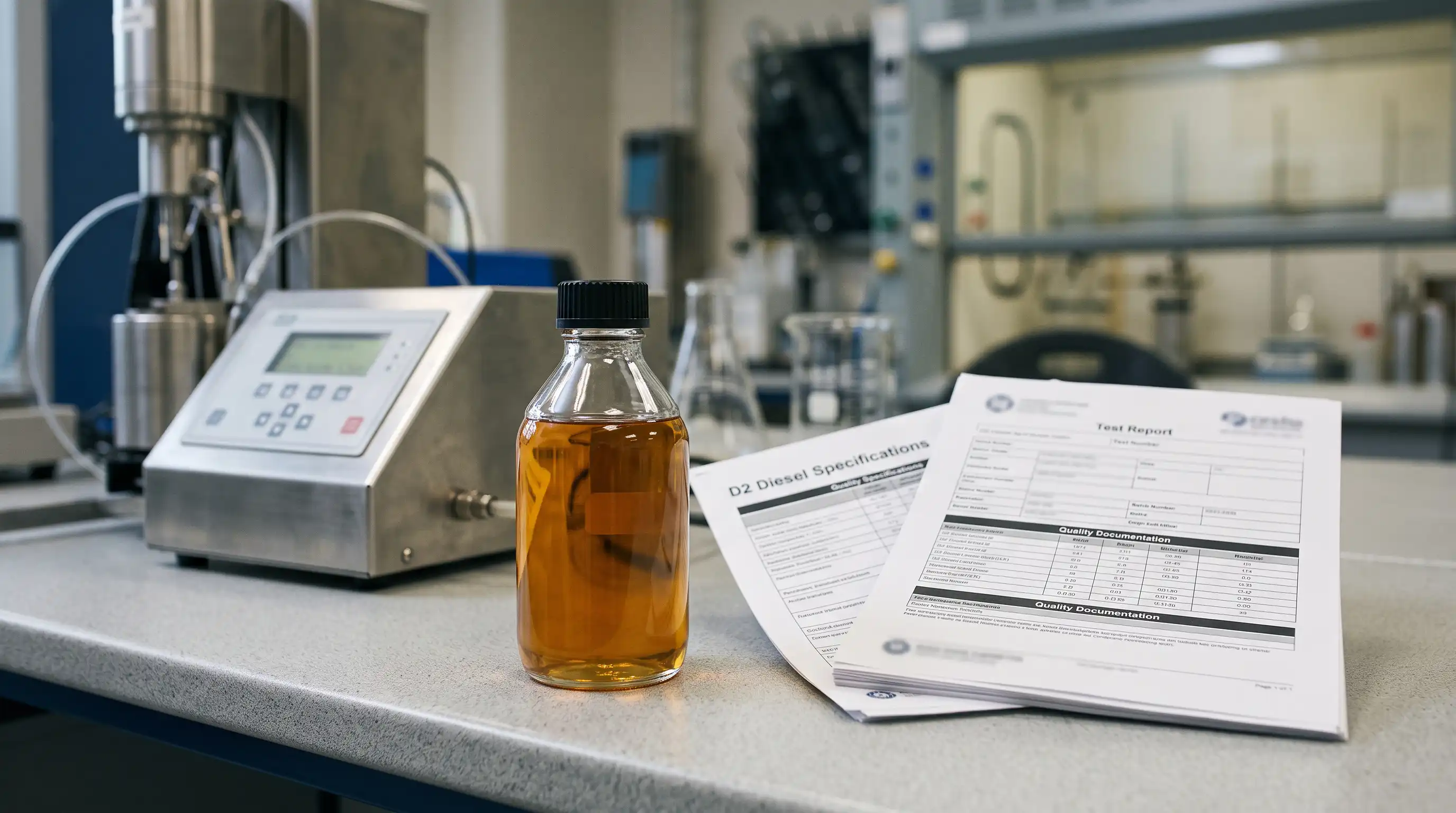
Receiving a document labelled “D2” or even a Certificate of Analysis does not, by itself, establish a complete fuel specification. A D2 diesel specification needs to identify what properties are controlled, which limits apply, what units and test methods are used, and which sample or batch the reported results represent.
That distinction matters to procurement teams, technical reviewers, importers, traders, and industrial users who need to interpret fuel-quality documentation without treating a commercial product name as a complete standard.
This guide from Coolak International Group focuses specifically on technical document interpretation: Specification Sheets, COAs, test methods, quality parameters, and the context of GOST references. For the broader terminology and definition of D2, see the D2 diesel definition and specifications guide.

Key Takeaways:
Identify the product designation, grade, reference standard, and revision before comparing numerical values.
Match every COA result to the corresponding acceptance limit, unit, test condition, and method.
Treat Cetane Number and Calculated Cetane Index as different technical entries.
Do not extend a sample-specific COA result to another batch or cargo without documented traceability.
Does D2 refer to one fixed diesel standard?
No. The term D2 by itself should not be treated as a single, universally fixed diesel specification.
A document may use D2 alongside a reference standard, sulfur category, grade designation, or a contract-specific specification table. As a result, two documents carrying the D2 name can define different limits or use different technical references.
A technical reviewer should establish four points before interpreting the figures:
What is the exact product or grade designation?
Which reference standard applies?
Which edition or revision is cited?
Where are the actual acceptance limits defined?
A statement such as “D2 according to GOST” is therefore incomplete unless the document identifies the relevant standard and technical requirements.
The product name helps identify the subject. The specification defines what the product is expected to meet.
What should a D2 Specification Sheet contain?
A useful Specification Sheet connects each controlled property with a measurable requirement and its testing context.
A well-structured technical table should allow the reader to identify:
Specification element | Question it should answer |
|---|---|
Property | What characteristic is being evaluated? |
Limit | Is there a minimum, maximum, range, or reporting requirement? |
Unit | How is the value expressed? |
Test Method | How is the property determined? |
Test Condition | Under what defined conditions is it measured? |
Reference Standard | Which technical framework supports the requirements? |

Property and acceptance limits
A number printed in a specification is not automatically an acceptance limit.
Common entries include Minimum, Maximum, Range, Report, and Typical Value:
Minimum establishes a lower acceptance boundary.
Maximum establishes an upper boundary.
Range defines an acceptable interval.
Report requires a test result to be stated without necessarily setting a numerical acceptance boundary in that row.
Typical Value is descriptive and should not automatically be treated as a contractual or standard acceptance limit.
When reading a COA, compare the reported result with the actual limit, not simply with a typical figure from another document.
Units and test conditions
Measurement context can materially change how a result should be interpreted.
Density, for example, should be read together with its reference temperature. Kinematic viscosity must also be associated with the specified test temperature.
Sulfur data require the same discipline. A value expressed in ppm, mg/kg, or mass percentage should not be compared with another figure until the units and reporting basis are confirmed.
If two D2 diesel specifications appear to disagree, first check whether they use the same units and conditions.
Test methods
A property name does not fully describe a test result. The stated test method forms part of its technical meaning.
ASTM D445, for example, covers the determination of kinematic viscosity for liquid petroleum products, and ASTM notes the importance of viscosity measurements in petroleum-product specifications.
The point is not simply to find an ASTM or another standards code in a table. The method must correspond to the property and result being reported.
Which parameters matter most in a D2 diesel analysis?
No single parameter defines the complete quality profile. The main properties should be interpreted as a set and against the limits of the applicable specification.
Total sulfur
Total Sulfur reports the sulfur content of the fuel using the unit defined in the relevant document.
One common documentation error is to assign a single sulfur value to every product labelled D2. The term D2 alone does not support that conclusion.
Instead, check:
the sulfur limit in the applicable specification;
the stated unit;
the reported COA result;
the test method;
whether the result and limit use directly comparable units.
Statements such as “standard D2 sulfur is X” therefore need a clearly identified specification before they can be evaluated.
Cetane Number and Calculated Cetane Index
Cetane-related values describe ignition-quality characteristics, but Cetane Number and Calculated Cetane Index are not interchangeable test entries.
ASTM D4737 calculates an estimate of ASTM Cetane Number from density and distillation recovery-temperature data. ASTM describes the Calculated Cetane Index as a supplementary estimation tool rather than another method of expressing the ASTM Cetane Number.
A COA should therefore make clear whether it reports:
Cetane Number;
Calculated Cetane Index;
or another cetane-related value.
A Calculated Cetane Index result should not automatically be checked against a limit written specifically for Cetane Number without reviewing the specification and method requirements.
Density
Density is an important physical property, but the numerical result needs a reference condition.
When comparing two specifications or COAs, check the reference temperature as well as the unit. Values measured or reported under different reference conditions should not be treated as directly comparable merely because both rows are labelled “Density.”
Kinematic viscosity
Kinematic viscosity describes the flow behaviour of a liquid under defined test conditions. ASTM D445 covers its measurement for liquid petroleum products and notes that viscosity is relevant to petroleum-fuel specifications.
The test temperature matters. A viscosity value without the associated temperature provides less information than an entry that clearly states the measurement condition.
Review the result, unit, temperature, and test method together.
Flash point
Flash Point is a defined laboratory property. It should not be confused with autoignition temperature, which is a different concept.
A specification may impose a minimum Flash Point, but that minimum must be read from the applicable standard or product specification. It is not technically sound to assign one universal Flash Point limit to every document carrying the D2 name.
The result, acceptance limit, and test method should be read as a set.
Distillation characteristics
Distillation behaviour is usually described through several data points rather than one standalone number.
A specification may report recovery percentages, temperatures associated with specified recovery points, or other distillation limits. Comparisons are meaningful only when the same criteria and methods are being compared.
Distillation data can also form part of calculated cetane-index methods, which is one example of how different specification properties may be technically connected.
Pour Point, Cloud Point and CFPP
Pour Point, Cloud Point, and CFPP are separate low-temperature properties.
Cloud Point relates to the onset of visible wax-crystal formation under the specified test.
Pour Point relates to low-temperature flow behaviour under its defined test procedure.
CFPP — Cold Filter Plugging Point is another low-temperature indicator associated with fuel behaviour through a standardized filtration test.
They should not be treated as three names for the same measurement. A specification should indicate which property is relevant and what limit or reporting requirement applies.
Water, sediment and other supporting properties
A D2 specification may include additional properties such as:
Water Content
Sediment
Ash Content
Carbon Residue
Copper Strip Corrosion
These entries cover different aspects of product condition or composition. Their role should be determined from the applicable specification rather than assembled into a generic “D2 standard” table.

How are GOST 305-82 and GOST 305-2013 related to D2?
D2 should not be presented as another name for GOST 305-82.
GOST 305-82 is an older diesel-fuel standard that can still appear in legacy or commercial documentation. The official Rosstandart database identifies GOST 305-2013 as the replacement for GOST 305-82.
That creates two document-review rules.
First, the word GOST alone is not a sufficient technical reference. The complete standard designation is needed.
Second, even GOST 305 can remain ambiguous if the year or applicable edition is missing.
A technical document should therefore avoid unsupported assumptions such as:
“D2 is GOST 305-82.”
“Every D2 product must meet the GOST 305-82 table.”
“The word GOST on a document establishes the product specification.”
The reference standard is one part of the technical definition. Product designation, limits, methods, and reported results must remain consistent with it.
What is the difference between a Specification Sheet, COA and Q&Q report?
These documents answer different questions.
Document | Main purpose |
|---|---|
Specification Sheet | Defines expected properties, limits, units, methods, and requirements |
COA / Certificate of Analysis | Reports test results for an identified sample or batch |
Certificate of Quality | States quality information within the scope defined by its issuer |
Q&Q Report | Reports quantity and quality where an independent inspection scope has been defined |
A COA does not automatically provide independent confirmation of every product or cargo carrying the same commercial name.
Its evidential value depends on details such as:
sample identification;
batch or other traceable identification;
sampling and testing dates;
laboratory or document issuer;
units;
test methods;
reference specification;
reported results.
The same principle applies to a Certificate of Quality: its title does not tell the reader who sampled the material, what was tested, or what scope the issuer assumed.
A Q&Q report should likewise be interpreted according to its stated inspection scope and the identity of the material or quantity covered.
What should you check on a D2 COA?
A technically useful COA should connect its test results to an identifiable sample and an applicable specification.
Use this documentation checklist:
What exact product or grade is named?
Is a reference standard identified?
Can the sample or batch be identified?
Are sampling and testing dates stated where applicable?
Does every key result include a unit?
Are the test methods identified?
Can each result be compared with an acceptance limit?
Are relevant test conditions stated?
Is the laboratory or issuing entity identifiable?
Is the scope of the COA clear about what sample the results represent?
This type of review can identify missing information and internal inconsistencies. It cannot establish document authenticity from appearance alone.
What are the common mistakes when reading D2 specifications?
Most errors come from missing context rather than difficult mathematics.
Treating D2 as one fixed specification
The D2 name does not, by itself, establish one universal set of acceptance limits.
Copying a generic internet table
A table without a verified reference standard, revision, or technical context should not automatically become the benchmark for another product document.
Ignoring the test method
Two rows with the same property name may not be meaningfully comparable if their methods or reporting basis differ.
Ignoring units
This is particularly relevant to sulfur and other concentration measurements.
Treating Cetane Number and Cetane Index as identical
ASTM treats Calculated Cetane Index as an estimation tool, not a second label for a measured Cetane Number.
Comparing density or viscosity without test conditions
Reference temperature can be an essential part of the result.
Treating the Specification Sheet as a COA
A Specification Sheet defines what is required. A COA reports what was measured for the identified sample.
Extending one COA to unrelated material
A result should remain connected to the sample, batch, or other identifier stated in the document. A matching product name does not create traceability by itself.
Can D2 be compared with EN590 by name alone?
No. A meaningful comparison requires a defined D2 specification and a property-by-property review.
EN590 is a defined diesel-fuel standard framework. The D2 label, by contrast, can appear with different technical references in commercial documentation. The useful question is therefore not simply “D2 or EN590?” but how a specified D2 document compares with the relevant EN590 requirements across the properties that matter.
For a dedicated standards comparison, see D2 vs EN590: technical differences explained.

Technical checklist for reviewing a D2 document
Before drawing conclusions from a D2 Specification Sheet or COA, confirm that:
the product designation is clear;
the grade is identified where applicable;
the reference standard and edition are stated;
acceptance limits can be identified;
units are provided;
test methods are specified;
relevant test conditions are stated;
the COA is traceable to an identified sample or batch;
results are compared with the corresponding limits;
Cetane Number and Calculated Cetane Index remain distinct;
density and viscosity are interpreted with their measurement conditions;
Pour Point, Cloud Point, and CFPP are treated as separate properties.
This is a framework for technical and documentary interpretation. It does not replace laboratory analysis or applicable legal and regulatory requirements.
A useful D2 specification goes beyond the product name
A D2 diesel specification should allow the reader to move from the product designation to a clear set of technical requirements and then to traceable test results.
The strongest evaluation is not based on one sulfur figure, one cetane entry, or the presence of GOST in a document. It connects the Reference Standard, Limits, Units, Test Methods, Test Conditions, and results from the identified sample.


For broader D2 terminology, read What Is D2 Diesel? Specifications and Applications. For standards-focused comparison, use the D2 vs EN590 guide.
Need product guidance?
Contact our team for specifications, availability, and pricing details.