
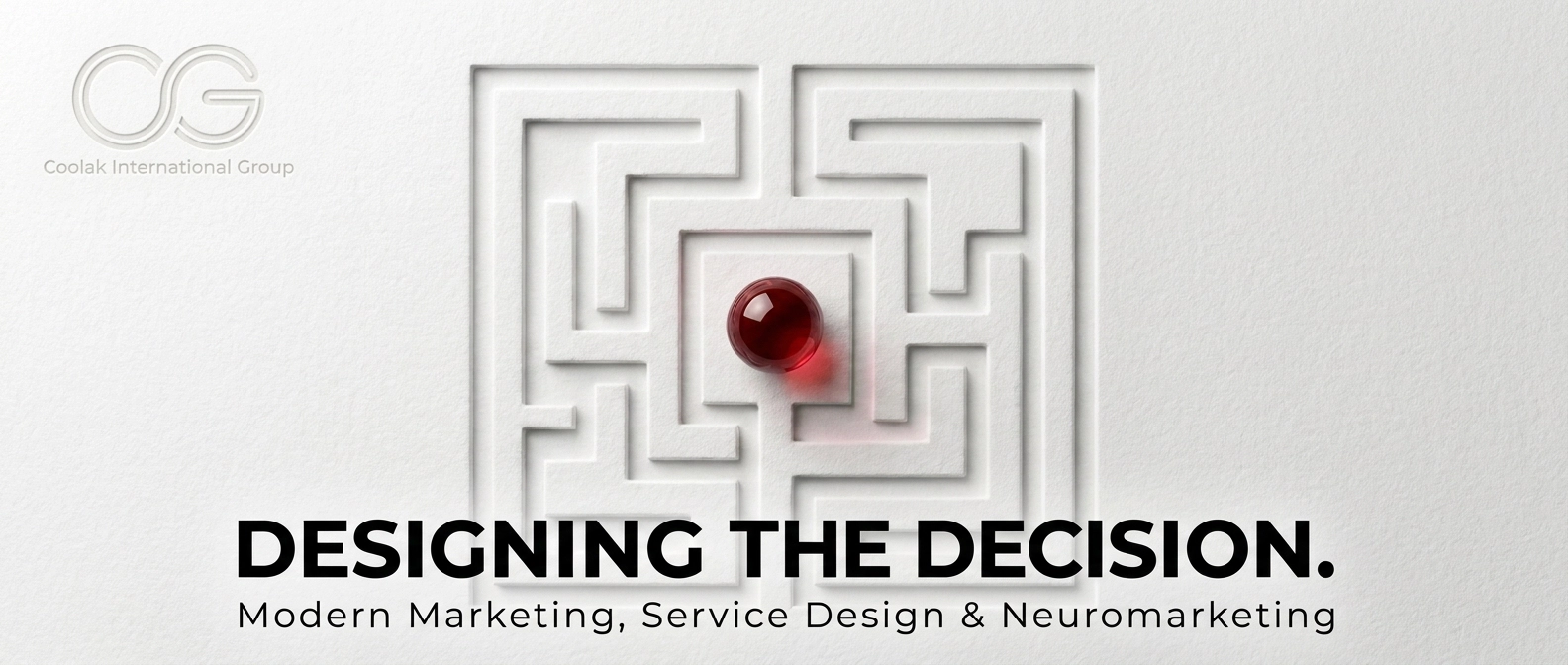
In B2B markets, product quality and price are only part of the buying decision. The way information is presented, the communication process, the structure of a commercial proposal, the service experience, and the level of trust built throughout the journey can also influence the buyer’s decision.
Coolak International Group provides B2B marketing consulting, service design, and neuromarketing services to help businesses evaluate their marketing and sales processes from the customer’s perspective and identify points of ambiguity, friction, or reduced trust.
The objective is not simply to produce promotional content or run a campaign. The focus is on designing a better customer decision journey and aligning marketing, sales, and service experience with actual market behavior.
What Do Our Marketing Consulting Services Include?
The scope of cooperation depends on the type of business, target market, and the specific problem that needs to be addressed.
Services may include:
Reviewing the current brand positioning and value proposition
Analyzing B2B audiences and buyers
Reviewing marketing and sales processes
Designing or improving the Customer Journey
Designing services and customer touchpoints
Reviewing the structure of commercial proposals
Improving the presentation of products or services
Reviewing customer experience across websites and communication channels
Analyzing customer decision-making behavior
Applying neuromarketing principles to message and experience design
Identifying friction points in the sales process
Designing a more effective path from Lead to commercial opportunity
Aligning brand messaging with real market needs
The goal is to create a process in which the customer can understand more quickly what is being offered, why it is relevant, and what the next step should be.
B2B Marketing Is Different from Advertising Alone
B2B marketing should support the buyer’s decision-making process, not simply produce more messages.
In many organizational purchases, the decision is not made by one person in one moment. Several people may be involved in evaluating the product, budget, technical requirements, risk, contract, or final approval.
A B2B marketing process therefore needs to answer different questions:
What problem does the product or service solve?
Why is this offer relevant to the buyer’s need?
How is it different from other options?
Where can the required technical and commercial information be found?
How can the buyer evaluate the claims?
What is the next step for starting a discussion?
How clear is the process for making contact or requesting an offer?
If the answers to these questions are scattered or unclear, even a suitable product may be eliminated during evaluation.
Understand the Buyer Before Designing the Marketing Message
Marketing messages are more effective when they are based on the buyer’s actual needs and decisions, rather than only on what the business wants to say about itself.
Audience analysis should go beyond basic demographic information such as age or location.
For a B2B customer, it is useful to identify questions such as:
What problem triggered the initial search?
Who identifies the need?
Who compares the available options?
Which person or department approves the final decision?
What risks prevent the purchase?
What information is required to create trust?
Which criteria are used to compare offers?
At what stage is the buyer ready to make contact or start negotiations?
This understanding becomes the basis for decisions related to the main message, website structure, sales content, and customer journey design.
Designing the Customer Journey for the Sales Process
The Customer Journey shows the stages a customer moves through from initial awareness to the final decision, and what information or action is needed at each stage.
A typical path may include:
Awareness → Initial Review → Comparison → Information Request → Negotiation → Decision → Start of Cooperation
A different obstacle may appear at each stage.
For example:
At the awareness stage, the value proposition may be unclear.
During evaluation, there may not be enough information about the service.
During comparison, the difference from competitors may not be clear.
The request form may be unnecessarily complicated.
The first sales response may be slow or unclear.
The commercial proposal may not directly address the customer’s requirement.
Customer Journey design helps evaluate these issues as parts of one connected process rather than as isolated problems.
Service Design: From Brand Promise to Actual Customer Experience
Service Design examines the complete experience a customer has when receiving a service.
This experience is not limited to the website interface.
For a B2B service, the customer experience may include:
Finding initial information
Contacting the company
Submitting a request
Receiving a response
Providing information or documents
Receiving a proposal
Negotiation
Contracting
Service execution
Post-service support
If these stages are designed only from the perspective of internal departments and do not form a logical path for the customer, friction can occur.
Service Design aims to redesign this path from the customer’s perspective while also identifying the internal processes required to deliver a better experience.
Identifying Friction Points in the Customer Experience
Friction is anything that makes the customer’s next step more difficult than necessary.
Friction is not always a technical problem.
Examples may include:
Unclear service descriptions
Ambiguous CTAs
Long forms
Asking for unnecessary information too early
No clear explanation of the cooperation process
A gap between the marketing message and actual experience
Slow response times
Complex and unfocused proposals
Missing information required by a decision-maker
Reviewing these points can reveal that low conversion is not always a traffic problem.
Structuring the Value Proposition
A value proposition should explain why a product or service is relevant to a specific customer problem.
Phrases such as:
High quality
Professional services
Best solution
Expert team
Competitive price
do not create clear differentiation on their own.
A stronger value proposition should answer three questions:
What problem does the customer have?
What does the business specifically provide?
Why is this approach or offer relevant to that problem?
In B2B markets, evidence, a clear process, relevant expertise, and reduced uncertainty are often more valuable than generic promotional claims.
Messaging Structure for Websites and Service Pages
A service page should help the customer make a decision, not simply talk about the company.
An effective page should make it clear early on:
What is this service?
Who is it for?
What problem does it solve?
How does the cooperation process work?
What outcome should the customer expect?
What limitations apply?
What is the next step?
If the user has to read several generic paragraphs before understanding these points, the chance of leaving the page increases.
For this reason, consulting may include reviewing website structure, landing pages, CTAs, and the way services are presented.
What Role Does Neuromarketing Play in This Process?
Neuromarketing is used in this service as a tool for better understanding attention, perception, and customer decision-making, not as a replacement for market research or commercial strategy.
People do not process every piece of information with equal attention.
The way options are displayed, the order of information, cognitive load, message complexity, and clarity can all affect how an offer is perceived.
Behavioral and cognitive principles may be relevant to areas such as:
Order of information
Message prioritization
Reducing Cognitive Load
CTA design
Page structure
Comparing options
Presenting a price or offer
Form design
Proposal structure
Trust-building
The objective is not to create hidden techniques to force a customer to buy. Appropriate use of these principles should make decisions clearer and easier.
Reducing Cognitive Load in Commercial Communication
The more mental effort a customer needs to understand an offer, the greater the chance that the process will be abandoned.
This becomes even more important in specialized markets, where technical and commercial information is already complex.
Cognitive load can be reduced by:
Showing the most important information earlier
Grouping details logically
Avoiding unnecessary jargon
Defining one main CTA for each stage
Making comparisons easier
Keeping technical information separate from the main message but easily accessible
Clearly showing the steps of the process
Simplifying the experience does not mean removing important information. It means presenting information at the right time and in the right place.
Marketing and Sales Should Communicate the Same Message
If marketing creates one promise and the sales team creates a different experience, customer trust can decline.
One common B2B problem is the gap between Marketing and Sales.
For example, a website may emphasize expert advisory support while the first sales response consists only of a price list.
Or a campaign may emphasize speed while obtaining a proposal takes several days.
Alignment between the two functions means:
Both teams share the same definition of the target customer
The main message is consistent
Leads are transferred with appropriate information
Sales knows what the user has already seen
The sales response logically continues the marketing experience
This alignment helps create a more consistent customer experience.
Designing the Lead Generation Process
Lead Generation is valuable when it brings the right audience into the right process.
A higher number of submitted forms does not always indicate better performance.
A Lead Generation process should define:
Who is the target audience?
What action counts as a conversion?
What information is required from the Lead at each stage?
How is the Lead evaluated?
When is it transferred to Sales?
What response should the Lead receive?
How are irrelevant Leads handled?
The objective is not simply to increase the number of people who submit their contact information. The objective is to generate more relevant commercial opportunities.
Designing Appropriate Forms and CTAs
Forms and CTAs should match the customer’s level of readiness at that specific stage.
A user who is reviewing a service for the first time may not be ready to complete a long form or provide extensive information.
At the same time, a specialized B2B request may not be assessable without collecting the main project details.
A balance is therefore needed between:
Reducing friction
Collecting the necessary information
Different CTAs may support different objectives, for example:
Request a consultation
Submit project details
Request more information
Request a Proposal
Start a cooperation review
Each CTA should correspond to a specific stage of the Customer Journey.
Presenting Proposals and Commercial Offers
A Proposal should make decision-making easier, not simply present a large amount of information about the company.
A suitable commercial proposal should normally begin by showing that the customer’s requirement has been understood.
It can then clarify:
What is the problem?
What solution is being proposed?
What is the scope of service?
How will the work be carried out?
What are the responsibilities of the parties?
What outputs will be delivered?
What is the next step?
A well-structured Proposal can be especially important in specialized services, where it can reduce the gap between the initial discussion and the customer’s decision.
Which Businesses Can Benefit from This Service?
Marketing consulting, service design, and neuromarketing services may be useful for businesses facing issues such as:
The website receives traffic but does not generate enough Leads
Leads are generated but do not become sales opportunities
Customers do not clearly understand the difference between the product or service and other options
The request or purchase process is complicated
Marketing and Sales communicate different messages
Proposals do not produce the expected result
The company is entering a new market or segment
A new service is being designed
Customer experience is inconsistent across different touchpoints
The business does not know at which stage customers leave the process
The scope of cooperation should be based on the actual business problem rather than on selecting a predefined tool.
How Does the Consulting Process Work?
1. Define the Problem
The first step is to identify the main issue and determine what result needs to improve.
This may involve Conversion, Lead quality, customer experience, sales structure, market entry, or another specific business issue.
2. Review the Current Situation
The website, messaging, sales process, customer journey, touchpoints, and other relevant areas are reviewed.
3. Identify Friction Points and Opportunities
Areas causing ambiguity, complexity, inconsistency, or reduced trust are identified.
4. Design the Recommended Structure
Based on the problem, recommendations are developed for messaging, Journey, processes, Service Design, or customer interaction.
5. Implement and Evaluate
Depending on the scope of cooperation, changes may be implemented and then evaluated and refined based on actual results.
Better Marketing Starts with Better Customer Understanding
Increasing the advertising budget is not always the answer to a marketing problem.
If customers do not understand the offer, the buying journey is complicated, or Marketing and Sales create different experiences, sending more traffic into the same process only exposes the same problems to more people.
The approach of Coolak International Group in this service focuses on customer decisions, experience structure, and the actual commercial process.
If you want to review your marketing and sales journey, customer experience, or an existing service, you can submit the current situation and business problem for an initial assessment.
Need product guidance?
Contact our team for specifications, availability, and pricing details.